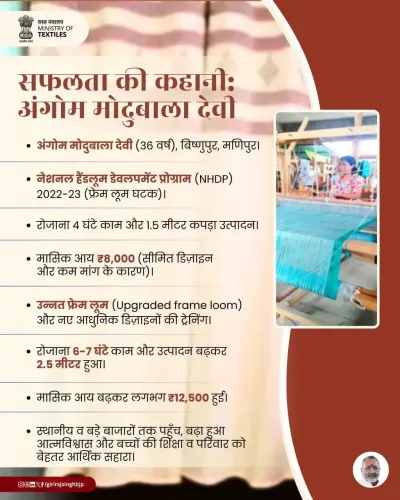
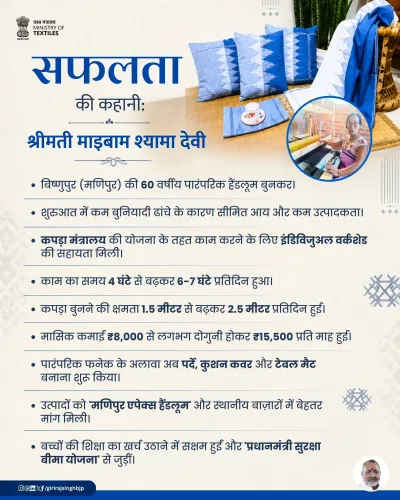
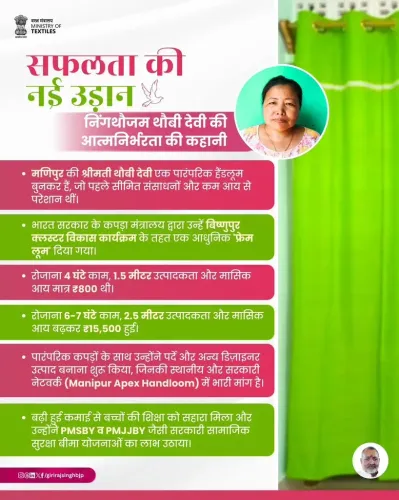
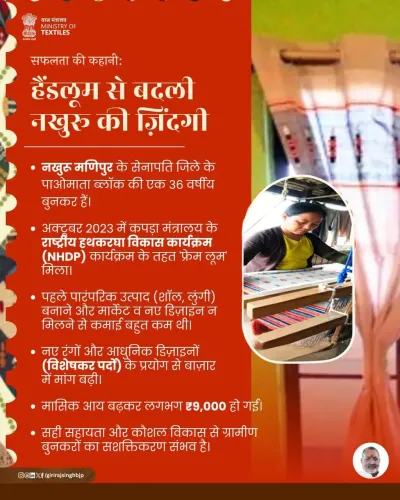
Giriraj Singh highlights Manipur weaver's success under Textiles Ministry
Synopsis
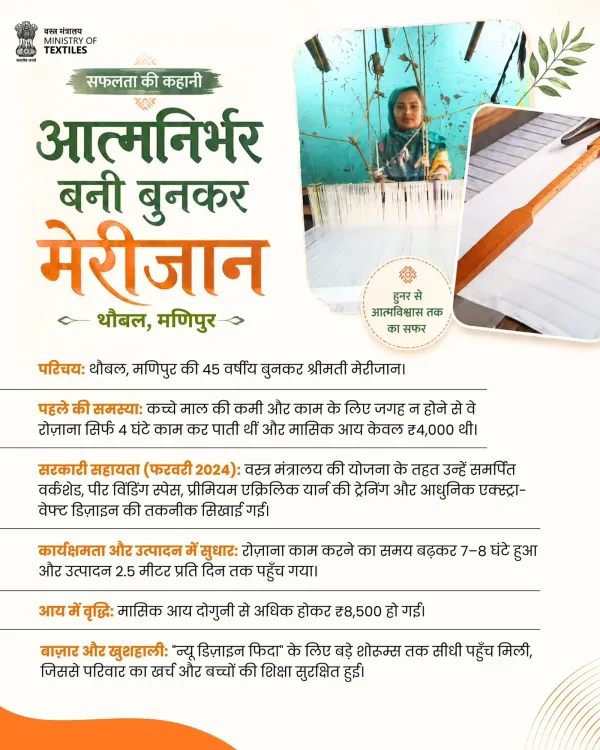
Union Textiles Minister Giriraj Singh on 22 June 2026 highlighted the story of Smt. Merojana, a weaver from Thoubal, Manipur, who increased her productivity and income through Ministry of Textiles training and resources, calling her journey an inspiring example of Atmanirbhar Bharat and women's empowerment.
Key Takeaways
Giriraj Singh shared the success story of Smt.
Merojana , a handloom weaver from Thoubal, Manipur , on 22 June 2026 .
The weaver received modern training and improved resources through Ministry of Textiles support, leading to higher productivity and a notable income rise.
The Minister framed her journey as an example of Atmanirbhar Bharat and women's economic empowerment.
The post is part of a broader Ministry communications pattern of amplifying beneficiary stories from traditional handloom clusters, especially in the Northeast .
The Atmanirbhar Bharat Abhiyan , launched in May 2020 , underpins central support for handloom artisans through skill development, loom upgradation, and market linkage schemes.
Handloom is one of India's largest rural employment sectors, with women forming the majority of its workforce.
Union Textiles Minister Giriraj Singh on Monday, 22 June 2026, spotlighted the story of Smt. Merojana, a handloom weaver from Thoubal, Manipur, crediting Ministry of Textiles support with helping her transform hardship into opportunity through modern training and improved resources.
Posting in Hindi on X, the Minister wrote: 'मणिपुर के थौबल की बुनकर श्रीमती मेरोजाना ने अपने हुनर और मेहनत के दम पर चुनौतियों को अवसर में बदला है' — 'Weaver Smt. Merojana of Thoubal, Manipur, has turned challenges into opportunities through her skill and hard work.' He added that ministry assistance provided her with modern training and better resources, leading to increased productivity and a notable rise in income. The Minister described her journey as 'an inspiring example of Atmanirbhar Bharat and women's empowerment,' signing off with the slogan: 'Sashakt Bunkar, Samridh Bharat' — 'Empowered Weavers, Prosperous India.'
Context
Thoubal is one of Manipur's prominent handloom districts, where weaving — particularly of traditional Meitei fabrics — has long been a primary livelihood for women. The Ministry of Textiles periodically highlights individual beneficiary stories from such clusters to demonstrate the on-ground reach of its training and resource-support programmes. Merojana's story follows this pattern, serving as a human-interest illustration of policy outcomes in the Northeast.
Policy Backdrop
The Atmanirbhar Bharat Abhiyan, launched in May 2020, placed explicit emphasis on strengthening local production chains, including handlooms and traditional artisanal crafts. The Ministry of Textiles has since aligned several of its schemes — covering technology upgradation, skill development, and market linkages — with the broader Vocal for Local framework. Women weavers in the Northeast have been a recurring focus of this push, given the region's deep cultural and economic ties to handloom activity.
Central support for handloom clusters typically flows through schemes that fund loom upgradation, yarn supply at subsidised rates, design and marketing assistance, and exposure to national-level trade fairs. The Ministry's communications strategy increasingly uses beneficiary narratives to make these scheme outcomes visible to a wider audience.
Stakeholders and Impact
Women artisans in rural Manipur represent a constituency that sits at the intersection of several government priorities: women's economic participation, Northeast development, and the revival of traditional crafts. Handloom remains one of the largest rural employment sectors in India after agriculture, with a significant share of its workforce being women.
By amplifying Merojana's story, the Minister signals continued political attention to this demographic ahead of potential scheme announcements or budget allocations for handloom clusters. The hashtags #VocalForLocal, #HandloomIndia, #WomenEmpowerment, and #AtmanirbharBharat also indicate a deliberate effort to keep these themes in public discourse.
What's Next
The Ministry of Textiles is expected to face parliamentary scrutiny on its performance in the upcoming session, with handloom cluster development and Northeast outreach likely to feature in questions. Further scheme guidelines or enhanced budget support for weaving communities in states like Manipur, Assam, and Nagaland could follow such public-facing advocacy. Individual success stories like Merojana's are often precursors to broader programme announcements or scheme expansions targeting similar beneficiary groups.
Point of View
Women's empowerment, and the Atmanirbhar Bharat brand. For the Ministry of Textiles, such storytelling serves a dual purpose: it humanises abstract scheme data and keeps the ministry's work visible between major policy announcements. The choice of a Manipur weaver is also geographically deliberate, given the Centre's sustained effort to deepen its footprint in the Northeast. Whether these individual success stories translate into measurable, aggregate welfare gains for the handloom sector will be the harder question for parliamentary committees to probe.
NationPress
20 Sept 2026
Frequently Asked Questions
Who is Smt. Merojana and why is she in the news?
Smt. Merojana is a handloom weaver from Thoubal, Manipur, who came into focus after Union Textiles Minister Giriraj Singh highlighted her story on 22 June 2026, crediting Ministry of Textiles training and resources with boosting her productivity and income.
What support does the Ministry of Textiles provide to handloom weavers?
The Ministry of Textiles supports handloom weavers through schemes covering modern training, loom upgradation, subsidised yarn supply, design assistance, and market linkages, all aligned with the Atmanirbhar Bharat and Vocal for Local frameworks.
What is the Atmanirbhar Bharat Abhiyan and how does it relate to weavers?
Atmanirbhar Bharat Abhiyan was launched in May 2020 to strengthen local production, including handloom and artisanal crafts. It has provided a policy umbrella for central support to traditional weavers, particularly women artisans in states like Manipur.
Why does the government focus on Northeast India for handloom development?
The Northeast has a deep cultural and economic tradition of handloom weaving, with women forming the bulk of the workforce. The region receives recurring central attention for technology upgradation and market access as part of broader Northeast development priorities.
What does 'Sashakt Bunkar, Samridh Bharat' mean?
'Sashakt Bunkar, Samridh Bharat' is a Hindi slogan used by the Ministry of Textiles meaning 'Empowered Weavers, Prosperous India,' capturing the ministry's stated goal of linking weaver welfare to national economic growth.