Giriraj Singh highlights Manipur weaver Samia's self-reliance story
Synopsis
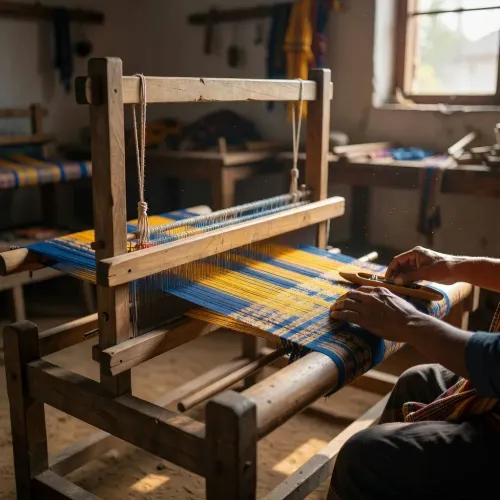
Union Textiles Minister Giriraj Singh praised Samia, a traditional handloom weaver from Lilong, Manipur, saying the Ministry's Cluster Development Programme helped her double her income. He linked her story to the Atmanirbhar Bharat and Vocal for Local campaigns, calling hardworking weavers 'the true strength of the nation.'
Key Takeaways
Union Textiles Minister Giriraj Singh highlighted weaver Samia from Lilong, Manipur as a model of artisan self-reliance on 13 June 2026 .
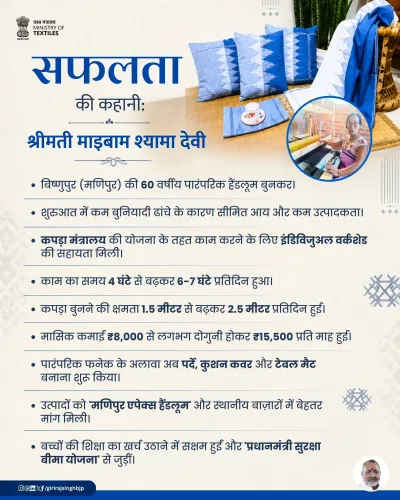
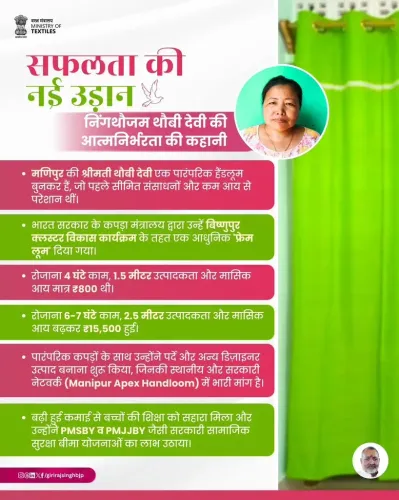
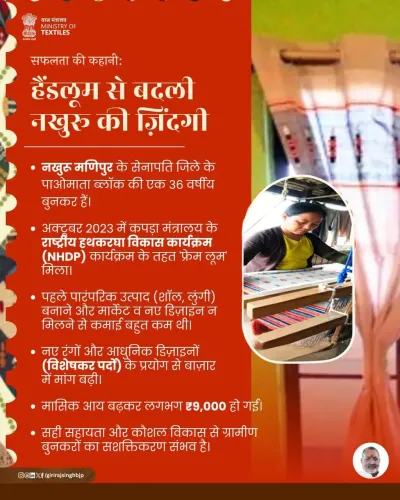
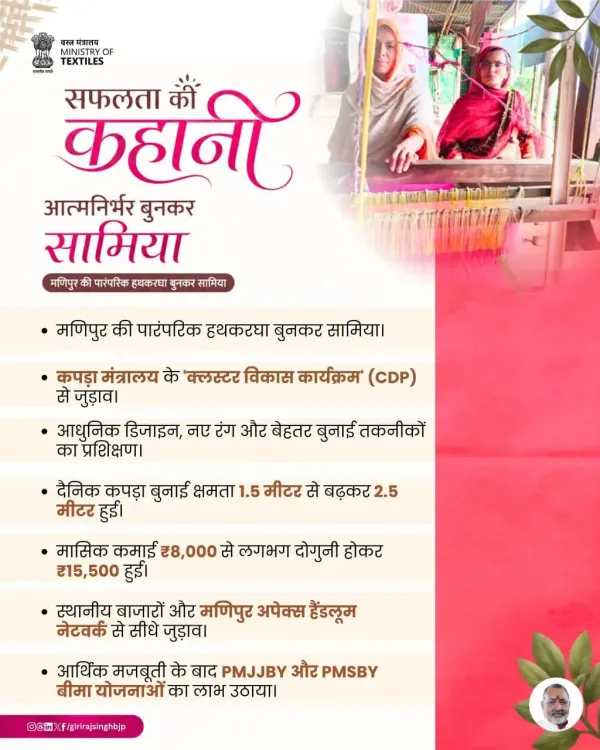
Samia is credited with doubling her income after joining the Ministry of Textiles' Cluster Development Programme and adopting modern techniques.
The Samarth Yojana , launched in 2020 , targets skill training for up to 10 lakh textile workers including handloom artisans.
The Cluster Development Programme provides infrastructure, design, and marketing support to handloom clusters, with the Northeast as a priority region.
The post forms part of the government's Atmanirbhar Bharat and Vocal for Local campaigns promoting domestic craft and artisan livelihoods.
Policy watchers await fresh budget allocations and scheme impact reports for handloom clusters in the upcoming Union Budget .
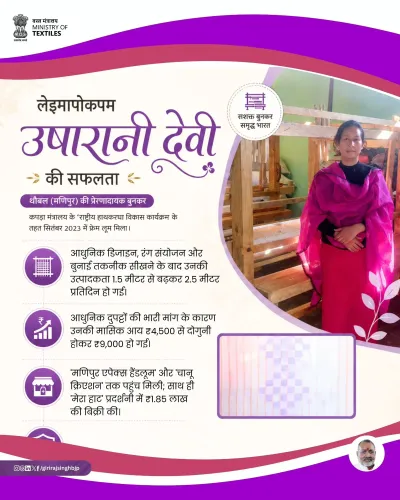
Union Textiles Minister Giriraj Singh on Saturday, 13 June 2026 spotlighted Samia, a traditional handloom weaver from Lilong, Manipur, as a symbol of artisan empowerment, crediting the Ministry of Textiles' Cluster Development Programme for helping her double her income and carry forward India's weaving heritage.
Posting in Hindi, the Minister wrote: 'Manipur ke Lilong ki paramparik hathkargha bunkar Samia apne hunar se atmanirbharta ki nayi kahani likh rahi hain' — ('Samia, a traditional handloom weaver from Lilong, Manipur, is writing a new story of self-reliance through her skill'). He added that by joining the Cluster Development Programme and embracing modern techniques, she had not only doubled her earnings but also advanced the country's rich weaving heritage, concluding: 'Such hardworking weavers are the true strength of the nation.'
Context
Lilong is a town in Manipur with a historically significant concentration of traditional handloom weavers. The region's artisans are known for distinctive textile traditions, and women form the backbone of the local weaving economy. The Ministry of Textiles has in recent years focused on the Northeast as a priority geography for handloom cluster development, given the density of weaving communities and the export potential of their craft.
The Minister's post carries the hashtags #VocalForLocal, #SamarthYojana, #Handloom, and #AtmanirbharBharat, situating Samia's story within the government's broader self-reliance and domestic-production campaign.
Policy Backdrop
The Cluster Development Programme under the National Handloom Development Programme provides infrastructure, design support, and marketing linkages to handloom clusters. Its cluster component has been operational since the 12th Five Year Plan period, and the Ministry has continued to expand its reach across states including Assam, Nagaland, and Manipur.
Separately, the Samarth Yojana — a skill development scheme for the textile sector launched in 2020 — targets training for up to 10 lakh textile workers, including handloom artisans. Together, the two programmes form the policy backbone for integrating heritage craft with organised value chains, enabling artisans to access better markets and technology.
Stakeholders and Impact
Women artisans in Manipur and across the Northeast stand as the primary beneficiaries of these interventions. By linking weavers to clusters, the government aims to move them from subsistence-level production to commercially viable enterprises. Similar cluster-based messaging has accompanied handloom drives in Assam and Nagaland, suggesting a regional pattern in the Ministry's outreach strategy.
The broader Atmanirbhar Bharat and Vocal for Local campaigns have lent political visibility to such artisan success stories, with individual weavers increasingly being profiled by Union ministers as proof-of-concept for scheme effectiveness. This approach also serves to encourage other artisans to enrol in government programmes.
What's Next
Policy watchers will look to the next Union Budget and any forthcoming textile policy revision for fresh allocations to handloom clusters, particularly in the Northeast. The Ministry is also expected to release scheme impact assessment reports that would provide verifiable data on income gains and artisan enrolment under programmes like Samarth and the Cluster Development Programme.
As India continues to position its handloom sector as a cultural and export asset, the government's ability to scale individual success stories into systemic outcomes will be the key measure of the 'Sashakt Bunkar, Samridh Bharat' — 'Empowered Weavers, Prosperous India' — vision articulated by Minister Singh.
Point of View
The messaging simultaneously addresses Northeast outreach, women's empowerment optics, and the Atmanirbhar Bharat narrative. The repeated invocation of Samarth Yojana and Cluster Development Programme in such posts keeps these schemes politically visible ahead of potential budget cycles. However, the absence of independently verified income data means the post functions more as aspirational branding than as a policy accountability statement.
NationPress
18 Sept 2026
Frequently Asked Questions
What is the Cluster Development Programme for handloom weavers?
The Cluster Development Programme is a Ministry of Textiles initiative under the National Handloom Development Programme that provides infrastructure, design support, and marketing linkages to handloom clusters across India, with a focus on regions like the Northeast.
What is the Samarth Yojana and who does it benefit?
Samarth Yojana is a government skill development scheme for the textile sector, launched in 2020, that aims to train up to 10 lakh workers including handloom artisans, helping them improve productivity and access better livelihoods.
Who is Samia, the weaver mentioned by Giriraj Singh?
Samia is a traditional handloom weaver from Lilong, Manipur, cited by Union Textiles Minister Giriraj Singh as an example of artisan self-reliance after she enrolled in the Ministry's Cluster Development Programme and adopted modern weaving techniques.
What is Lilong known for in Manipur?
Lilong is a town in Manipur with a historically significant concentration of traditional handloom weavers, and its artisans are known for distinctive textile traditions that the Ministry of Textiles has been working to support through cluster-based programmes.
What does Vocal for Local mean for handloom artisans?
Vocal for Local is a central government campaign under Atmanirbhar Bharat that encourages Indians to buy domestically made products, including handloom textiles, with the aim of boosting artisan incomes and preserving India's craft heritage.