Textiles Minister Giriraj Singh highlights Manipur weaver's income rise under NHDP
Synopsis
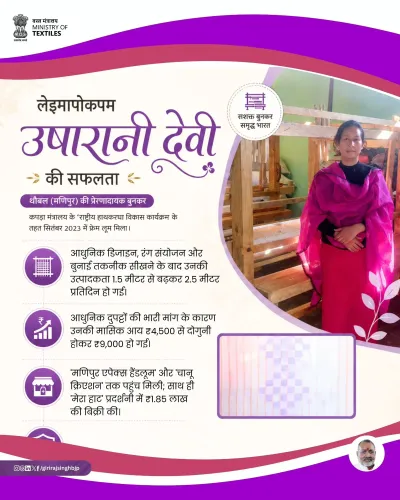
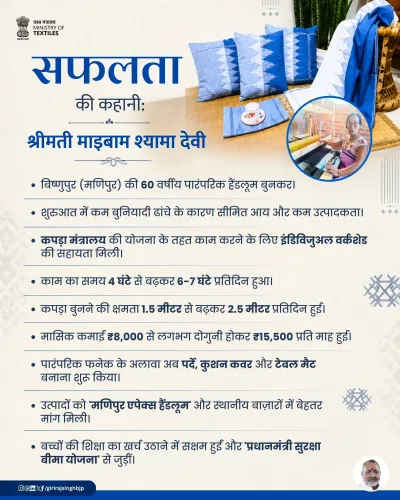
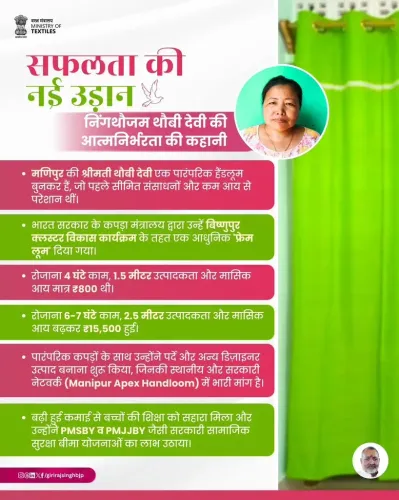
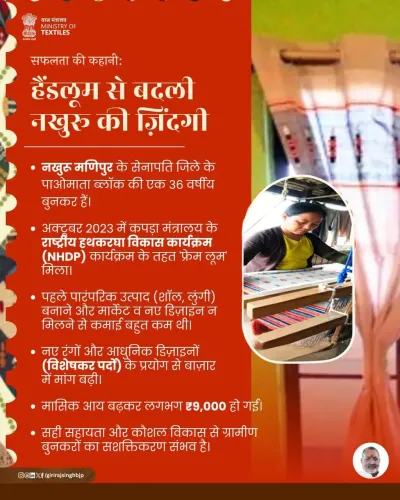
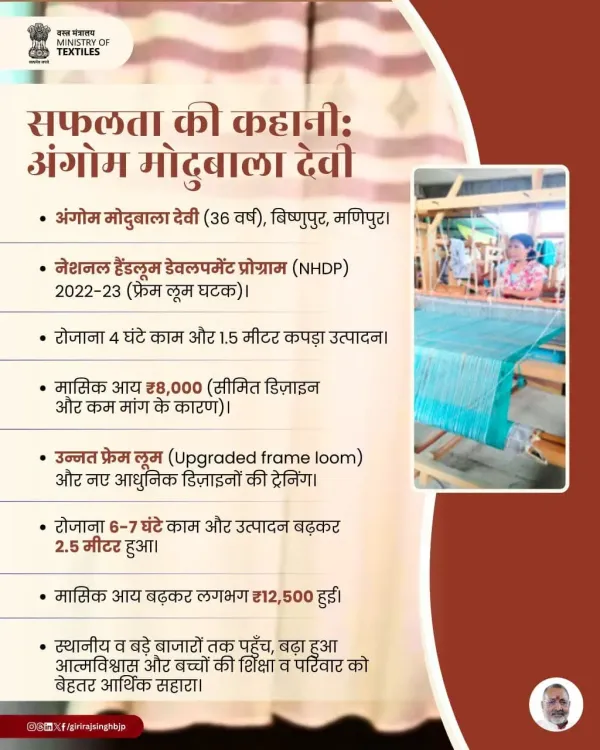
Union Textiles Minister Giriraj Singh on 6 June 2026 cited Manipur weaver Angom Modubala Devi as a success story of the NHDP, noting her monthly income grew from ₹8,000 to ₹12,500 after she received an upgraded frame loom and training under the scheme.
Key Takeaways
Angom Modubala Devi , a handloom weaver from Manipur , is the beneficiary cited by Minister Giriraj Singh in the post dated 6 June 2026 .
Her monthly income reportedly rose from ₹8,000 to ₹12,500 — an increase of approximately 56 per cent — after receiving an upgraded frame loom and training under NHDP .
The National Handloom Development Programme (NHDP) covers loom upgradation, cluster development, and weaver skill training, with the Northeast as a priority region.
The post is tagged #VocalForLocal and #SupportArtisans , linking the story to the Atmanirbhar Bharat and Vocal for Local campaigns launched in 2020 .
Manipur has one of India's highest concentrations of handloom weavers, with women forming the majority of practitioners in the sector.
Next phase of NHDP cluster approvals and budget allocations for handloom modernisation in the Northeast will be a key development to watch.
Union Textiles Minister Giriraj Singh on Saturday, 6 June 2026, shared the story of Angom Modubala Devi, a handloom weaver from Manipur, citing her as an example of how the National Handloom Development Programme (NHDP) is improving livelihoods through upgraded equipment and skill training.
Context
In his post, Minister Singh wrote: 'Manipur ki Angom Modubala Devi NHDP ke tahat mile unnat frame loom aur training se atmanirbhar ban rahi hain' — ['Manipur's Angom Modubala Devi is becoming self-reliant through the advanced frame loom and training received under NHDP']. He noted that her monthly income has risen from ₹8,000 to ₹12,500, and that this financial improvement has strengthened the confidence of her entire family. The post was accompanied by an image and tagged with the hashtags #VocalForLocal, #SupportArtisans, and #Handloom.
Angom Modubala Devi's case is being presented by the Ministry as a human-interest illustration of scheme impact — a weaver who received an upgraded frame loom and training under NHDP and subsequently recorded a measurable income gain. Such individual success stories are routinely highlighted by the Ministry of Textiles to demonstrate the on-ground reach of central welfare programmes in the unorganised weaving sector.
Policy Backdrop
The National Handloom Development Programme is the Central government's primary umbrella scheme for the handloom sector, covering loom upgradation, cluster development, and weaver skill training. The programme specifically targets modernising production infrastructure for weavers who rely on traditional techniques, with a focus on raising both productivity and income. The Northeast — including Manipur — has historically been a priority geography under the scheme, given the region's deep-rooted handloom traditions and its large population of women weavers.
The Vocal for Local campaign, launched in 2020 under the broader Atmanirbhar Bharat framework, has provided political and promotional momentum to domestic artisan welfare initiatives. The campaign encourages consumers to prefer locally produced goods, and handloom products from states like Manipur have been positioned prominently within that narrative. Minister Singh's post squarely fits within this messaging arc.
Stakeholders and Impact
Manipur has one of the highest concentrations of handloom weavers in India, with women forming the overwhelming majority of practitioners. Schemes that provide upgraded looms and structured training can meaningfully reduce production time and improve fabric quality, both of which translate into higher market earnings for individual weavers. The reported income increase from ₹8,000 to ₹12,500 per month — a rise of roughly 56 per cent — represents a significant household-level improvement if replicated at scale across beneficiary clusters.
Beyond the individual weaver, the broader beneficiary group includes handloom clusters across the Northeast that are eligible for NHDP support. Women artisans in the unorganised sector, who often lack access to formal credit or market linkages, stand to gain the most from technology upgradation and training components of the programme. Advocacy groups working with weavers have long called for faster disbursement of loom upgradation grants and more consistent follow-up training.
What's Next
Attention will now turn to the next phase of NHDP cluster approvals and budget allocations for handloom modernisation in Manipur and neighbouring northeastern states. The Ministry of Textiles is expected to scale outreach to more beneficiaries in the region as part of its broader push to document and publicise scheme outcomes. Whether the momentum generated by individual success stories translates into expanded programme coverage and faster disbursals will be the key metric to watch in the months ahead.
Point of View
The Ministry of Textiles simultaneously reinforces its Northeast outreach credentials and the Vocal for Local narrative ahead of potential budget or scheme renewal discussions. The choice of Manipur is also politically significant given the state's ongoing importance to the BJP's Northeast consolidation. The broader pattern suggests the Ministry will continue amplifying such stories as a low-cost, high-visibility way to build public and political support for NHDP funding in future allocation cycles.
NationPress
19 Sept 2026
Frequently Asked Questions
What is the National Handloom Development Programme (NHDP)?
The National Handloom Development Programme is the Central government's umbrella scheme for the handloom sector, providing support for loom upgradation, cluster development, and skill training for weavers across India, with a focus on the Northeast.
Who is Angom Modubala Devi?
Angom Modubala Devi is a handloom weaver from Manipur who was cited by Union Textiles Minister Giriraj Singh as a beneficiary of the NHDP, having received an upgraded frame loom and training that reportedly raised her monthly income from ₹8,000 to ₹12,500.
What is the Vocal for Local campaign?
Vocal for Local is a campaign launched in 2020 under the Atmanirbhar Bharat framework to promote domestically produced goods and support Indian artisans, including handloom weavers.
How much did Angom Modubala Devi's income increase under NHDP?
According to Minister Giriraj Singh's post, her monthly income rose from ₹8,000 to ₹12,500 after she received an advanced frame loom and training under the National Handloom Development Programme.
What is the government doing for handloom weavers in Manipur?
The Central government, through the Ministry of Textiles, is implementing the NHDP in Manipur to provide upgraded looms and skill training to weavers, particularly women artisans, as part of its broader Northeast development and Vocal for Local push.