Giriraj Singh highlights AP weaver's income rise under Handloom scheme
Synopsis
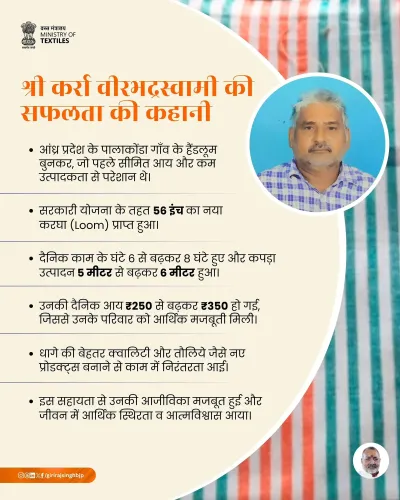
Union Textiles Minister Giriraj Singh spotlights Andhra Pradesh weaver S. Venkat Subbaiah, whose monthly income rose from ₹40,000 to ₹50,000 after joining the Handloom Marketing Assistance Scheme, thanks to timely access to quality raw material reducing production costs.
Key Takeaways
Andhra Pradesh weaver S.
Venkat Subbaiah joined the Handloom Marketing Assistance Scheme and now earns ₹50,000 per month , up from ₹40,000 — a 25 per cent income rise.
The key driver was timely access to quality raw material, which cut his production costs.
The scheme is a component of the National Handloom Development Programme , approved in 2015 by the Ministry of Textiles .
Andhra Pradesh has a longstanding handloom tradition, especially in cotton saree production.
Union Textiles Minister Giriraj Singh shared the beneficiary story on 21 October 2026 as part of ongoing scheme outreach.
A cotton saree weaver from Andhra Pradesh has become the latest face of a central government push to show real-world gains from the Handloom Marketing Assistance Scheme — and the numbers are striking. Union Textiles Minister Giriraj Singh shared the story of weaver S. Venkat Subbaiah on Wednesday, 21 October 2026, highlighting how scheme enrolment pushed his monthly income from ₹40,000 to ₹50,000 — a 25 per cent jump.
From raw material crunch to ₹50,000 a month
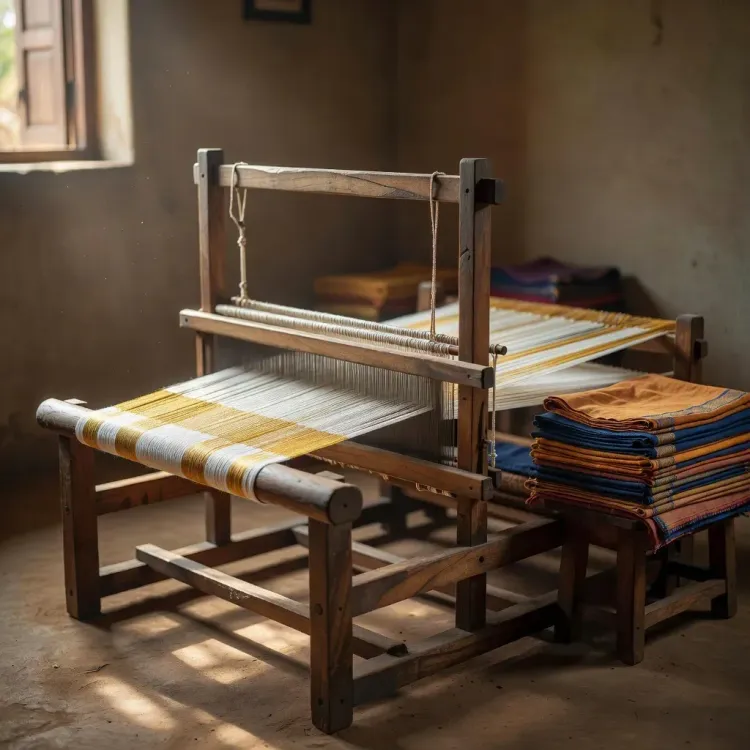
According to the Minister's post, the turning point for Subbaiah was reliable, timely access to quality raw material — a chronic pain point for handloom weavers who often pay a premium on the open market or lose working days waiting for supplies. The scheme plugged that gap directly, cutting his production cost and freeing capacity he channelled into weaving 'utkriṣṭa sūtī sāṛiyāṃ' — high-quality cotton sarees for which Andhra Pradesh carries a centuries-old reputation.
The income gain, Minister Singh noted, translated into economic stability for Subbaiah's family — a phrase that carries weight in a sector where earnings are famously irregular and weather-dependent on festival cycles and export demand.
What the Handloom Marketing Assistance Scheme actually does
The Handloom Marketing Assistance Scheme sits under the Ministry of Textiles as a component of the broader National Handloom Development Programme, which was approved in 2015. Its core logic is straightforward: connect weavers to organised supply chains for raw material, give them marketing linkages that bypass middlemen, and let the craft — not the logistics — determine a weaver's earnings ceiling.
Andhra Pradesh is one of the scheme's natural target states. The state's handloom belt, particularly around districts such as Mangalagiri and Venkatagiri, produces fine cotton sarees that command premium prices but whose weavers have historically struggled with working-capital cycles and inconsistent yarn supply.
A minister's playbook: one weaver, one headline
The post is part of a pattern that Minister Giriraj Singh has used consistently — amplifying individual beneficiary stories to give a human face to scheme statistics. It is a communications strategy the Ministry of Textiles has deployed across handloom, handicraft, and technical textile initiatives: one name, one income figure, one before-and-after. Concrete and hard to argue with.
India's handloom sector employs over 35 lakh weavers, making it one of the largest cottage-industry employers in the country. Policy continuity — successive governments have maintained dedicated support structures since at least the early 2000s — reflects both the sector's electoral salience and its genuine economic fragility. The Subbaiah story lands inside that larger frame: a sector-wide challenge, solved one loom at a time.
Watch for scheme performance data to surface during the next Textiles Ministry budget review — that is when headline beneficiary counts will be tested against ground-level income audits.
Point of View
000 monthly income jump for S. Venkat Subbaiah is modest in absolute terms but significant as a percentage gain for a household-level weaver — exactly the kind of data point that travels well in political messaging. Placed against the backdrop of the National Handloom Development Programme's decade-plus run, it signals that the ministry is prioritising continuity and visibility of existing schemes over new launches. The real policy test will come at budget time, when individual stories must aggregate into sector-wide income data.
NationPress
21 Oct 2026
Frequently Asked Questions
What is the Handloom Marketing Assistance Scheme?
The Handloom Marketing Assistance Scheme is a central government programme under the Ministry of Textiles that provides handloom weavers with marketing support and access to quality raw material at affordable rates, helping reduce production costs and improve incomes.
Who is S. Venkat Subbaiah?
S. Venkat Subbaiah is a handloom weaver from Andhra Pradesh who specialises in cotton sarees. He was highlighted by Union Textiles Minister Giriraj Singh as a beneficiary of the Handloom Marketing Assistance Scheme, with his monthly income rising from ₹40,000 to ₹50,000.
How did the scheme help the Andhra Pradesh weaver increase his income?
The scheme gave S. Venkat Subbaiah timely access to quality raw material, which reduced his production costs and enabled him to produce more high-quality cotton sarees, pushing his monthly income up by ₹10,000.
What is the National Handloom Development Programme?
The National Handloom Development Programme is a central scheme approved in 2015 that supports handloom weavers through raw material supply, marketing linkages, and skill development. The Handloom Marketing Assistance Scheme is one of its key components.
Why is Andhra Pradesh significant for handloom weaving?
Andhra Pradesh has a centuries-old tradition of handloom production, particularly fine cotton sarees from regions such as Mangalagiri and Venkatagiri, making it one of India's most important states for handloom textile heritage and livelihoods.