Giriraj Singh: India exports nearly doubled since 2014
Synopsis
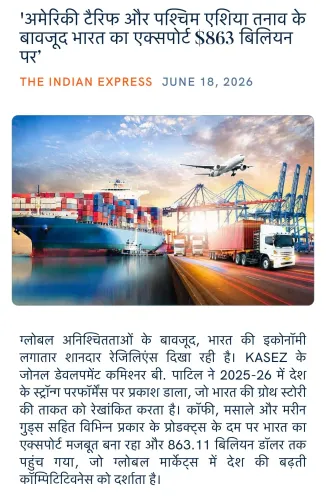
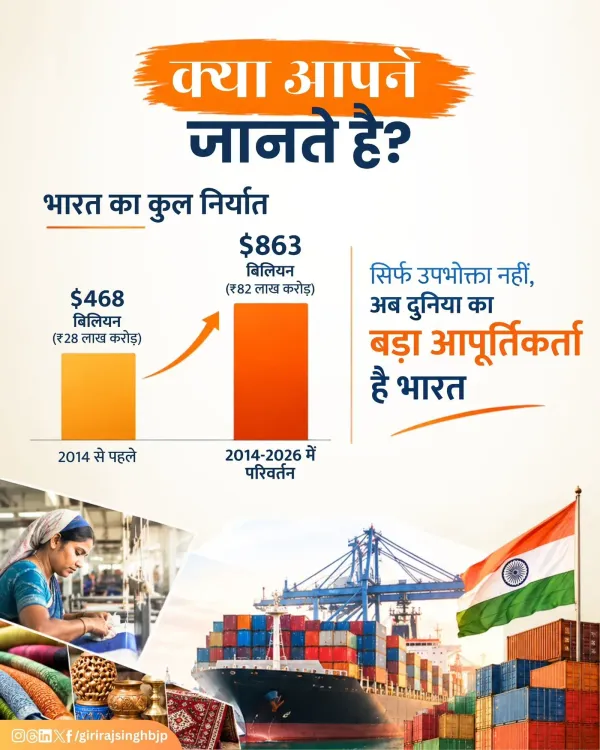
Union Textiles Minister Giriraj Singh highlighted that India's total exports surged from $468 billion before 2014 to $863 billion by 2026, crediting Make in India and PLI schemes for the near-doubling, and positioning India as a major global supplier rather than just a consumer.
Key Takeaways
Union Textiles Minister Giriraj Singh posted on X on October 16, 2026 citing India's export figures.
India's total exports rose from $468 billion (pre-2014) to $863 billion between 2014 and 2026 , a near-doubling.
The Make in India campaign, launched in September 2014 , and successive PLI schemes from 2020 onward form the policy backbone behind the export push.
Singh framed the growth as India's transition from net consumer to a 'major global supplier.' The Foreign Trade Policy 2015–2020 was specifically designed to raise India's share in global exports post-2014.
Commerce Ministry monthly trade data releases remain the key indicator to watch for trend continuity.
India's total exports have nearly doubled since 2014 — from $468 billion to $863 billion — and Union Textiles Minister Giriraj Singh wants that number to define the country's place in the world. Posting on X on Friday, October 16, 2026, the senior BJP leader framed the leap not merely as a trade statistic but as proof of a structural shift: India graduating from consumer to global supplier.
Posting in Hindi, the Minister wrote: '2014 से पहले भारत का कुल निर्यात $468 बिलियन था, जो 2014 से 2026 के बीच बढ़कर $863 बिलियन हो गया' — ('Before 2014, India's total exports stood at $468 billion; between 2014 and 2026 they rose to $863 billion.') He added that today India is emerging not merely as a consumer but as a 'major supplier to the world.'From Make in India to PLI: the policy spine behind the numbers
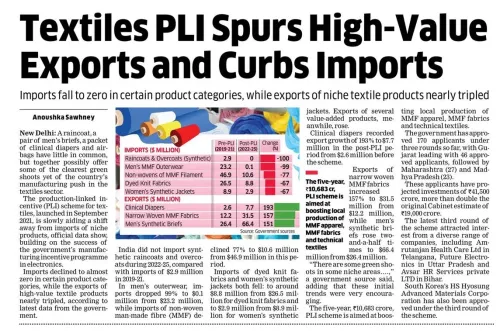
The jump did not happen in a vacuum. When Prime Minister Narendra Modi launched the Make in India campaign in September 2014, its explicit mandate was to pull manufacturing's share of GDP upward and plug Indian factories into global supply chains. A revamped Foreign Trade Policy (2015–2020) followed, engineering incentive architecture around export competitiveness. Then, from 2020 onward, a wave of Production Linked Incentive (PLI) schemes across sectors — electronics, pharmaceuticals, textiles, specialty chemicals — gave domestic manufacturers a financial runway to scale for export markets.
The combined effect, as Singh's post signals, is an economy that no longer relies solely on import-driven consumption. Merchandise and services exports have pushed through successive global headwinds — the 2020 pandemic contraction chief among them — and the diversification-away-from-single-country-sourcing trend in global supply chains has opened fresh doors for Indian exporters.
Why Giriraj Singh is the one making this argument
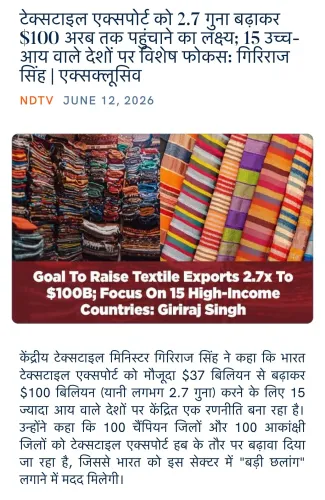
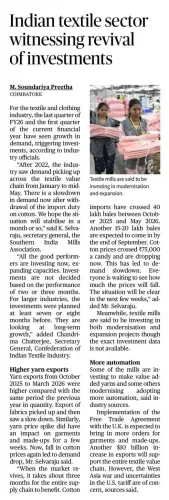
As Union Minister of Textiles and Lok Sabha MP from Begusarai, Bihar, Singh sits at the intersection of domestic manufacturing and export ambition. Textiles remain one of India's largest export earners, and the ministry has been central to PLI rollout in that sector. His framing — India as supplier, not just consumer — directly echoes the government's 'Viksit Bharat' (Developed India) vocabulary, where export prowess is both an economic and a geopolitical signal.
The Commerce Ministry's monthly trade data releases will be the next checkpoint on whether the $863 billion trajectory holds and whether the current Foreign Trade Policy can sustain momentum as global demand softens in parts of Europe and the United States.
Point of View
Where manufacturing depth and export share are positioned as proof of structural transformation, not just cyclical growth. For the Textiles Minister specifically, championing export figures also reinforces the case for continued PLI outlays in labour-intensive sectors like garments and technical textiles. The claim's political potency will depend on how disaggregated merchandise export data — as opposed to combined goods-and-services totals — hold up under Commerce Ministry scrutiny.
NationPress
16 Oct 2026
Frequently Asked Questions
What did Giriraj Singh say about India's exports?
Union Textiles Minister Giriraj Singh stated that India's total exports grew from $468 billion before 2014 to $863 billion between 2014 and 2026, calling it proof that India is becoming a major global supplier.
How much have India's exports grown since 2014?
According to Giriraj Singh's post, India's exports nearly doubled — rising from $468 billion in the pre-2014 period to $863 billion by 2026, representing growth of roughly 84 per cent.
Which government schemes are credited for India's export growth?
The Make in India campaign (launched September 2014), the Foreign Trade Policy 2015–2020, and Production Linked Incentive (PLI) schemes rolled out from 2020 onward are the key policy drivers cited for India's export expansion.
What is the PLI scheme and how does it help exports?
Production Linked Incentive schemes provide financial incentives to manufacturers in targeted sectors — including textiles, electronics, and pharmaceuticals — to scale domestic production and compete in global export markets.
Why is Giriraj Singh talking about exports?
As Union Textiles Minister, Giriraj Singh oversees one of India's largest export-earning industries; his comments on trade performance align with the government's push to position India as a global manufacturing hub under the Viksit Bharat agenda.