Giriraj Singh: PLI Scheme Boosting India Textile Exports
Synopsis
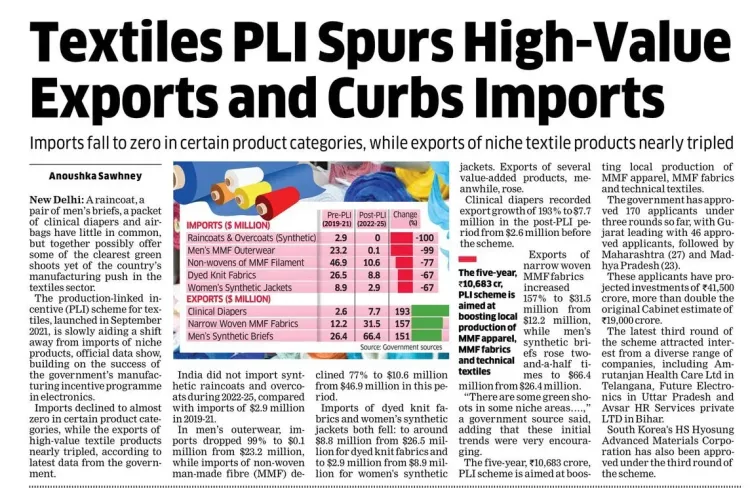
Union Textiles Minister Giriraj Singh credited PM Modi's PLI scheme on 19 June 2026 for a notable fall in MMF outerwear imports and sharp export growth in clinical diapers, narrow woven MMF fabrics and synthetic garments, signalling India's shift from consumer to global textile manufacturer.
Key Takeaways
Union Textiles Minister Giriraj Singh posted on 19 June 2026 highlighting PLI scheme outcomes for the textile sector.
Imports of raincoats, synthetic jackets and MMF outerwear have seen a notable decline under the scheme.
Exports of clinical diapers, narrow woven MMF fabrics and synthetic garments have recorded sharp growth.
The PLI scheme for textiles was approved in 2021 with an outlay of Rs 10,683 crore , targeting MMF and technical textiles.
The scheme is part of the Atmanirbhar Bharat framework aimed at reducing import dependence and building domestic manufacturing capacity.
Singh framed the shift as India emerging as a strong producer and exporter in the global textile market, not just a consumer.
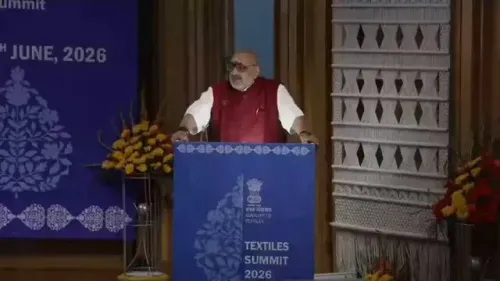
Union Textiles Minister Giriraj Singh on Friday, 19 June 2026 highlighted a significant shift in India's textile trade profile, attributing declining imports and rising exports in key man-made fibre (MMF) categories to the Production Linked Incentive (PLI) scheme launched under Prime Minister Narendra Modi.
Posting on X, the minister stated that 'PLI yojana Bharatiya vastra udyog ko nayi shakti pradan kar rahi hai' — 'the PLI scheme is providing new strength to India's textile industry.' He specifically noted a 'notable decline' in imports of raincoats, synthetic jackets and MMF outerwear, alongside 'sharp growth' in exports of clinical diapers, narrow woven MMF fabrics and synthetic garments.
Context
The post frames India's evolving role in global textiles: no longer merely a consumer, but an emerging manufacturer and exporter. Singh wrote that the transformation shows India is now 'ek sashakt nirmaata aur niryaatk' — 'a strong producer and exporter' — in the global textile market. The remarks come as the Ministry of Textiles continues to monitor quarterly trade data for signs that PLI incentives are translating into measurable industrial output.
Policy Backdrop
The Union Cabinet approved the PLI scheme for textiles in 2021 with a total outlay of Rs 10,683 crore, targeting MMF apparel, MMF fabrics and technical textiles — segments where India had historically lagged behind competitors such as China and Vietnam. The scheme sits within the broader Atmanirbhar Bharat framework announced in 2020, which sought to reduce import dependence and build domestic value chains across labour-intensive sectors.
The Make in India initiative, running since 2014, had already positioned textiles as a priority manufacturing sector; the PLI scheme gave that ambition a direct financial incentive structure, tying government payouts to incremental production benchmarks rather than upfront capital subsidies.
Stakeholders and Impact
The primary beneficiaries of the trade shift cited by Singh are MMF manufacturers and textile exporters, particularly those producing technical textiles such as clinical diapers and narrow woven fabrics — categories with high global demand and relatively low Indian market share until recently. A reduction in imports of finished outerwear products such as raincoats and synthetic jackets points to domestic capacity building in segments previously served largely by imports.
For workers in textile clusters across states such as Gujarat, Tamil Nadu and Maharashtra, sustained export growth in MMF categories can translate into expanded employment, particularly in spinning, weaving and garmenting units that have invested under PLI eligibility criteria.
What's Next
Analysts and industry bodies will watch the Ministry of Textiles quarterly export-import data releases for corroboration of the trends Singh described. A mid-term review of PLI disbursement targets is also anticipated, which could determine whether the scheme's outlay is revised upward or its product-category scope is widened. Separately, the outcome of ongoing Free Trade Agreement negotiations affecting synthetic garment tariffs could further shape the export trajectory for Indian MMF producers in the near term.
If the import-substitution and export-growth trends in MMF categories hold through the financial year, the government is likely to cite them as evidence for extending or replicating the PLI model in adjacent textile sub-sectors, reinforcing the Viksit Bharat manufacturing ambition.
Point of View
The minister signals that the government's MMF-focused industrial policy is producing results on both sides of the trade ledger — a politically potent narrative in the run-up to any mid-term PLI review. The choice of specific product categories — clinical diapers and narrow woven fabrics — is notable because these are technical textile segments where India has historically had minimal global presence, making growth there more structurally significant than in conventional apparel. If the data holds up to independent scrutiny, it would represent a meaningful inflection in India's decades-long effort to capture a larger slice of the global synthetic textile market from East Asian incumbents.
NationPress
19 Sept 2026
Frequently Asked Questions
What is the PLI scheme for textiles in India?
The Production Linked Incentive (PLI) scheme for textiles was approved by the Union Cabinet in 2021 with an outlay of Rs 10,683 crore. It targets man-made fibre (MMF) apparel, MMF fabrics and technical textiles to boost domestic manufacturing and exports, tying government incentives to incremental production rather than upfront subsidies.
What did Giriraj Singh say about PLI and textile exports?
Union Textiles Minister Giriraj Singh said on 19 June 2026 that the PLI scheme is providing new strength to India's textile industry, citing a notable decline in imports of raincoats, synthetic jackets and MMF outerwear, and sharp export growth in clinical diapers, narrow woven MMF fabrics and synthetic garments.
Which textile products are showing export growth under PLI?
According to Giriraj Singh, exports of clinical diapers, narrow woven MMF fabrics and synthetic garments have recorded sharp growth, reflecting India's expanding role as a producer and exporter in the global MMF and technical textiles market.
How does the PLI scheme relate to Atmanirbhar Bharat?
The PLI scheme for textiles is a key component of the Atmanirbhar Bharat (Self-Reliant India) framework launched in 2020. The broader initiative aims to reduce India's dependence on imports and strengthen domestic value chains across labour-intensive sectors, with textiles being a priority area.
What is the significance of MMF textiles for India's export ambitions?
Man-made fibre (MMF) textiles represent a large and fast-growing segment of global trade historically dominated by China and Vietnam. By incentivising domestic MMF production through PLI, India aims to capture a larger share of this market, diversify its export basket beyond cotton-based products, and create manufacturing employment at scale.