Giriraj Singh targets $100bn textile exports, eyes 15 high-income markets
Synopsis
Union Textiles Minister Giriraj Singh has announced a target to raise India's textile exports 2.7 times to $100 billion, with a dedicated focus on 15 high-income countries, signalling a major shift toward premium markets and higher-value segments in the sector's export strategy.
Key Takeaways
Union Textiles Minister Giriraj Singh announced a target to raise textile exports 2.7 times to $100 billion .
The strategy places special focus on 15 high-income countries , marking a deliberate pivot to premium markets.
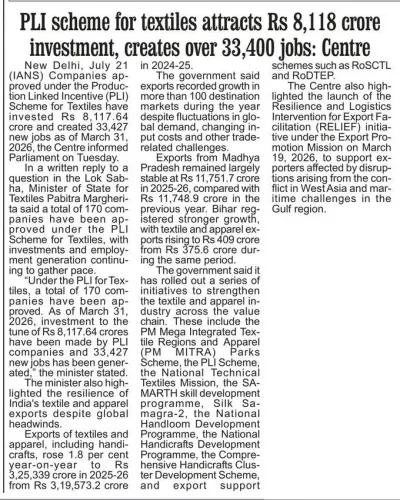
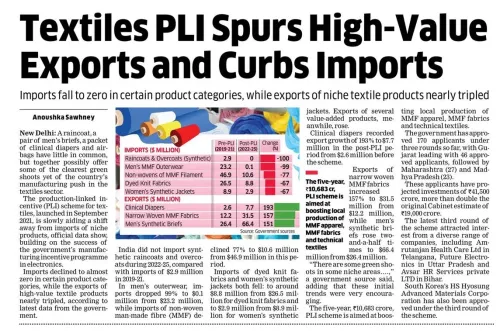
The PLI Scheme for Textiles , approved in 2021 with a Rs 10,683 crore outlay, underpins the supply-side push.
The RoSCTL scheme continues to support exporters by reimbursing embedded state and central taxes.
The push aligns with India's Atmanirbhar Bharat agenda and the global 'China+1' supply-chain realignment.
MSME manufacturers and textile exporters across major clusters are the primary stakeholders of the revised export roadmap.
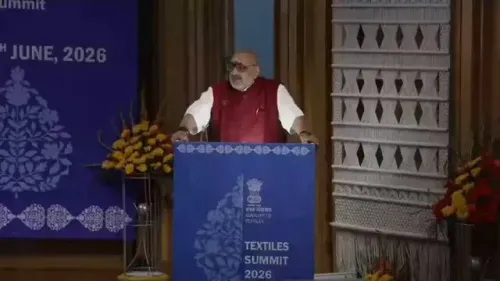
Union Textiles Minister Giriraj Singh on Friday, 12 June 2026 set out an ambitious roadmap to raise India's textile exports 2.7 times to $100 billion, with a special focus on 15 high-income countries, in an exclusive interview shared via the NaMo App.
Context
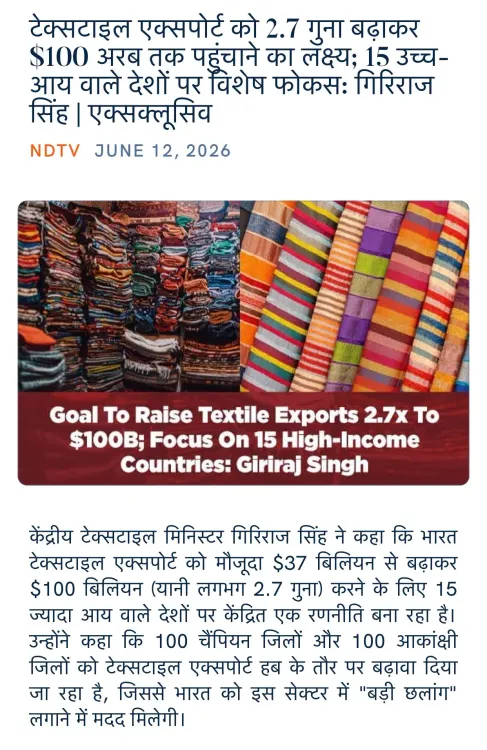
Posting on X, Giriraj Singh highlighted the headline figures from the interview: 'टेक्सटाइल एक्सपोर्ट को 2.7 गुना बढ़ाकर $100 अरब तक पहुंचाने का लक्ष्य; 15 उच्च-आय वाले देशों पर विशेष फोकस' ('Goal to raise textile exports 2.7 times to $100 billion; special focus on 15 high-income countries'). The statement signals a deliberate pivot away from volume-led growth in conventional markets toward premium segments in wealthier economies.
India's current textile and apparel export basket is estimated in the tens of billions of dollars annually. A 2.7-times multiplication to reach the $100 billion mark would represent one of the most significant leaps in the sector's export history.
Policy Backdrop
The push builds on a layered policy architecture assembled over the past several years. The Production Linked Incentive (PLI) Scheme for Textiles, approved by the Cabinet in September 2021 with an outlay of Rs 10,683 crore, was designed to attract fresh investment in man-made fibre and technical textile manufacturing — precisely the high-value categories that premium markets demand.
Separately, the Rebate of State and Central Taxes and Levies (RoSCTL) scheme was extended and revised between 2019 and 2021 to reduce the cost burden on exporters by reimbursing embedded taxes. Together, these instruments form the supply-side foundation on which the new export target rests.
The emphasis on 15 high-income countries also reflects India's broader Atmanirbhar Bharat manufacturing agenda and the global 'China+1' supply-chain realignment that has gathered pace since 2020, as international buyers diversify sourcing away from a single dominant supplier.
Stakeholders and Impact
Textile exporters and MSME manufacturers — the backbone of clusters in states such as Gujarat, Tamil Nadu, Maharashtra and Uttar Pradesh — stand to benefit most directly if the target translates into firm orders and market-access agreements. The sector employs tens of millions of workers, making export growth a significant lever for rural and semi-urban employment.
For large integrated mills as well as small power-loom operators, the focus on high-income destinations implies a quality and compliance upgrade: meeting stringent environmental, labour and product standards that premium markets impose. Industry bodies are expected to engage closely with the Ministry of Textiles on the roadmap's operational details.
What's Next
The ministry is expected to flesh out the list of 15 high-income target countries and the specific market-access or trade-agreement levers that will support the push. Analysts will watch quarterly textile export data releases for early signals of momentum.
Any fresh financial outlays or scheme modifications tied to this target could feature in the next Union Budget. With Giriraj Singh placing the goal squarely in the public domain, parliamentary scrutiny and industry consultation are likely to intensify in the months ahead.
Point of View
Building political capital in manufacturing constituencies. Whether the target is backed by new financial commitments or relies on existing PLI and RoSCTL instruments will be the defining question for industry observers.
NationPress
19 Sept 2026
Frequently Asked Questions
What is Giriraj Singh's textile export target for India?
Union Textiles Minister Giriraj Singh has announced a target to raise India's textile exports 2.7 times to $100 billion , with a special focus on 15 high-income countries .
Which scheme supports India's textile export growth?
The Production Linked Incentive (PLI) Scheme for Textiles , approved in September 2021 with an outlay of Rs 10,683 crore , is the flagship supply-side instrument, alongside the RoSCTL scheme that reimburses taxes for exporters.
Why is India focusing on high-income countries for textile exports?
India is targeting high-income countries to move up the value chain into premium, higher-margin segments and to capitalise on the global 'China+1' supply-chain realignment, where international buyers are diversifying sourcing.
How does the $100 billion textile export target affect MSMEs?
MSME manufacturers in major textile clusters stand to gain from increased orders, but will need to meet the stricter quality, environmental and compliance standards that high-income markets require.
When did Giriraj Singh announce the $100 billion textile export goal?
The announcement was shared publicly on Friday, 12 June 2026 , via a post on X using the NaMo App .