Giriraj Singh: 22 More Textile Firms Approved Under PLI
Synopsis
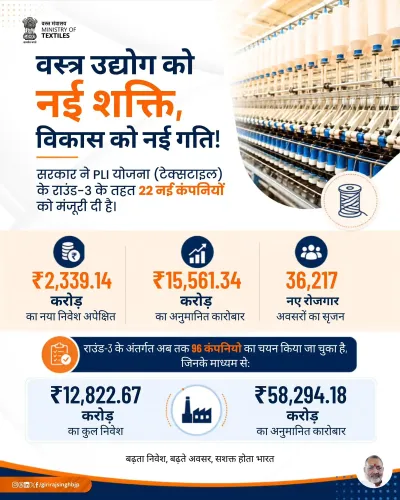
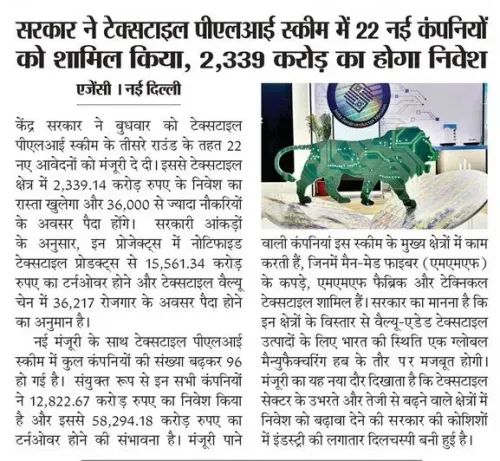
Union Textiles Minister Giriraj Singh announced that the government has approved 22 more textile companies under the PLI scheme, raising total Round III selections to 96. The Rs 10,683 crore scheme targets man-made fibres and technical textiles as part of India's Atmanirbhar Bharat manufacturing push.
Key Takeaways
The government approved 22 additional textile companies under the PLI scheme , announced by Union Textiles Minister Giriraj Singh on June 11, 2026 .
Total company selections in Round III of the textile PLI now stand at 96 .
The textile PLI scheme carries a total outlay of Rs 10,683 crore , approved by the Union Cabinet in September 2021 .
The scheme focuses on man-made fibre apparel, MMF fabrics, and technical textiles — segments where India seeks to compete globally.
Incentives are disbursed against actual investment and turnover milestones , meaning approvals do not automatically translate to payouts.
The announcement is part of a broader 14-sector PLI framework launched under Atmanirbhar Bharat in 2020 .
Union Textiles Minister Giriraj Singh announced on Thursday, June 11, 2026 that the government has approved 22 additional textile companies under the Production Linked Incentive (PLI) scheme, taking the total number of companies selected in Round III to 96.
Context
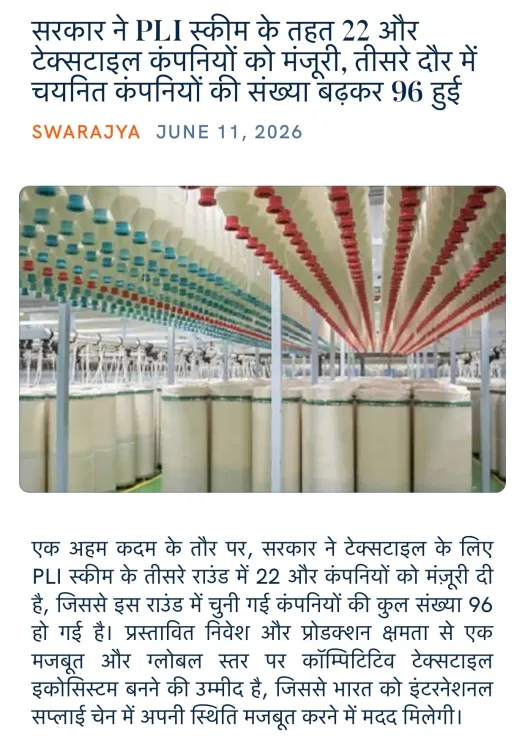
Posting on X via the NaMo App, Singh shared the update in Hindi: 'सरकार ने PLI स्कीम के तहत 22 और टेक्सटाइल कंपनियों को मंजूरी, तीसरे दौर में चयनित कंपनियों की संख्या बढ़कर 96 हुई' ('The government has approved 22 more textile companies under the PLI scheme, taking the number of companies selected in the third round to 96'). The announcement signals continued momentum in the government's effort to scale domestic textile manufacturing capacity.
Policy Backdrop
The Union Cabinet approved the PLI scheme for textiles in September 2021 with a total outlay of Rs 10,683 crore, focusing on man-made fibre (MMF) apparel, MMF fabrics, and technical textiles. The scheme was formally notified in December 2021 as part of the broader Atmanirbhar Bharat package, which rolled out 14 PLI schemes across key manufacturing sectors. The textiles PLI was designed to attract fresh investment, raise domestic value addition, and reduce India's dependence on imports in a labour-intensive industry.
The Ministry of Textiles has positioned successive rounds of company approvals as a deliberate, sequenced strategy to build production capacity — particularly in segments where China has historically dominated global supply chains. The broader PLI framework, initiated in 2020, covers sectors ranging from electronics to automobiles alongside textiles.
Stakeholders and Impact
Textile manufacturers and apparel exporters are the primary beneficiaries of the scheme, with incentives tied to incremental investment and turnover milestones. The approval of 22 new companies in this tranche expands the pool of firms eligible to claim production-linked payouts, potentially unlocking fresh capital expenditure in MMF and technical textile segments. Industry bodies have consistently flagged the PLI as a critical lever to help India capture a larger share of global textile trade at a time when buyers are actively diversifying sourcing away from China.
For workers and ancillary units in textile clusters across states such as Gujarat, Tamil Nadu, Maharashtra, and Uttar Pradesh, a larger approved company base under PLI can translate into expanded production lines and incremental employment over the medium term.
What's Next
Attention will now shift to the disbursement phase — whether the newly approved companies meet the investment and turnover thresholds required to actually draw down incentives. Analysts and industry stakeholders will also watch whether the Union Budget brings any further expansion of the scheme's outlay or a revision of eligibility criteria in light of Round III's scale-up. Minister Singh's continued public communication around PLI milestones suggests the Ministry of Textiles intends to keep the scheme's progress visible ahead of the next policy cycle.
Point of View
Publicising each tranche serves a dual purpose: signalling administrative delivery to the BJP's industrial base and reinforcing the Atmanirbhar Bharat narrative ahead of budget season. The focus on man-made fibres and technical textiles is strategically calibrated to capture supply-chain shifts away from China, a theme that resonates with both domestic investors and global sourcing executives. The real test, however, remains disbursement — whether approved companies clear investment thresholds and whether incentive payouts materialise at the scale the outlay promises.
NationPress
25 Oct 2026
Frequently Asked Questions
What is the PLI scheme for textiles in India?
The Production Linked Incentive (PLI) scheme for textiles was approved by the Union Cabinet in September 2021 with an outlay of Rs 10,683 crore. It provides financial incentives to companies that achieve incremental production in man-made fibre apparel, MMF fabrics, and technical textiles, and is part of the broader Atmanirbhar Bharat manufacturing package.
How many companies have been selected under textile PLI Round III?
As of June 11, 2026, a total of 96 companies have been selected under Round III of the textile PLI scheme, following the latest approval of 22 additional firms announced by Union Textiles Minister Giriraj Singh.
Who is Giriraj Singh and what ministry does he head?
Giriraj Singh is a senior BJP leader and Lok Sabha MP from Begusarai, Bihar. He currently serves as Union Minister of Textiles in the central government.
What types of textiles does the PLI scheme cover?
The textile PLI scheme focuses on man-made fibre (MMF) apparel, MMF fabrics, and technical textiles — segments identified as high-growth areas where India aims to increase domestic production and reduce import dependence.
When will PLI incentives be disbursed to approved textile companies?
Incentives under the textile PLI scheme are not disbursed at the time of approval. Companies must first meet defined investment and turnover milestones, after which they become eligible to claim production-linked payouts from the government.