Giriraj Singh: PLI Phase 3 Clears 22 Textile Firms
Synopsis
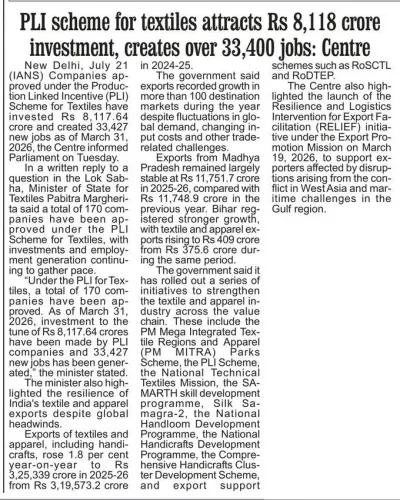
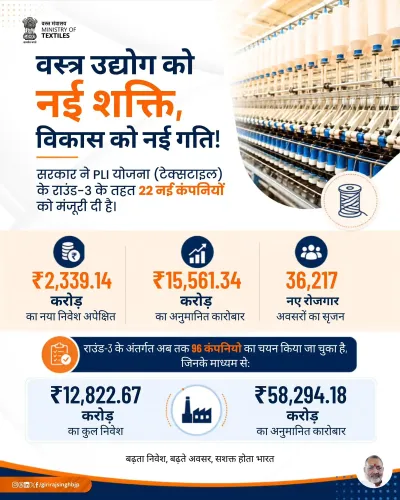
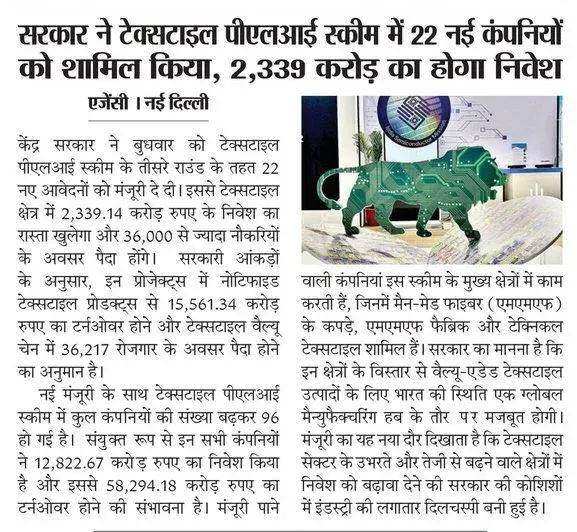
Union Textiles Minister Giriraj Singh announced that 22 new companies have been approved under PLI Phase 3 for textiles, set to attract over ₹2,339 crore in investment and create more than 36,000 jobs, advancing India's Atmanirbhar Bharat manufacturing push.
Key Takeaways
22 new companies have received approval under Phase 3 of the Production Linked Incentive (PLI) scheme for textiles.
The approved firms are projected to bring in investments exceeding ₹2,339 crore .
More than 36,000 employment opportunities are expected to be created through these approvals.
The textiles PLI scheme was launched by the Union Cabinet in September 2021 with a total outlay of ₹10,683 crore over five years.
The scheme targets man-made fibre apparel, fabrics, and technical textiles to boost India's export competitiveness.
Actual incentive disbursement depends on companies meeting incremental sales milestones under ministry review.
Union Textiles Minister Giriraj Singh on Thursday, June 11, 2026, announced that 22 new companies have been approved under the third phase of the Production Linked Incentive (PLI) scheme for textiles, promising investments exceeding ₹2,339 crore and the creation of more than 36,000 jobs.
Context
Posting on X, the minister stated: 'PLI योजना के तीसरे चरण में 22 नई कंपनियों को स्वीकृति मिली है' ('22 new companies have been approved in the third phase of the PLI scheme'), adding that this would channel investments of over ₹2,339 crore and generate more than 36,000 employment opportunities. He framed the approvals as a step toward realising the goals of Atmanirbhar Bharat (Self-Reliant India) and Viksit Bharat (Developed India) under the leadership of Prime Minister Narendra Modi.
Policy Backdrop
The Union Cabinet approved the PLI scheme specifically for the textiles sector in September 2021, with a total outlay of ₹10,683 crore spread over five years. The scheme was designed to offer incentives on incremental sales to manufacturers of man-made fibre apparel, man-made fibre fabrics, and technical textiles — segments where India has historically lagged behind competitors such as China, Vietnam, and Bangladesh.
The broader PLI architecture, introduced in 2020, now spans 14 sectors and sits at the heart of the government's Atmanirbhar Bharat strategy to reduce import dependence and raise domestic value addition. Textiles has been accorded priority status given its labour-intensive character and its potential to lift export earnings.
Stakeholders and Impact
The textile manufacturing sector stands to benefit most directly, with the newly approved firms expected to commission fresh production capacity and absorb workers across spinning, weaving, and garmenting operations. Given that textiles is one of India's largest employers after agriculture, the projected 36,000-plus jobs carry particular significance for states with established textile clusters.
For textile sector workers, especially in states such as Gujarat, Maharashtra, Tamil Nadu, and Telangana, the fresh investment pipeline could translate into formal employment and improved wages if the approved companies meet their committed production milestones. Industry bodies have long sought faster approvals and disbursements to stay competitive in global markets.
What's Next
The Ministry of Textiles will be expected to conduct quarterly reviews to track the physical and financial progress of the 22 newly approved companies. Actual disbursement of PLI incentives is contingent on companies meeting incremental sales targets, making implementation monitoring the critical near-term test for the scheme's third phase.
With global apparel and technical textile supply chains continuing to diversify away from single-source dependence, India's ability to convert approved investment into operational capacity swiftly will determine whether the ₹10,683 crore textiles PLI outlay delivers its intended export and employment dividends.
Point of View
The announcement reinforces the political messaging around job creation in a labour-intensive sector ahead of what remains a competitive export landscape. The framing around 'Viksit Bharat' and 'Atmanirbhar Bharat' places the approvals within a long-term national economic vision rather than a standalone policy event. The real test, however, will be whether the newly approved companies translate committed investment into operational capacity and verifiable employment within the scheme's timeline.
NationPress
26 Oct 2026
Frequently Asked Questions
What is the PLI scheme for textiles in India?
The Production Linked Incentive (PLI) scheme for textiles was approved by the Union Cabinet in September 2021 with an outlay of ₹10,683 crore over five years, offering incentives to manufacturers of man-made fibre apparel, fabrics, and technical textiles on incremental sales above a baseline.
How many companies were approved in PLI textiles Phase 3?
Union Textiles Minister Giriraj Singh announced that 22 new companies were approved under Phase 3 of the PLI scheme for textiles, with projected investment of over ₹2,339 crore.
How many jobs will PLI textiles Phase 3 create?
According to the minister's announcement, the 22 newly approved companies under PLI textiles Phase 3 are expected to generate more than 36,000 employment opportunities.
What is Atmanirbhar Bharat and how does PLI fit into it?
Atmanirbhar Bharat, or Self-Reliant India, is a government initiative launched in 2020 to boost domestic manufacturing and reduce import dependence. The PLI scheme, now covering 14 sectors including textiles, is the flagship instrument of this strategy.
When will the PLI textile companies start production?
The Ministry of Textiles conducts quarterly reviews of approved companies' progress; actual incentive disbursements are tied to companies meeting incremental production and sales milestones, with timelines varying by project.