Giriraj Singh Hails Smartphone PLI Scheme Exceeding Targets
Synopsis
India's smartphone PLI scheme has surpassed its production targets and quadrupled value addition, Union Textiles Minister Giriraj Singh announced on 8 July 2026, signalling a major milestone for the country's Atmanirbhar Bharat electronics manufacturing push.
Key Takeaways
Union Textiles Minister Giriraj Singh shared on 8 July 2026 that India's smartphone PLI scheme has gone beyond its set targets.
Value addition in the smartphone segment has reportedly increased fourfold , as communicated by the industry to the government.
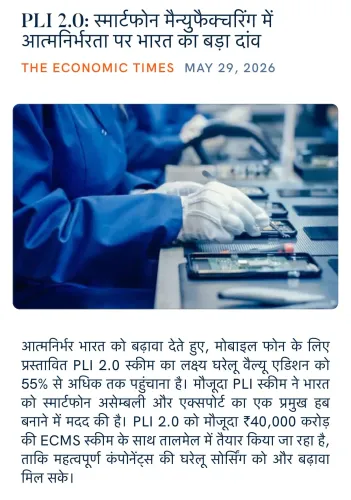
The PLI scheme for mobile phones was launched in 2020 with a Rs 15,000 crore outlay over five years.
The scheme is administered by the Ministry of Electronics and Information Technology (MeitY) under the Atmanirbhar Bharat framework.
Rising domestic value addition indicates India is deepening its electronics supply chain, not just assembling imported components.
Next milestones include PLI disbursements, possible Budget-level scheme extensions, and quarterly electronics export data.
Union Textiles Minister Giriraj Singh on Wednesday, 8 July 2026, shared that India's Production Linked Incentive (PLI) scheme for smartphones has surpassed its targets, with value addition in the sector reportedly quadrupling — a milestone the industry has communicated to the government.
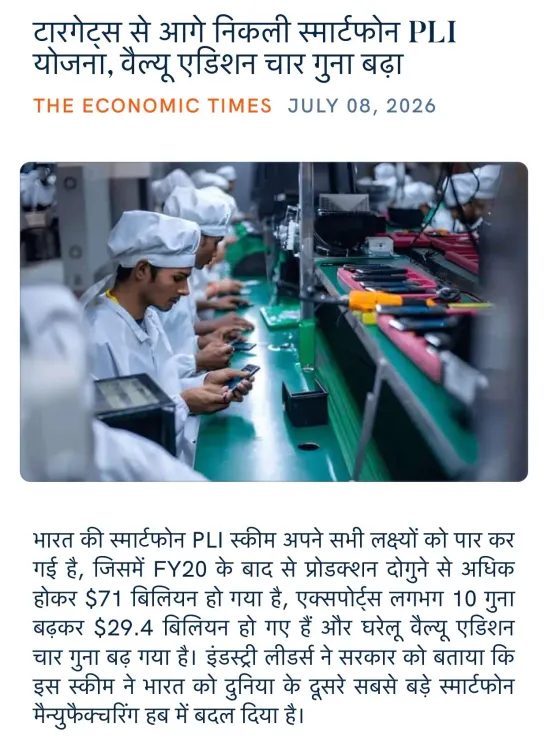
Sharing the development via the NaMo App, Singh posted in Hindi: 'टारगेट्स से आगे निकली स्मार्टफोन PLI योजना, वैल्यू एडिशन चार गुना बढ़ा' — translated as 'Smartphone PLI scheme has gone beyond targets, value addition has increased fourfold.' The post underscores the government's confidence in the scheme's performance as a pillar of domestic electronics manufacturing.
Context
India's PLI scheme for mobile phones and specified electronic components was notified in 2020 with an outlay of Rs 15,000 crore over five years. Administered by the Ministry of Electronics and Information Technology (MeitY), the scheme offers financial incentives to manufacturers based on incremental production over a defined base year. The core objective was to attract global investment, boost domestic output, and reduce India's dependence on imported electronics.
The scheme sits within the larger Atmanirbhar Bharat framework, under which the government has launched over a dozen sector-specific PLI programmes since 2020. Smartphones were among the first and most high-profile sectors to be brought under the initiative, drawing significant foreign direct investment from global handset makers.
Policy Backdrop
The smartphone PLI scheme was designed with escalating incentive slabs tied to incremental sales of goods manufactured in India. Eligible companies — both domestic and global — were required to commit to minimum investment thresholds and production targets over the incentive period. Rising local value addition has been a key metric, reflecting deeper integration of domestic component supply chains rather than mere assembly of imported parts.
India has positioned itself as an alternative manufacturing hub to China, and the smartphone segment has been central to that narrative. Success in value addition signals that the country is moving up the electronics manufacturing value chain — a goal that goes beyond raw production volumes.
Stakeholders and Impact
The primary beneficiaries of the scheme's outperformance are electronics manufacturers, smartphone exporters, and component suppliers operating within India's growing ecosystem. A fourfold increase in value addition implies that a significantly larger share of a device's worth is now being created domestically — through local sourcing of parts, sub-assemblies, and manufacturing processes.
For workers and ancillary industries in electronics manufacturing clusters, stronger scheme performance typically translates into sustained employment and investment inflows. The data also strengthens the government's case for continuing or expanding PLI-style interventions in adjacent electronics segments.
What's Next
Attention will now turn to the next round of PLI disbursements and whether the Union Budget will signal any extension or enhancement of the scheme's scope. Quarterly electronics export figures released by the commerce ministry will serve as an independent barometer of whether the on-ground momentum matches the targets-exceeded narrative. Any formal announcement from MeitY elaborating on the specific figures cited by the industry would provide the fuller picture that policymakers and investors are watching for.
Point of View
Though from the Textiles Ministry rather than MeitY, reflects how the BJP's communication machinery uses cross-ministerial amplification to reinforce the Atmanirbhar Bharat narrative ahead of budget season. A fourfold value-addition claim, if substantiated by formal MeitY data, would represent one of the strongest performance metrics any PLI scheme has produced — lending credibility to the government's broader industrial policy bet. The timing also signals intent: with global supply chain realignment ongoing, India is keen to cement its image as a reliable electronics manufacturing destination. The key test will be whether independent export and investment data corroborate the industry's self-reported figures.
NationPress
7 Oct 2026
Frequently Asked Questions
What is the smartphone PLI scheme in India?
The Production Linked Incentive scheme for smartphones is a Government of India programme launched in 2020 with a Rs 15,000 crore outlay to boost domestic mobile phone manufacturing by offering financial incentives tied to incremental production.
Has India's smartphone PLI scheme met its targets?
According to information shared by Union Textiles Minister Giriraj Singh on 8 July 2026, the smartphone PLI scheme has exceeded its targets, with the industry informing the government that value addition has increased fourfold.
What does 'value addition' mean in the context of the smartphone PLI scheme?
Value addition refers to the share of a smartphone's worth that is created within India — through local sourcing of components, sub-assemblies, and manufacturing — rather than simply assembling imported parts.
Which ministry oversees the smartphone PLI scheme?
The Ministry of Electronics and Information Technology (MeitY) is the nodal ministry responsible for designing and implementing the PLI scheme for smartphones and specified electronic components.
What comes next for India's smartphone PLI scheme?
Upcoming milestones include the next round of PLI disbursements, potential scheme extensions in the Union Budget, and quarterly electronics export data that will independently verify the scheme's performance claims.