Giriraj Singh backs PLI 2.0 push for smartphone self-reliance
Synopsis
Union Textiles Minister Giriraj Singh on 29 May 2026 backed India's PLI 2.0 initiative, describing it as a major push for self-reliance in smartphone manufacturing. The scheme, with roots in a Rs 40,951 crore outlay approved in 2020, aims to deepen domestic value addition and reduce import dependence in electronics.
Key Takeaways
Giriraj Singh shared support for PLI 2.0 on 29 May 2026 via the NaMo App, signalling unified BJP backing for the policy.
The original PLI scheme for large-scale electronics was approved in 2020 with an outlay of approximately Rs 40,951 crore .
PLI 2.0 aims to push manufacturers beyond assembly toward deeper component and sub-assembly production within India .
Global firms including Apple and Samsung have already expanded Indian operations under earlier PLI rounds.
The policy is part of the broader Atmanirbhar Bharat and Make in India frameworks launched in 2020 and 2014 respectively.
Quarterly reviews by the Ministry of Electronics and IT will track investment, local value-addition, and export benchmarks.
Union Textiles Minister Giriraj Singh on Friday, 29 May 2026 shared a post highlighting India's PLI 2.0 initiative aimed at deepening domestic smartphone manufacturing, framing it as a major bet on atmanirbharta (self-reliance) in electronics. The minister shared the post via the NaMo App, signalling broad BJP endorsement of the policy push.
Context
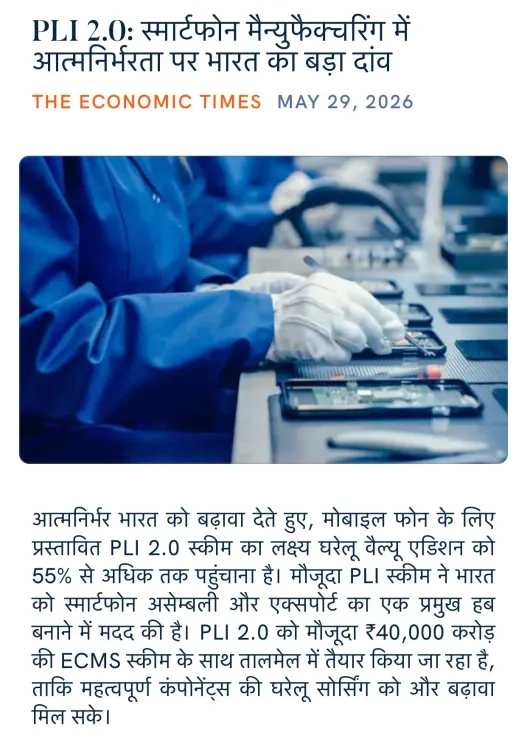
The post, captioned 'PLI 2.0: स्मार्टफोन मैन्युफैक्चरिंग में आत्मनिर्भरता पर भारत का बड़ा दांव' — translated as 'PLI 2.0: India's big bet on self-reliance in smartphone manufacturing' — underscores the government's continued emphasis on building a robust domestic electronics supply chain. Giriraj Singh, while heading the Textiles Ministry, is a senior BJP leader whose amplification of cross-sectoral economic policy signals unified cabinet messaging.
The Production Linked Incentive scheme for large-scale electronics manufacturing was first approved in 2020 with an outlay of approximately Rs 40,951 crore, designed to offer financial rewards tied to incremental domestic production. A second iteration, widely referred to as PLI 2.0, seeks to deepen that push by encouraging greater local value addition beyond final assembly.
Policy Backdrop
India's drive to become a global smartphone manufacturing hub traces back to the Make in India programme launched in 2014, which was significantly reinforced after 2020 under the Atmanirbhar Bharat framework. The overarching goal has been to reduce dependence on imports — particularly from China — while attracting foreign direct investment into Indian assembly and component plants.
Global majors including Apple and Samsung, along with their contract manufacturers, have expanded operations in India in response to earlier PLI incentives. The next phase is expected to push manufacturers further up the value chain, moving from assembly toward component fabrication and sub-assembly within Indian borders.
Stakeholders and Impact
Domestic and multinational electronics manufacturers stand to gain the most directly, as incremental production targets unlock government incentive payouts. For consumers, sustained investment in local manufacturing is expected to gradually reduce smartphone prices and improve supply resilience.
Workers in electronics manufacturing clusters — concentrated in states such as Uttar Pradesh, Tamil Nadu, Karnataka, and Andhra Pradesh — could see expanded employment as capacity scales. Export competitiveness is also a stated objective, with India positioning itself as an alternative sourcing destination for global buyers diversifying away from single-country supply chains.
What's Next
The Ministry of Electronics and Information Technology is expected to track incremental investment commitments, local value-addition percentages, and export figures in subsequent quarterly reviews. Industry analysts will watch whether PLI 2.0 incentive structures are calibrated to move participants beyond screwdriver assembly toward deeper component manufacturing. The pace of FDI announcements and production ramp-ups over the next two to three quarters will be the clearest indicator of whether the policy is achieving its stated self-reliance objectives.
Frequently Asked Questions
What is PLI 2.0 for smartphones in India?
PLI 2.0 refers to the next phase of India's Production Linked Incentive scheme for large-scale electronics manufacturing, aimed at deepening domestic value addition in smartphone production beyond final assembly. The original scheme was approved in 2020 with an outlay of approximately Rs 40,951 crore.
Why did Giriraj Singh share a post about smartphone manufacturing?
As a senior BJP leader, Giriraj Singh shared the PLI 2.0 article via the NaMo App to signal broad cabinet and party support for India's self-reliance agenda in electronics manufacturing, even though his ministerial portfolio is Textiles.
What is Atmanirbhar Bharat's role in smartphone manufacturing?
Atmanirbhar Bharat, launched in 2020, provides the overarching policy framework for reducing import dependence in strategic sectors including electronics. PLI schemes for smartphones are a core instrument of this initiative, incentivising domestic production and attracting foreign investment.
Which companies are investing in smartphone manufacturing in India under PLI?
Global majors including Apple and Samsung, along with their contract manufacturers, have expanded manufacturing operations in India in response to PLI incentives, making India an increasingly significant smartphone production base.
What will determine the success of PLI 2.0 for electronics?
Success will be measured by incremental investment commitments, growth in local value-addition percentages, and export figures tracked in quarterly reviews by the Ministry of Electronics and Information Technology.