Giriraj Singh Flags India Electronics Exports Rise to $5.09 Bn
Synopsis
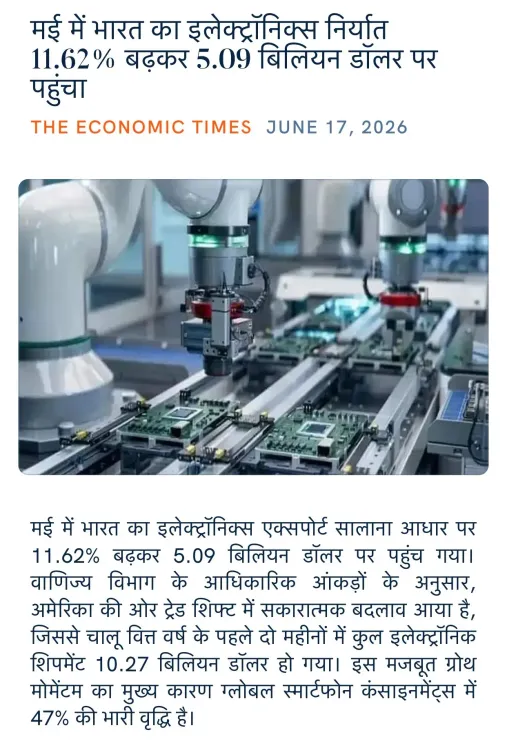
Union Textiles Minister Giriraj Singh on June 17, 2026 highlighted that India's electronics exports climbed 11.62 per cent year-on-year to $5.09 billion in May 2026, underscoring the continued impact of the PLI scheme and Atmanirbhar Bharat's manufacturing push.
Key Takeaways
India's electronics exports rose 11.62 per cent year-on-year in May 2026 , reaching $5.09 billion .
Union Textiles Minister Giriraj Singh shared the data on June 17, 2026 via the NaMo App on X.
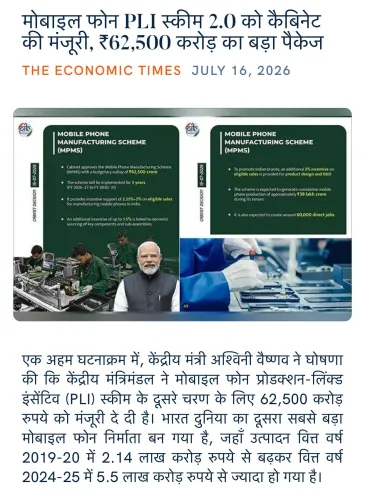
The PLI Scheme for Large-Scale Electronics Manufacturing , notified in April 2020 with a Rs 38,325 crore outlay, has been a primary driver of this export growth.
A second PLI for IT Hardware round approved in 2023 extended incentives to laptops and servers.
Electronics export growth supports both large OEMs and the broader MSME component supplier ecosystem.
Sustained growth through June–July 2026 would strengthen India's case to become a top-five global electronics exporter.
Union Textiles Minister Giriraj Singh on Wednesday, June 17, 2026 shared data indicating that India's electronics exports rose 11.62 per cent year-on-year in May 2026, reaching $5.09 billion — citing the figure via the NaMo App on his official X account.
Context
The post, shared in Hindi, states: 'Maii mein Bharat ka electronics niryaat 11.62% badhkar 5.09 billion dollar par pahuncha' — ['India's electronics exports in May rose 11.62% to reach $5.09 billion']. The figure signals continued momentum in a sector that the central government has treated as a strategic pillar of its Atmanirbhar Bharat manufacturing push.
Though Giriraj Singh holds the Textiles portfolio, senior BJP leaders routinely amplify broader economic data on social media as part of the ruling coalition's communications strategy around India's industrial performance.
Policy Backdrop
India's electronics export surge has been closely linked to the Production Linked Incentive (PLI) Scheme for Large-Scale Electronics Manufacturing, notified in April 2020 with a total outlay of Rs 38,325 crore. The scheme was designed to reduce import dependence, attract global investment, and scale up domestic assembly — particularly in mobile phones and components.
A second tranche, the PLI for IT Hardware, was approved in 2023 to extend incentives to laptops, servers, and allied electronics products. The Ministry of Electronics and Information Technology (MeitY) oversees disbursement and compliance for both rounds. Cumulative electronics exports have trended sharply upward since FY2021, driven primarily by mobile phone assembly and localisation targets set under the scheme.
India has also positioned itself as a beneficiary of global supply-chain diversification away from China, with several multinational manufacturers expanding or shifting capacity to Tamil Nadu, Uttar Pradesh, and Andhra Pradesh.
Stakeholders and Impact
The primary beneficiaries of rising electronics exports are large-scale Original Equipment Manufacturers (OEMs) operating under PLI contracts, as well as the MSME component supplier ecosystem that feeds into their production lines. A sustained export run at this level supports job creation targets that the government has publicly tied to the scheme's success metrics.
For MSME suppliers, higher export volumes from anchor manufacturers translate into increased order books, though margin pressures and component import costs remain a structural concern flagged by industry bodies. The data, if sustained through the June–July 2026 period, would strengthen the government's case for PLI as a replicable model across other manufacturing verticals.
What's Next
Analysts and policymakers will watch the June and July 2026 monthly export releases closely to determine whether the May figure represents an acceleration or a seasonal spike. A mid-term review of PLI disbursement targets in the electronics sector is also expected, which could recalibrate incentive slabs based on actual export performance.
If India sustains double-digit electronics export growth through the second half of 2026, it would materially bolster the country's ambition to become a top-five global electronics exporter — a goal embedded in the broader India Semiconductor Mission and allied industrial policy frameworks.
Point of View
If verified in subsequent official releases, would represent a meaningful acceleration in a sector that has become central to India's industrial identity under the PLI framework. The timing also signals confidence in the Atmanirbhar Bharat brand as a political asset, not merely a policy instrument. Sustained double-digit electronics export growth could give the ruling coalition a concrete economic data point to counter criticism about job creation and import dependency.
NationPress
16 Sept 2026
Frequently Asked Questions
What were India's electronics exports in May 2026?
According to data shared by Union Textiles Minister Giriraj Singh, India's electronics exports in May 2026 stood at $5.09 billion , representing an 11.62 per cent year-on-year increase.
What is the PLI scheme for electronics in India?
The Production Linked Incentive (PLI) Scheme for Large-Scale Electronics Manufacturing was notified in April 2020 with an outlay of Rs 38,325 crore to boost domestic production, attract investment, and reduce India's dependence on electronics imports.
Why is Giriraj Singh commenting on electronics exports if he is the Textiles Minister?
Giriraj Singh is a senior BJP leader and Lok Sabha MP from Begusarai, Bihar . Senior ruling-party ministers routinely share broader economic data on social media as part of the government's communications strategy, even when the data falls outside their specific portfolio.
Which ministry oversees India's electronics exports and PLI scheme?
The Ministry of Electronics and Information Technology (MeitY) is the primary central body responsible for policy formulation, PLI disbursement, and export promotion in India's electronics sector.
How has India's electronics export trend changed since 2021?
India's cumulative electronics exports have risen sharply since FY2021 , driven mainly by mobile phone assembly under the PLI scheme and the country's positioning as an alternative manufacturing hub amid global supply-chain diversification away from China .