Giriraj Singh Hails IIP at 5-Month High of 5.1% in May
Synopsis
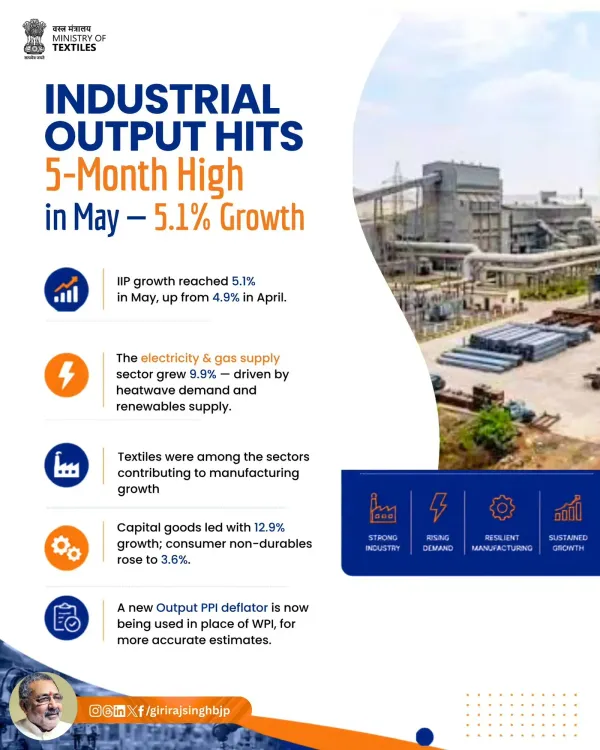
Union Textiles Minister Giriraj Singh on 3 July 2026 hailed India's IIP rising to a five-month high of 5.1 percent in May, crediting PM Modi's sustained manufacturing and infrastructure policies and linking the data to the Viksit Bharat 2047 development vision.
Key Takeaways
India's Index of Industrial Production rose to 5.1 percent in May 2026 , the highest in five months.
Union Textiles Minister Giriraj Singh attributed the growth to PM Narendra Modi's manufacturing and infrastructure policies.
The minister linked the milestone to the Viksit Bharat 2047 vision of making India a developed economy by independence's centenary.
Key policy enablers cited include Make in India (launched 2014), PLI schemes across 14 sectors, and the Atmanirbhar Bharat package.
The next IIP release and Union Budget announcements on PLI outlays will be closely watched to assess whether the trend is sustained.
Union Textiles Minister Giriraj Singh on Friday, 3 July 2026, welcomed official data showing India's Index of Industrial Production (IIP) rising to a five-month high of 5.1 percent in May 2026, attributing the milestone to sustained policy efforts under Prime Minister Narendra Modi. The minister shared his remarks on X, framing the reading as evidence of accelerating industrial momentum aligned with the government's long-term development vision.
In his post, Singh wrote — translated from Hindi — that 'Bharat ka audyogik utpadan May mein 5.1% ke saath paanch mahine ke uchchtam star par pahuncha hai' ('India's industrial production has reached a five-month high of 5.1 percent in May'). He credited PM Modi's continuous push to strengthen manufacturing, infrastructure, and industry, and said the achievement 'further reinforces the resolve of Viksit Bharat.' The post carried hashtags #ViksitBharat2047, #MakeInIndia, #Manufacturing, and #NewIndia.
Context
The Index of Industrial Production is a monthly statistical release by the Ministry of Statistics and Programme Implementation that tracks output growth across three broad segments: manufacturing, mining, and electricity. A reading of 5.1 percent for May 2026 would mark the strongest pace in five months, signalling a broad-based pickup in factory activity after a period of softer momentum earlier in the year.
Singh, who represents Begusarai in Bihar as a Lok Sabha MP and holds the Union Textiles portfolio, has been a consistent voice on industrial growth themes, often linking sectoral data to the ruling party's broader economic narrative. His post situates a single monthly data point within the government's multi-decade industrialisation ambition.
Policy Backdrop
The Modi government's manufacturing push traces back to the Make in India programme launched in September 2014, which set a target of raising manufacturing's share of GDP to 25 percent. That initiative was followed by a wave of Production Linked Incentive (PLI) schemes rolled out from 2020 across 14 sectors, offering fiscal incentives to domestic and foreign producers who scale up output on Indian soil.
The Atmanirbhar Bharat package, announced in May 2020, added a self-reliance dimension — encouraging import substitution and deeper domestic value chains. Together, these measures represent a deliberate policy pivot away from services-led growth toward higher manufacturing value addition in global supply chains.
The Viksit Bharat 2047 vision — the government's stated goal of making India a fully developed economy by the centenary of independence — provides the overarching frame within which monthly IIP prints are increasingly being read by ministers and officials.
Stakeholders and Impact
A sustained rise in IIP benefits a wide cross-section of the economy. Manufacturing sector firms — from textiles and electronics to steel and chemicals — see higher capacity utilisation, which typically precedes fresh capital investment. Industrial exporters gain competitiveness when domestic output scales up, reducing per-unit costs.
For the textiles sector specifically — Singh's own ministerial domain — stronger IIP signals can translate into improved order books for mills and garment units, particularly as global buyers diversify supply chains away from single-country dependence. Bihar and other manufacturing-aspiring states also stand to benefit if the trend encourages fresh plant locations outside traditional industrial belts.
What's Next
Analysts and policymakers will watch the next monthly IIP release to see whether the May reading marks the start of a durable recovery or a one-month uptick. Any upward revision in the first-quarter GDP manufacturing component would reinforce the optimistic reading.
The forthcoming Union Budget is also being closely tracked for signals on whether PLI outlay expansions or new infrastructure spending will sustain the industrial impulse. If the trend holds, it strengthens the government's hand in presenting its economic management record ahead of state and national electoral cycles.
Point of View
But the consistency with which the Modi government ties IIP readings to the Viksit Bharat 2047 frame signals a deliberate effort to build a long-arc industrial success narrative ahead of electoral cycles. Giriraj Singh's post is notable because it comes from the Textiles Ministry rather than Finance or Commerce, suggesting the government wants all senior ministers reinforcing the same economic messaging. The 5.1 percent reading, if it holds through revision, would mark a meaningful rebound and could strengthen the case for expanded PLI outlays in the forthcoming Union Budget. Whether the data point reflects structural momentum or a base-effect bounce is the critical question analysts will press in the weeks ahead.
NationPress
2 Oct 2026
Frequently Asked Questions
What is India's IIP growth rate for May 2026?
India's Index of Industrial Production grew at 5.1 percent in May 2026 , which is the highest reading in five months, according to data highlighted by Union Textiles Minister Giriraj Singh on 3 July 2026.
What is the IIP and why does it matter?
The Index of Industrial Production (IIP) is a monthly indicator released by the Ministry of Statistics and Programme Implementation that measures output growth in manufacturing, mining, and electricity. It is a key gauge of the health of India's industrial economy.
What is Viksit Bharat 2047?
Viksit Bharat 2047 is the Indian government's vision to transform India into a fully developed economy by 2047 , the centenary of independence, encompassing goals across manufacturing, infrastructure, technology, and social development.
What is the Make in India scheme?
Make in India is a flagship government programme launched in September 2014 aimed at raising manufacturing's share of GDP to 25 percent by attracting foreign investment and boosting domestic production capacity.
What are PLI schemes?
Production Linked Incentive (PLI) schemes are fiscal incentive programmes rolled out by the Indian government from 2020 across 14 sectors , rewarding companies that scale up domestic manufacturing output above specified thresholds.