Giriraj Singh flags strong India manufacturing outlook
Synopsis
Union Textiles Minister Giriraj Singh on 1 July 2026 amplified an assessment that India's manufacturing sector remains resilient despite global challenges, with machine tools, metals, and automobiles leading optimism — a signal aligned with the government's decade-long push through Make in India and PLI schemes.
Key Takeaways
Union Textiles Minister Giriraj Singh on 1 July 2026 shared an assessment that India's manufacturing outlook is strong despite global headwinds.
Machine tools, metals, and the auto sector were identified as the areas of greatest optimism.
The post was shared via the NaMo App , part of periodic official messaging on industrial resilience.
India's manufacturing push is underpinned by Make in India (launched September 2014 ) and PLI schemes across 14 sectors introduced from 2020 .
The Atmanirbhar Bharat Abhiyan ( May 2020 ) added a domestic self-reliance layer to India's industrial strategy.
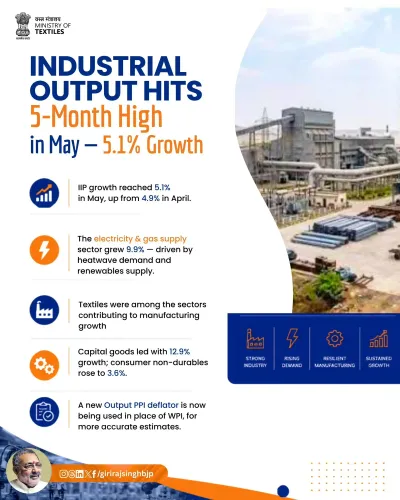
Upcoming IIP data and PMI manufacturing readings will indicate whether stated optimism converts into measurable output growth.
Union Textiles Minister Giriraj Singh on Wednesday, 1 July 2026 shared an assessment that India's manufacturing outlook remains resilient despite global headwinds, highlighting machine tools, metals, and the auto sector as the leading sources of optimism. The minister shared the post via the NaMo App, amplifying a report on industrial sentiment at a time of heightened global economic uncertainty.
Context
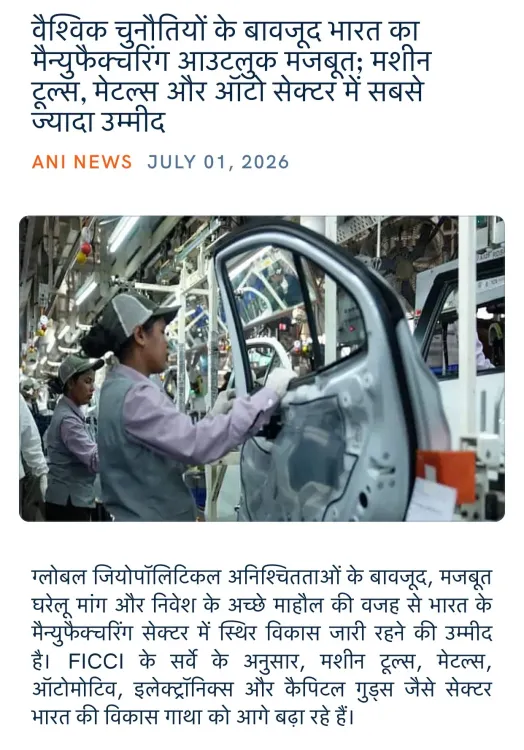
The post, written in Hindi, notes: 'वैश्विक चुनौतियों के बावजूद भारत का मैन्युफैक्चरिंग आउटलुक मजबूत' — 'India's manufacturing outlook is strong despite global challenges' — with machine tools, metals, and the auto sector cited as areas of greatest optimism. Singh shared this as part of broader government messaging on India's industrial trajectory, reinforcing the narrative that domestic manufacturing can withstand external pressures.
Global supply chains have faced persistent disruptions since 2020, driven by the pandemic aftermath, geopolitical tensions, and shifting trade patterns. Against this backdrop, periodic assessments of India's industrial sentiment have taken on added significance for policymakers and investors alike.
Policy Backdrop
India's manufacturing ambitions are anchored in a cluster of flagship initiatives. Make in India, launched in September 2014, set out to raise manufacturing's share of GDP and position the country as a global production hub. It was followed by the Production Linked Incentive (PLI) schemes, introduced from 2020 and subsequently extended to 14 sectors including automobiles and metals, offering output-linked financial incentives to domestic and foreign manufacturers.
The Atmanirbhar Bharat Abhiyan, announced in May 2020, added a self-reliance dimension — prioritising domestic value addition and reducing import dependence across critical sectors. Together, these policies have shaped a consistent government stance: use targeted incentives and FDI liberalisation to push manufacturing deeper into the economy.
Machine tools are a foundational input for virtually every manufacturing sub-sector, making optimism in that segment a bellwether for broader industrial health. Metals and auto components similarly sit at the upstream end of large value chains, so positive sentiment there typically signals wider production momentum.
Stakeholders and Impact
The sectors highlighted — machine tools, metals, and automobiles — collectively employ millions of workers and anchor large industrial clusters in states such as Maharashtra, Tamil Nadu, Gujarat, and Uttarakhand. Auto component makers and metal producers have been among the most active participants in PLI schemes, and their outlook directly influences capital expenditure decisions and hiring plans.
For the Ministry of Textiles, which Singh heads, manufacturing resilience in allied sectors matters because textile machinery depends heavily on domestic machine-tool capacity. A confident machine-tools industry therefore has downstream implications for textile modernisation as well.
Foreign investors and global supply-chain planners also watch India's manufacturing sentiment indices closely, particularly as companies seek to diversify production away from single-country dependencies.
What's Next
The next quarterly Index of Industrial Production (IIP) figures and the monthly Purchasing Managers' Index (PMI) for manufacturing will be the clearest test of whether the optimism Singh amplified translates into actual output growth. Any fresh PLI disbursements or tariff adjustments for the auto and metals sectors in the forthcoming Union Budget will also be closely watched.
If industrial sentiment in machine tools, metals, and autos holds, it would bolster the government's case that structural reforms since 2014 have made India's manufacturing base durable enough to absorb global shocks — a claim that will feature prominently in the run-up to budget season.
Point of View
Metals, and autos — three sectors with deep PLI linkages — the post implicitly credits the incentive architecture built since 2020. The timing, ahead of budget season, is unlikely to be coincidental: a resilient manufacturing story strengthens the case for continued or expanded PLI outlays. Neutral observers will note that sentiment surveys and actual IIP or PMI data do not always move in tandem, making the next set of hard numbers the real verdict on the optimism Singh has flagged.
NationPress
30 Sept 2026
Frequently Asked Questions
What did Giriraj Singh say about India's manufacturing sector?
On 1 July 2026, Union Textiles Minister Giriraj Singh shared an assessment stating that India's manufacturing outlook remains strong despite global challenges, with machine tools, metals, and the auto sector leading optimism.
Which sectors are driving India's manufacturing optimism in 2026?
Machine tools, metals, and the automobile sector have been identified as the three segments generating the most optimism in India's manufacturing landscape, according to the assessment shared by Minister Giriraj Singh.
What is the PLI scheme and how does it relate to this?
The Production Linked Incentive (PLI) scheme, introduced from 2020 and expanded to 14 sectors including automobiles and metals, offers output-linked financial incentives to manufacturers and is a key pillar of the government's strategy to boost domestic production.
What is Make in India and when was it launched?
Make in India is a flagship government programme launched in September 2014 to raise manufacturing's share of GDP, attract foreign direct investment, and position India as a global manufacturing hub.
How will we know if India's manufacturing optimism is backed by real growth?
The next quarterly Index of Industrial Production (IIP) data and monthly PMI manufacturing readings will be the primary indicators of whether the positive sentiment translates into actual output growth.