Giriraj Singh flags 8%+ India growth outlook for early 2026
Synopsis
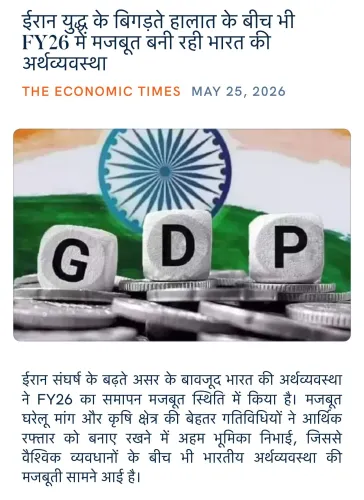
Union Textiles Minister Giriraj Singh amplified a forecast on the NaMo App projecting India's GDP growth above 8 per cent in early 2026, asserting resilience despite global oil-price shock concerns — continuing the BJP government's broader narrative of India as the world's fastest-growing major economy.
Key Takeaways
Giriraj Singh shared the growth forecast via the NaMo App on 8 June 2026 .
The post projects India's GDP growth above 8 per cent in early 2026.
The message explicitly flags resilience against global oil-price shock concerns.
India imports roughly 85 per cent of its crude oil, making energy prices a key macroeconomic risk.
The messaging aligns with the BJP government's Viksit Bharat 2047 developed-economy narrative.
Quarterly GDP data and the next Economic Survey will be the key verification points for the forecast.
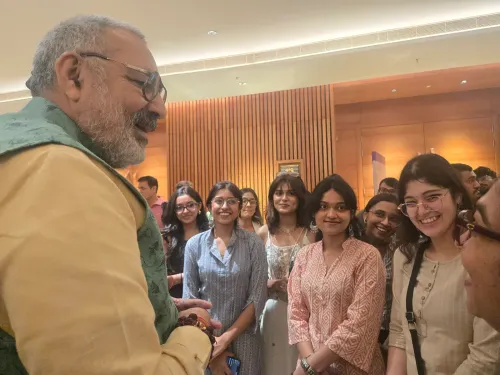
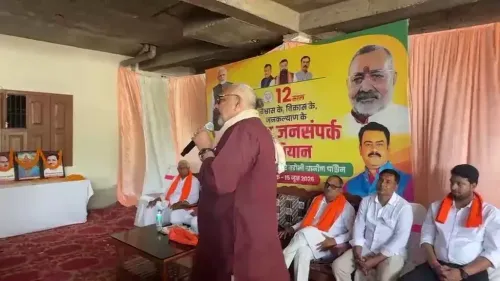
Union Textiles Minister Giriraj Singh on Monday, 8 June 2026 shared a macroeconomic forecast via the NaMo App, highlighting that India's growth is expected to remain above 8 per cent in early 2026 despite concerns over global oil-price shocks.
Context
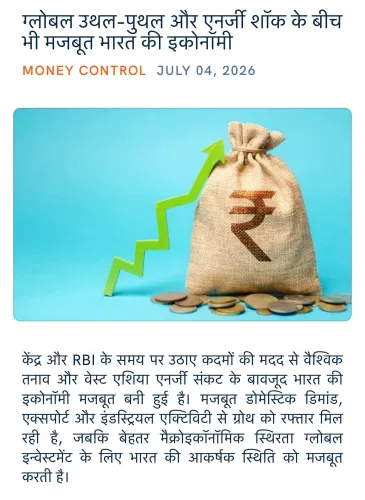
The post, shared in Hindi, reads: '2026 की शुरुआत में भारत की ग्रोथ 8%+ रहने की संभावना, तेल झटके की चिंताओं के बावजूद मजबूती बरकरार' — translated as 'India's growth likely to remain 8%+ in early 2026, resilience intact despite oil shock concerns.' The message was amplified through the NaMo App, a platform used by ministers and BJP leaders to disseminate official government messaging and policy highlights.
Giriraj Singh, a senior BJP leader and Lok Sabha MP from Begusarai, Bihar, holds the Textiles portfolio but has been an active voice in projecting India's broader economic strength on social media — a pattern common among non-finance ministers in the current government.
Policy Backdrop
India's ambition of sustained high growth has been underpinned by structural reforms including Production Linked Incentive (PLI) schemes across sectors and a significant ramp-up in infrastructure spending over successive Union Budgets. Economic Surveys since 2021 have repeatedly projected GDP growth above 7 per cent, with the government citing these reforms as a buffer against external headwinds.
Oil price volatility has historically been one of the most significant risks to India's macroeconomic stability, given that the country imports roughly 85 per cent of its crude oil requirements. The government has pointed to lessons from the 2014–16 and 2022 oil shock episodes to argue that policy preparedness — including strategic petroleum reserve utilisation and import diversification — has strengthened India's resilience over time.
The broader political messaging aligns with the BJP government's long-running narrative of positioning India as the fastest-growing major economy globally, a theme that has been central to official communications since the post-pandemic recovery phase and is tied to the Viksit Bharat 2047 vision of a developed economy by India's centenary of independence.
Stakeholders and Impact
A sustained above-8 per cent growth trajectory would carry significant implications for Indian businesses, investors, and exporters, particularly in capital-intensive sectors such as textiles, manufacturing, and infrastructure. For the textiles sector specifically — which Singh oversees — strong domestic demand and export competitiveness are directly linked to overall economic momentum.
Global investors tracking emerging markets have closely watched India's growth resilience relative to peers. Any confirmation of an 8 per cent-plus GDP print for early 2026 would reinforce India's standing as a preferred destination for foreign direct investment amid a slowing global economy.
What's Next
The release of the next Economic Survey and the quarterly GDP figures for early 2026 will be closely watched for any upward or downward revision to growth estimates. Government statements on oil import diversification and strategic petroleum reserve policy are also expected to shed light on how New Delhi plans to manage energy-price risks going forward. If the growth forecast holds, it is likely to feature prominently in the BJP's political messaging ahead of upcoming state elections and in India's engagement with multilateral economic forums.
Point of View
Where ministers across portfolios — not just finance — actively amplify positive macro data to reinforce the 'fastest-growing major economy' brand. Using the NaMo App as the distribution channel adds an official imprimatur that distinguishes it from a personal social media opinion. The explicit acknowledgement of oil-shock risks is notable: it signals the government is aware of the vulnerability but is choosing to front-foot the resilience narrative rather than downplay the threat. Whether the 8 per cent-plus projection materialises will be a significant political and economic test, with quarterly GDP data becoming a direct accountability marker for this messaging.
NationPress
20 Sept 2026
Frequently Asked Questions
What is India's GDP growth forecast for early 2026?
Union Textiles Minister Giriraj Singh shared a forecast projecting India's GDP growth above 8 per cent in early 2026, citing resilience despite global oil-price shock concerns.
Why is Giriraj Singh talking about the economy if he is the Textiles Minister?
Senior BJP ministers across portfolios have increasingly used social media and platforms like the NaMo App to amplify positive macroeconomic messaging, reinforcing the government's narrative of India as the fastest-growing major economy.
What is the NaMo App?
The NaMo App is a digital platform associated with Prime Minister Narendra Modi and the BJP that ministers and party leaders use to share official government statements, policy highlights, and political messaging.
How does oil price volatility affect India's economy?
India imports roughly 85 per cent of its crude oil, making it highly sensitive to global oil price swings; sustained high prices can widen the current account deficit, stoke inflation, and weigh on growth.
When will India's actual GDP growth figures for early 2026 be available?
Official quarterly GDP data from the Ministry of Statistics and Programme Implementation, along with the next Economic Survey, will provide verified figures against which the 8 per cent-plus projection can be assessed.