Giriraj Singh Flags 15% Merchandise Export Rise Amid Global Headwinds
Synopsis
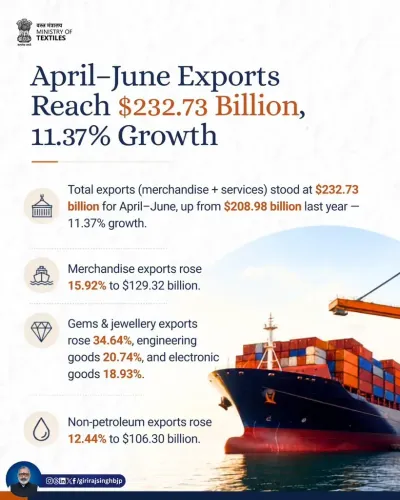
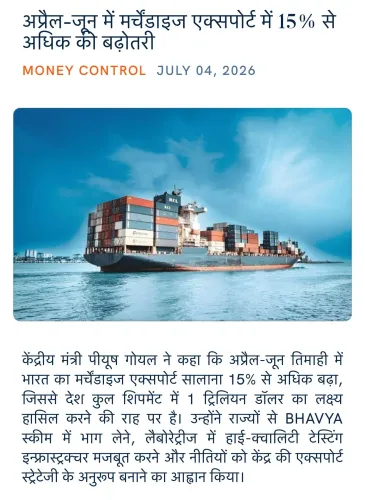
Union Textiles Minister Giriraj Singh on 22 June 2026 flagged a 15 per cent rise in India's merchandise exports for the April to 14 June 2026 period, framing it as a strong showing against a backdrop of global economic headwinds and India's long-term $2 trillion export target by 2030.
Key Takeaways
Union Textiles Minister Giriraj Singh posted on 22 June 2026 highlighting a 15 per cent rise in India's merchandise exports.
The growth covers the April to 14 June 2026 period, representing early first-quarter performance for the financial year.
India's Foreign Trade Policy 2023 sets a target of $2 trillion in total exports by 2030 .
Production Linked Incentive (PLI) schemes across 14 sectors , including textiles, are central to India's export competitiveness strategy.
Textiles, engineering goods, chemicals, and pharmaceuticals form the core of India's merchandise export basket.
The next official trade data release by the Ministry of Commerce and Industry will be key to confirming and contextualising the figure.
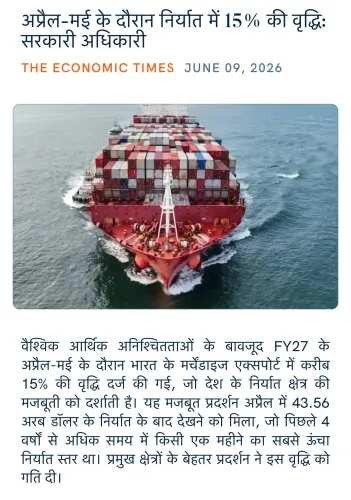
Union Textiles Minister Giriraj Singh on Monday, 22 June 2026 shared data highlighting a 15 per cent rise in India's merchandise exports during the April to 14 June 2026 period, calling it a strong performance despite prevailing global challenges.
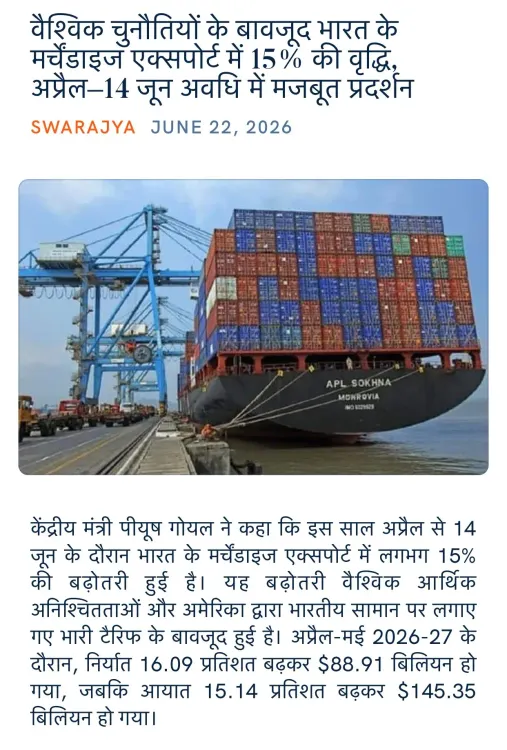
Posting on X via the NaMo App, the minister wrote: 'वैश्विक चुनौतियों के बावजूद भारत के मर्चेंडाइज एक्सपोर्ट में 15% की वृद्धि' — translated: 'India's merchandise exports rise 15% despite global challenges — strong performance in the April–14 June period.' The post underscores the government's confidence in India's export resilience at a time when several major economies are grappling with demand slowdowns and supply-chain disruptions.
Context
Merchandise export figures are tracked and released monthly by the Ministry of Commerce and Industry, and the numbers have shown significant quarterly volatility in recent years, driven by shifts in global demand, commodity price swings, and logistics bottlenecks. A 15 per cent year-on-year growth rate in the first quarter of the financial year, if sustained, would mark a notable rebound for an economy that has faced headwinds from softening demand in key Western markets. Textiles, engineering goods, chemicals, and pharmaceuticals form the backbone of India's merchandise export basket.
Policy Backdrop
India's export ambitions are anchored in the Foreign Trade Policy 2023, which replaced the 2015–20 policy and set a long-term target of $2 trillion in total exports by 2030. The policy lays out streamlined procedures for export promotion and market diversification beyond traditional partners. Complementing this, Production Linked Incentive (PLI) schemes — rolled out from 2020 across 14 sectors including textiles — have been designed to boost domestic value addition and make Indian goods more competitive in global markets.
As Union Textiles Minister, Giriraj Singh oversees a sector that is among India's top merchandise export earners, employing millions of workers across spinning, weaving, and garment manufacturing. The ministry has been pushing for greater integration of Indian textile exporters into global value chains, particularly as buyers seek alternatives to concentrated sourcing from a single geography.
Stakeholders and Impact
The data, if confirmed in the official monthly trade release, would be welcome news for exporters, manufacturers, and workers across labour-intensive sectors such as textiles, handicrafts, and engineering goods. A sustained upward trend would also strengthen India's case in ongoing Free Trade Agreement (FTA) negotiations, where export competitiveness is a key bargaining chip. Successive governments have pursued FTAs to open new markets in Europe, the Middle East, and Southeast Asia to diversify away from dependence on any single trade partner.
For Bihar-based constituencies and other textile-producing hubs, stronger export performance can translate into greater demand for raw materials and finished goods, supporting employment at the ground level.
What's Next
The next official monthly trade data release by the Ministry of Commerce and Industry will be closely watched to confirm and contextualise the 15 per cent growth figure for the April–June 2026 period. Any mid-year review of export incentive schemes — including PLI disbursements and remission of duties — could further shape the trajectory of merchandise exports in the second quarter. With the $2 trillion export target by 2030 firmly in view, the government is expected to use early-year momentum to build the case for sustained policy support to exporters.
Point of View
Particularly ahead of potential mid-year policy reviews. The choice to highlight a first-quarter number — rather than wait for a full-quarter official release — suggests the government is keen to project resilience at a time when global trade sentiment remains uncertain. For the Textiles Ministry specifically, strong export data reinforces the case for continued PLI disbursements and tariff support, giving the minister political and bureaucratic leverage in inter-ministerial budget discussions. Whether the momentum holds through the full quarter will determine how much policy capital the government can draw from this early signal.
NationPress
21 Sept 2026
Frequently Asked Questions
What is the merchandise export growth rate India reported for April to June 2026?
Union Textiles Minister Giriraj Singh cited a 15 per cent rise in India's merchandise exports for the April to 14 June 2026 period, describing it as a strong performance against global headwinds.
What is India's merchandise export target by 2030?
India's Foreign Trade Policy 2023 sets a target of $2 trillion in total exports — merchandise and services combined — by 2030 , with manufacturing-led merchandise exports expected to be a major driver.
What is the PLI scheme and how does it help Indian exports?
The Production Linked Incentive (PLI) scheme , introduced from 2020 across 14 sectors including textiles, provides financial incentives to manufacturers who increase domestic production, helping make Indian goods more price-competitive in global markets.
Which sectors drive India's merchandise exports?
India's merchandise export basket is led by textiles, engineering goods, chemicals, and pharmaceuticals , with each sector benefiting from a mix of PLI incentives, duty remission schemes, and bilateral trade agreements.
Who is Giriraj Singh and why is he commenting on export data?
Giriraj Singh is India's Union Minister of Textiles , a senior BJP leader and Lok Sabha MP from Begusarai, Bihar . As textiles minister, he has a direct stake in export performance since the sector is one of India's top merchandise export earners.