Giriraj Singh Hails 11.37% Export Rise in Q1 FY2026
Synopsis
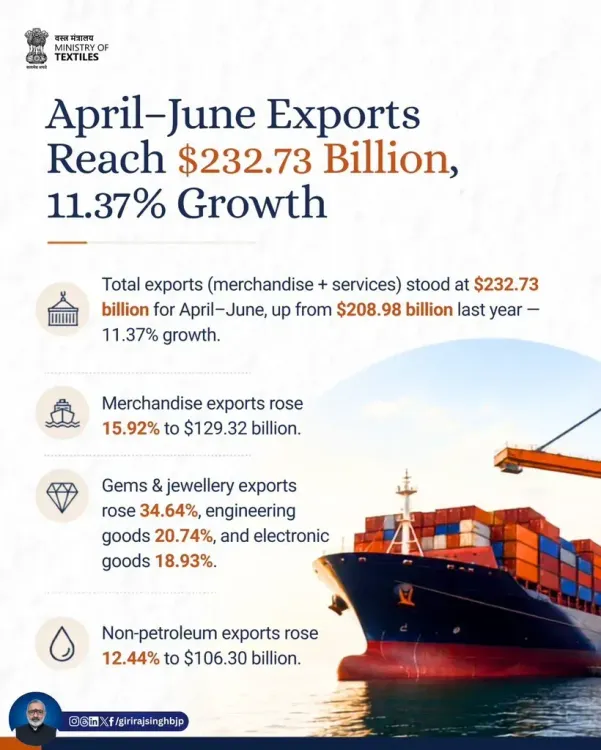
Union Textiles Minister Giriraj Singh has welcomed India's April–June 2026 export figures, citing 11.37% growth to USD 232.73 billion and attributing the performance to PM Modi's decade-long policy push on manufacturing, Ease of Doing Business and self-reliance initiatives.
Key Takeaways
Union Textiles Minister Giriraj Singh posted on 18 July 2026 welcoming India's first-quarter export data.
India's total exports for April–June 2026 reached USD 232.73 billion , a rise of 11.37 per cent year-on-year according to the post.
Singh credited Prime Minister Narendra Modi 's leadership and central government policies on industry, exports and Ease of Doing Business .
The post referenced three flagship policy frameworks: Make in India (2014), Atmanirbhar Bharat (2020) and Viksit Bharat 2047 (2023).
India's Ease of Doing Business World Bank ranking improved from 142nd to 63rd between 2014 and 2020 under related reforms.
Detailed sector-wise trade data from the Ministry of Commerce and Industry is awaited to identify which export categories led the growth.
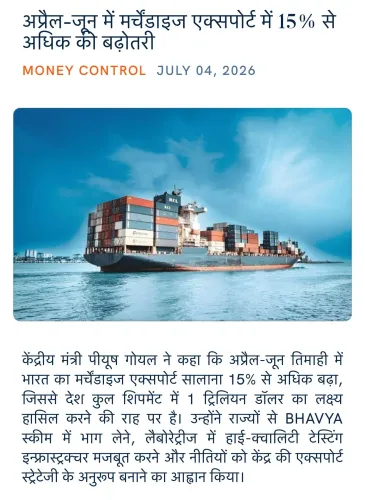
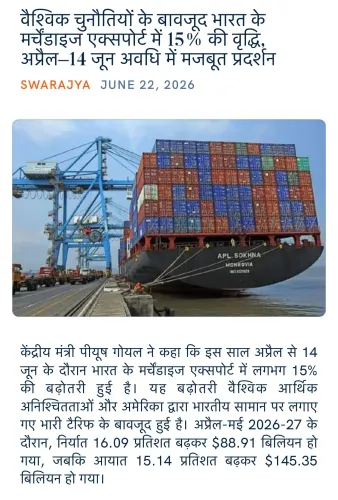
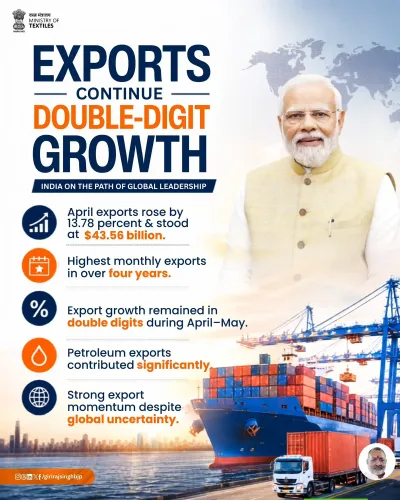
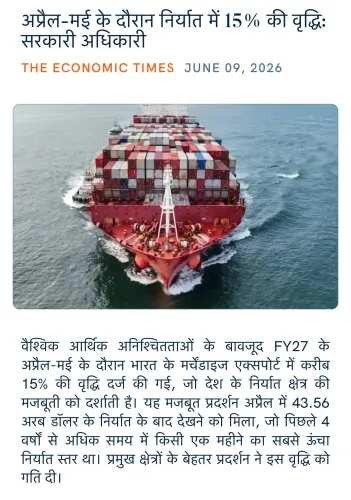
Union Textiles Minister Giriraj Singh on Saturday, 18 July 2026 welcomed India's merchandise export performance for the April–June 2026 quarter, citing an 11.37 per cent year-on-year rise that pushed total exports to USD 232.73 billion, calling the figures proof of the country's growing credibility and competitiveness in global markets.
Context
Posting in Hindi on X, Giriraj Singh described the quarterly export numbers as 'उत्साहवर्धक' (encouraging), stating that reaching USD 232.73 billion in a single quarter reflects India's rising stature as a reliable trade partner. He attributed the performance directly to the policy direction set by Prime Minister Narendra Modi, crediting reforms around industry promotion, export facilitation and Ease of Doing Business. The minister's post carried the hashtags #AtmanirbharBharat, #MakeInIndia and #ViksitBharat2047, signalling alignment with the government's long-term economic framework.
Policy Backdrop
The export push Singh referenced draws from a decade-long policy architecture. Make in India, launched in September 2014, was designed to position India as a global manufacturing destination by easing regulations and attracting investment into domestic production. The Atmanirbhar Bharat package, announced in May 2020, layered production-linked incentives and export-promotion components on top of that foundation.
India's Ease of Doing Business reforms, pursued continuously since 2014, helped improve the country's World Bank ranking from 142nd to 63rd by 2020. The Viksit Bharat 2047 vision, outlined in 2023, frames sustained export growth as central to achieving developed-economy status by the centenary of independence. Together, these programmes constitute the policy lineage Singh's post implicitly invokes.
Stakeholders and Impact
The sectors most directly affected by quarterly export trends include large manufacturers, MSMEs and the broader exporter community that relies on government-backed incentive schemes and trade facilitation infrastructure. A strong first-quarter showing, if sustained, typically feeds into improved capacity utilisation, employment and foreign-exchange earnings across goods-exporting industries.
Global supply-chain diversification has also created structural tailwinds for Indian exporters, as multinational buyers seek alternative sourcing locations. Giriraj Singh's own portfolio — textiles — is among the sectors that stand to benefit from both domestic policy support and shifting global procurement patterns, making his commentary on aggregate export data particularly pointed.
What's Next
The Ministry of Commerce and Industry is expected to release detailed sector-wise trade data that will clarify which categories drove the quarterly expansion. Parliamentary scrutiny of new trade agreements and potential expansions of production-linked incentive schemes will be the next formal arena where these export figures are likely to be cited. Whether the 11.37 per cent growth rate holds through subsequent quarters will determine how much political weight the government can place on this data heading into the next budget cycle.
Point of View
Deploying three flagship programme names in a single message to reinforce a decade-long government narrative. By framing aggregate export data through the lens of 'Make in India,' 'Atmanirbhar Bharat' and 'Viksit Bharat 2047,' the minister links a quarterly statistic to a much longer political arc — one the BJP has consistently used to distinguish its economic governance from predecessor administrations. As Textiles Minister, Singh's interest in export competitiveness is also sectoral, not merely rhetorical, which gives the statement a dual function: political signalling and portfolio advocacy. The real test of the narrative will come when sector-wise data reveals whether broad-based growth or concentration in a few commodity categories drove the headline number.
NationPress
17 Oct 2026
Frequently Asked Questions
What were India's exports in the April–June 2026 quarter?
According to Union Textiles Minister Giriraj Singh's post on 18 July 2026, India's total exports in the April–June 2026 quarter reached USD 232.73 billion, representing an 11.37 per cent year-on-year increase.
What is Viksit Bharat 2047?
Viksit Bharat 2047 is a long-term vision outlined by the Indian government in 2023, targeting developed-economy status for India by 2047 — the centenary of independence — with sustained export and trade expansion as a central pillar.
What is Atmanirbhar Bharat and how does it relate to exports?
Atmanirbhar Bharat, announced in May 2020, is a self-reliance economic initiative that includes production-linked incentives and export-promotion components aimed at reducing import dependence and boosting domestic manufacturing for global markets.
Why did Giriraj Singh comment on export data?
As Union Textiles Minister and a senior BJP leader, Giriraj Singh commented to attribute the strong quarterly export performance to the central government's decade-long policy reforms, including Make in India, Ease of Doing Business improvements and Atmanirbhar Bharat.
How has India's Ease of Doing Business ranking changed under Modi?
India's World Bank Ease of Doing Business ranking improved from 142nd to 63rd between 2014 and 2020 as the central government implemented successive rounds of regulatory simplification and procedural reforms.