Giriraj Singh Hails India's April Exports at $43.56 Billion
Synopsis
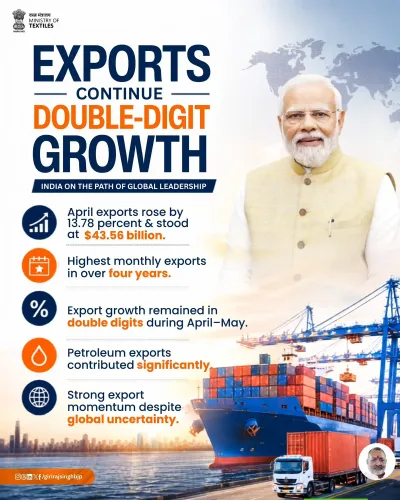
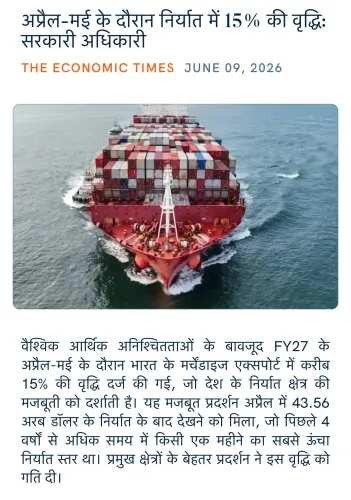
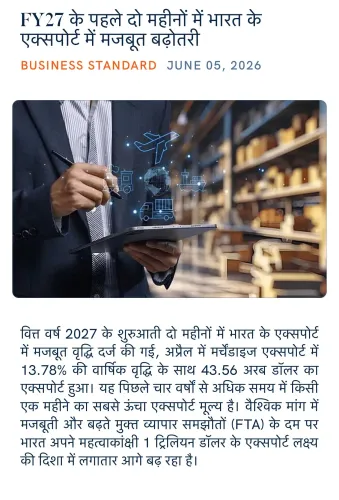
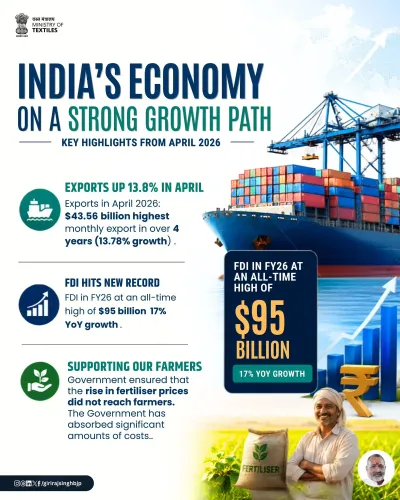
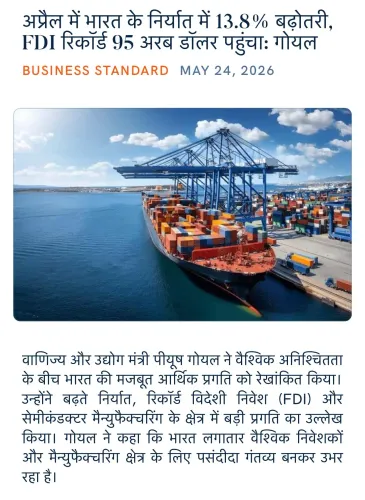
Union Textiles Minister Giriraj Singh on 2 June 2026 amplified official data showing India's merchandise exports reached $43.56 billion in April 2026, recording double-digit growth — a signal the government is using to underscore the impact of its trade and manufacturing policies.
Key Takeaways
Union Textiles Minister Giriraj Singh shared India's April 2026 export figures via the NaMo App on 2 June 2026 .
India's merchandise exports reached $43.56 billion in April 2026 , recording double-digit growth .
The data is compiled and released by the Ministry of Commerce and Industry .
India's exports had previously crossed the $400 billion annual mark in FY 2021-22 .
The Foreign Trade Policy 2023 and PLI schemes across 14 sectors form the structural backbone of India's export push.
Textiles is among India's most employment-intensive export sectors, giving the minister a direct stake in positive trade outcomes.
Union Textiles Minister Giriraj Singh on Tuesday, 2 June 2026 shared data showing India's merchandise exports reached $43.56 billion in April 2026, recording double-digit growth, amplifying the figures through the NaMo App to highlight the country's trade momentum.
Context
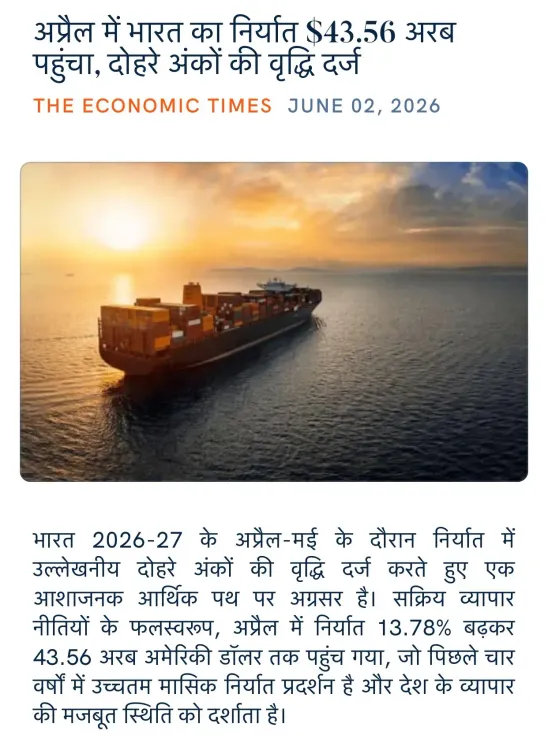
The post, shared in Hindi, reads: 'अप्रैल में भारत का निर्यात $43.56 अरब पहुंचा, दोहरे अंकों की वृद्धि दर्ज' ['India's exports reached $43.56 billion in April, double-digit growth recorded']. The figures cited relate to official monthly merchandise trade data compiled by the Ministry of Commerce and Industry, which releases these statistics to track the health of India's external trade sector.
Double-digit export growth, if sustained, would mark a significant acceleration at a time when global demand conditions remain uneven. Ministers across economic portfolios routinely amplify monthly trade releases as a signal of policy effectiveness.
Policy Backdrop
India's export push has deep structural roots. Following liberalisation in 1991, successive governments have used trade policy as a lever for growth and employment. Merchandise exports crossed the landmark $400 billion threshold in FY 2021-22, driven by post-pandemic recovery and sector diversification.
The Foreign Trade Policy 2023 — a five-year framework — replaced its predecessor with a mandate to simplify procedures, reduce compliance burdens, and scale up export volumes through targeted incentives. Alongside it, Production Linked Incentive (PLI) schemes, rolled out from 2020 across 14 sectors, have aimed to deepen domestic manufacturing capacity and improve export competitiveness.
The Atmanirbhar Bharat initiative has further framed export growth as integral to self-reliance, encouraging value-added manufacturing over raw-material shipments.
Stakeholders and Impact
The beneficiaries of sustained export growth span a wide base: large exporters, MSME manufacturers, logistics providers, and workers in labour-intensive sectors. Textiles — the portfolio held by Giriraj Singh — is among the most employment-intensive export categories in India, making trade data particularly resonant for the minister's constituency and communication.
For Bihar-based industries and smaller manufacturing clusters, strong national export numbers can translate into order flows and job creation, giving the minister a direct political stake in amplifying positive trade signals.
Global headwinds — including supply-chain realignments and demand softness in key markets such as the United States and Europe — have made consistent double-digit growth harder to achieve, lending additional weight to the April figures if confirmed by the commerce ministry's full release.
What's Next
Attention will now turn to the May 2026 trade data release by the Ministry of Commerce and Industry, which will indicate whether April's growth trajectory is holding. Any mid-term review or revision to the Foreign Trade Policy 2023 targets will also be closely watched by exporters and industry bodies.
If double-digit growth is sustained through the first quarter of FY 2026-27, it would strengthen the government's case that structural reforms — from PLI incentives to trade facilitation — are translating into measurable export gains, potentially influencing budget allocations and sector-specific policy tweaks in the months ahead.
Point of View
If verified in the commerce ministry's full release, would be a meaningful data point for a government navigating global trade uncertainty. As Textiles Minister, Singh's interest in broadcasting trade gains extends beyond optics: a strong overall export number typically buoys textile-specific order flows, reinforcing the case for continued PLI and FTP support for his sector. The broader arc here is India's decade-long effort to position itself as a credible alternative manufacturing and export hub — and ministers across portfolios increasingly serve as real-time amplifiers of that story.
NationPress
22 Sept 2026
Frequently Asked Questions
What were India's merchandise exports in April 2026?
India's merchandise exports reached $43.56 billion in April 2026, recording double-digit growth, according to data shared by Union Textiles Minister Giriraj Singh.
Why did Giriraj Singh share India's export data?
As a senior cabinet minister and BJP leader, Giriraj Singh shared the export figures via the NaMo App to highlight India's trade performance and signal the effectiveness of government economic policies.
What is the Foreign Trade Policy 2023?
The Foreign Trade Policy 2023 is a five-year framework introduced by the Ministry of Commerce and Industry to simplify export-import procedures, reduce compliance burdens, and scale up India's export volumes through targeted incentives.
How have PLI schemes helped India's exports?
Production Linked Incentive (PLI) schemes , rolled out from 2020 across 14 sectors, have strengthened domestic manufacturing capacity and improved the competitiveness of Indian goods in global markets, supporting the country's export growth trajectory.
When did India's annual exports first cross $400 billion?
India's merchandise exports crossed the $400 billion annual mark for the first time in FY 2021-22 , driven by post-pandemic recovery and diversification across sectors.