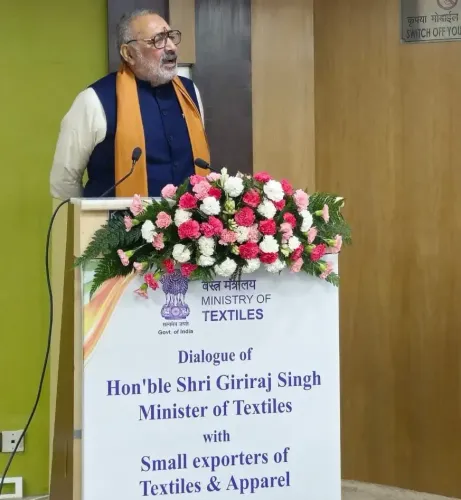
Giriraj Singh Hails $863 Bn Export Milestone Amid Global Headwinds
Synopsis
Union Textiles Minister Giriraj Singh on 18 June 2026 highlighted official data showing India's exports have reached $863 billion, framing the figure as proof of resilience against US tariffs and West Asia-linked trade disruptions. The post reinforces the government's Atmanirbhar Bharat and Foreign Trade Policy 2023 narrative.
Key Takeaways
Union Textiles Minister Giriraj Singh shared data on 18 June 2026 showing India's exports at $863 billion .
The milestone was achieved despite headwinds from US tariffs and West Asia tensions affecting shipping routes.
India's export framework rests on the Atmanirbhar Bharat PLI schemes (2020) and the Foreign Trade Policy 2023 .
Bilateral trade pacts with the UAE and Australia have helped diversify India's export markets.
Textile MSMEs — directly under Singh's ministerial portfolio — are among the key beneficiaries of sustained export demand.
Next quarterly Commerce Ministry data and progress in US-India trade negotiations will be the critical near-term indicators.
Union Textiles Minister Giriraj Singh on Thursday, 18 June 2026, shared data highlighting that India's merchandise and services exports have reached $863 billion, even as the country navigated the twin pressures of US tariffs and West Asia tensions. The post, shared via the NaMo App on his official X account, signals the ruling dispensation's intent to project macroeconomic resilience ahead of further trade negotiations.
Context
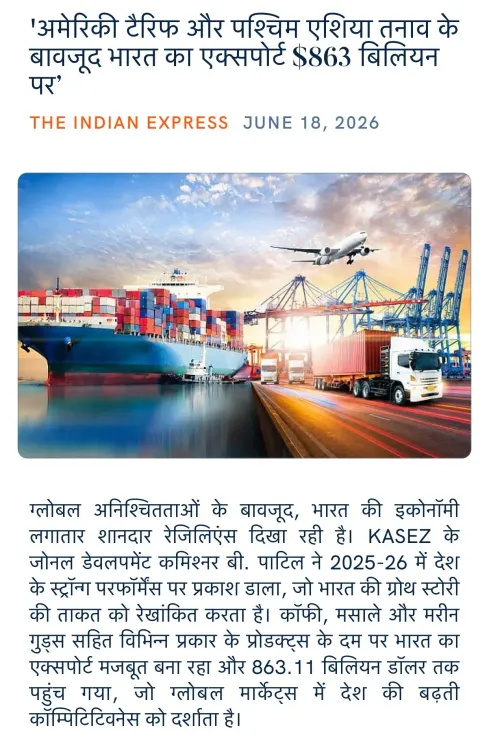
Singh's post, written in Hindi, reads: 'अमेरिकी टैरिफ और पश्चिम एशिया तनाव के बावजूद भारत का एक्सपोर्ट $863 बिलियन पर' — translating to 'India's exports at $863 billion despite US tariffs and West Asia tensions.' The figure, cited from official trade data, is being highlighted by a senior Cabinet minister as evidence that India's export engine has held firm through a turbulent global environment.
The post comes at a time when Indian exporters — particularly in textiles, gems, and engineering goods — have faced headwinds from periodic US tariff actions and elevated shipping costs linked to instability in West Asia, which affects key Red Sea trade routes used by Indian cargo vessels.
Policy Backdrop
The export performance sits on a policy architecture built over several years. The Atmanirbhar Bharat initiative, launched in 2020, introduced Production-Linked Incentive (PLI) schemes across sectors to raise the competitiveness of domestic manufacturing and push exports up the value chain. That was followed by the Foreign Trade Policy 2023, a five-year framework that replaced the 2015-20 policy and set an ambitious roadmap for both merchandise and services exports through procedural simplification and new incentives.
India has also signed bilateral trade agreements with the UAE and Australia since 2020, part of a deliberate effort to diversify export destinations away from traditional partners and reduce exposure to any single market's tariff decisions. The Ministry of Commerce and Industry has periodically released data underscoring overall export resilience even during episodic global shocks.
Stakeholders and Impact
For Indian textile MSMEs — a constituency directly under Giriraj Singh's ministerial remit — the $863 billion headline figure carries particular weight. The textiles sector is among India's largest export earners and one of the most sensitive to both US trade policy and raw-material supply chains that pass through West Asian shipping lanes.
Broader Indian exporters in sectors such as engineering goods, pharmaceuticals, and gems and jewellery also stand to benefit from the political signal this data point sends: that the government views the current export trajectory as a vindication of its trade diversification strategy. For textile MSMEs in states like Bihar, Gujarat, and Tamil Nadu, sustained export demand translates directly into employment and working-capital stability.
What's Next
Attention will now turn to the next quarterly trade data release by the Ministry of Commerce and Industry, which will indicate whether the $863 billion run-rate is sustainable through the second half of 2026. Ongoing US-India trade negotiations — which touch directly on tariff structures for textiles and steel — will be a key variable, as will any further escalation or de-escalation of tensions in West Asia that could affect Red Sea shipping costs and delivery timelines.
As India pursues its long-stated goal of becoming a major global manufacturing and export hub, milestones like this are likely to be amplified by ministers across portfolios, framing export data as both an economic and a political narrative of self-reliance and resilience.
Point of View
Amplifying an $863 billion figure serves a dual purpose: reassuring industry and reinforcing the Atmanirbhar Bharat brand. The timing, amid documented US tariff pressures and West Asia instability, makes the signal deliberate rather than incidental. Watched alongside the Foreign Trade Policy 2023 targets, this data point will be a benchmark the government is now publicly committed to defending.
NationPress
19 Sept 2026
Frequently Asked Questions
What is India's total export figure highlighted by Giriraj Singh?
Giriraj Singh highlighted that India's exports have reached $863 billion , sharing the data on 18 June 2026 via his X account.
How have US tariffs affected India's exports?
US tariff actions have periodically created headwinds for Indian exporters, particularly in textiles and steel, though the $863 billion figure suggests overall export momentum has been maintained despite these pressures.
What is the Foreign Trade Policy 2023?
The Foreign Trade Policy 2023 is a five-year framework launched by the Indian government to boost merchandise and services exports through procedural simplification and new incentives, replacing the earlier 2015-20 policy.
Why do West Asia tensions affect Indian exports?
West Asia tensions disrupt key Red Sea shipping lanes used by Indian cargo vessels, raising freight costs and delivery times for exporters across sectors including textiles, engineering goods, and chemicals.
What is Atmanirbhar Bharat and how does it relate to exports?
Atmanirbhar Bharat , launched in 2020, is India's self-reliance initiative that introduced Production-Linked Incentive schemes to raise domestic manufacturing competitiveness and push exports up the value chain across multiple sectors.