Giriraj Singh Flags Strong Export Growth in FY27's First Two Months
Synopsis
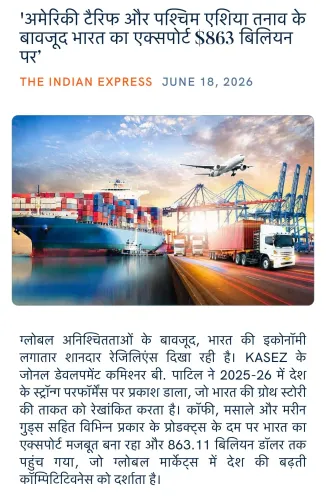
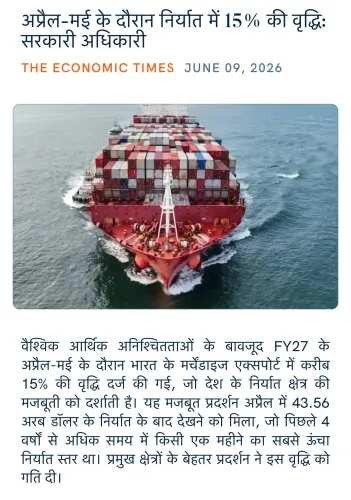
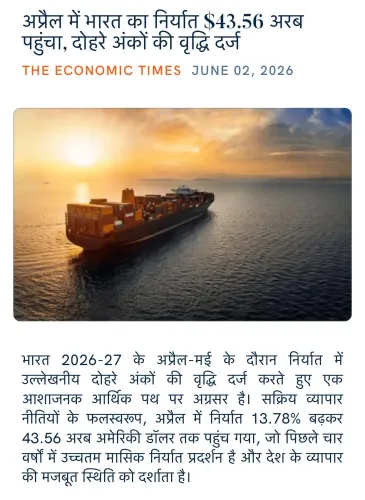
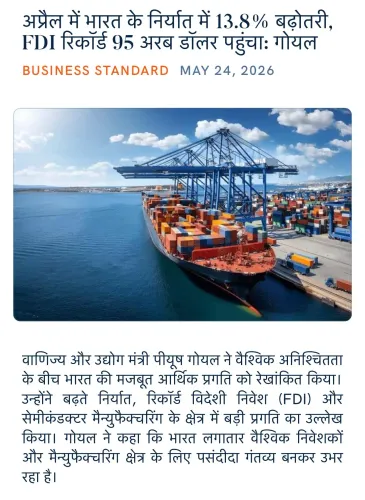
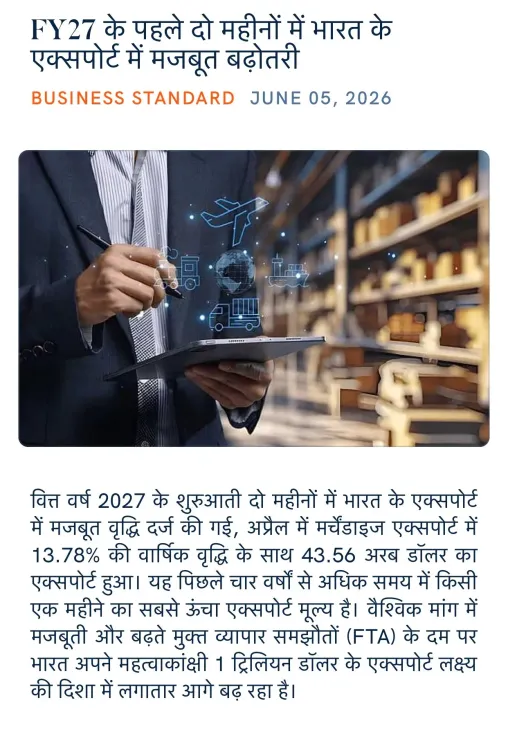
Union Textiles Minister Giriraj Singh flagged strong growth in India's exports in the first two months of FY2026-27, amplifying the trade data via the NaMo App on June 5, 2026, as the government pushes toward its $2 trillion export target by 2030.
Key Takeaways
Union Textiles Minister Giriraj Singh highlighted robust export growth in the first two months of FY2026-27 on June 5, 2026 .
India's Foreign Trade Policy 2023 targets $2 trillion in exports by 2030 , forming the strategic backdrop for the announcement.
The Make in India initiative (launched September 2014 ) and PLI schemes (from 2020 ) are key policy drivers behind export growth efforts.
The RoDTEP scheme (2021) provides WTO-compliant export incentives that support exporters, including in the textiles sector.
MSME exporters and textile manufacturers are among the primary stakeholders who benefit from sustained export momentum.
Monthly Commerce Ministry trade data releases will be critical to tracking whether FY27's early growth trend is sustained.
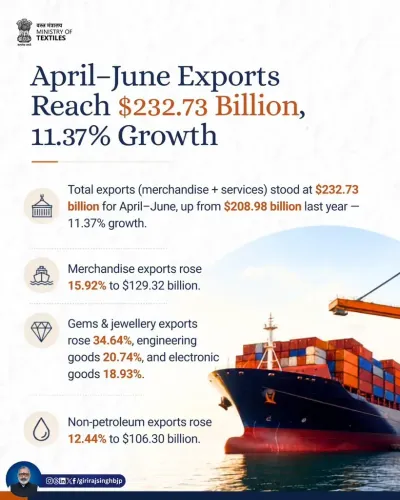
Union Textiles Minister Giriraj Singh on Friday, June 5, 2026, highlighted robust growth in India's merchandise exports during the first two months of FY2026-27, sharing the development via the NaMo App and his official X account.
Context
Singh's post, captioned 'FY27 ke pehle do mahinon mein Bharat ke export mein mazboot badhotri' (Strong growth in India's exports in the first two months of FY27), draws attention to early trade momentum in the current fiscal year. The post comes as the government continues to emphasise export-led growth as a pillar of economic strategy. As a senior BJP leader and Lok Sabha MP from Begusarai, Bihar, Singh regularly amplifies positive economic indicators, particularly those touching manufacturing and trade.
Policy Backdrop
India's export ambitions are anchored in the Foreign Trade Policy 2023, which set a target of $2 trillion in exports by 2030 while streamlining procedures and expanding market access. The policy builds on earlier frameworks including the Make in India initiative — launched in September 2014 — which aimed to raise manufacturing's share in GDP and grow merchandise exports across priority sectors. The RoDTEP (Remission of Duties and Taxes on Exported Products) scheme, introduced in 2021, replaced earlier incentive mechanisms to bring India in line with WTO norms and provide more predictable support to exporters.
Production-Linked Incentive (PLI) schemes, rolled out from 2020 onward, have further targeted investment attraction and export scaling in sectors including electronics and textiles. Textiles — the minister's own portfolio — remain among India's most employment-intensive export categories, and any uptick in overall trade data carries particular significance for the sector.
Stakeholders and Impact
MSME exporters and textile manufacturers stand to benefit most directly from sustained export momentum, as these segments depend heavily on global demand and government-backed incentive structures. A strong start to FY27 could reinforce confidence among exporters who have navigated supply-chain disruptions and shifting global trade patterns over recent years. Broader manufacturing communities invested in Make in India and PLI-linked production will also watch the trend closely.
India has been actively diversifying its export destinations beyond traditional markets, pursuing bilateral and regional trade agreements to reduce dependence on any single geography. A robust FY27 opening would lend weight to arguments that these diversification efforts are bearing results.
What's Next
The Commerce Ministry's monthly trade data releases will be the key data points to watch through FY2026-27, as they will confirm whether the early momentum is sustained or represents a seasonal spike. Any new Free Trade Agreements or reviews of existing agreements during this period could further shape the export trajectory. With the government's $2 trillion export target by 2030 still several years out, consistent quarterly performance will be critical to keeping that goal within reach.
Point of View
His amplification of broad merchandise export data — beyond his own portfolio — suggests a coordinated effort to project macroeconomic momentum. The move fits a well-established pattern of senior ministers using digital platforms to front-run official data releases with positive framing. Whether the early growth is broad-based or concentrated in a few sectors will determine how durable this narrative proves to be.
NationPress
21 Oct 2026
Frequently Asked Questions
What did Giriraj Singh say about India's exports in FY27?
Giriraj Singh highlighted that India's exports posted strong growth in the first two months of FY2026-27, sharing the development via his X account and the NaMo App on June 5, 2026.
What is India's export target for 2030?
India's Foreign Trade Policy 2023 set a target of $2 trillion in total exports — merchandise and services combined — by the year 2030.
What schemes support India's export growth?
Key schemes include the Production-Linked Incentive (PLI) programmes (from 2020), the RoDTEP scheme (2021) for duty remission, and the broader Make in India initiative launched in September 2014.
Why is Giriraj Singh commenting on export data?
As Union Textiles Minister and a senior BJP leader, Singh regularly highlights positive economic indicators, particularly those related to manufacturing and trade, which are closely linked to his ministerial portfolio.
Which sectors benefit most from India's export growth in FY27?
MSME exporters and textile manufacturers are among the primary beneficiaries of sustained export momentum, given their dependence on global demand and government incentive structures.