Giriraj Singh flags record $43.56 bn exports, $95 bn FDI in FY26
Synopsis
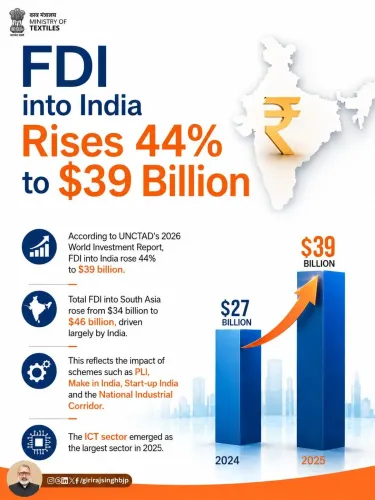
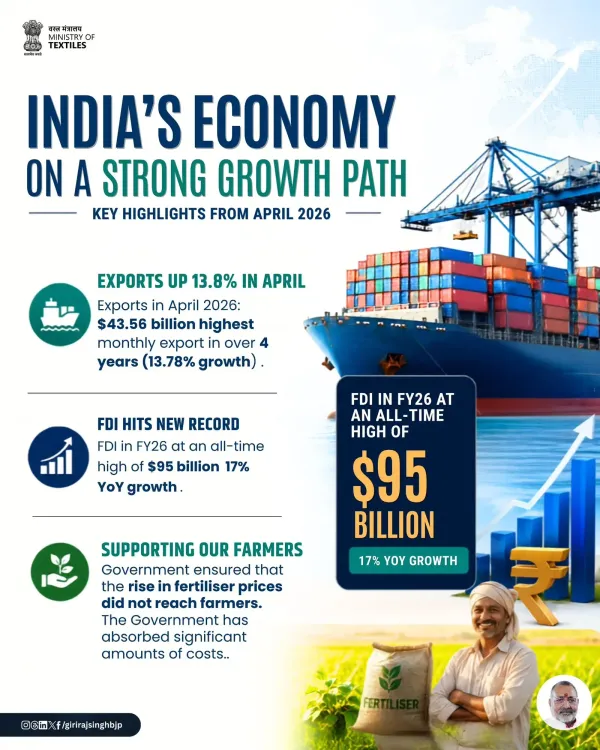
Union Textiles Minister Giriraj Singh posted on X citing April 2026 merchandise exports of $43.56 billion and FY26 FDI of $95 billion as evidence of record economic momentum under PM Narendra Modi's policies, invoking the Atmanirbhar Bharat and Viksit Bharat frameworks.
Key Takeaways
Giriraj Singh posted on June 1, 2026 citing two headline economic figures attributed to PM Modi 's policies.
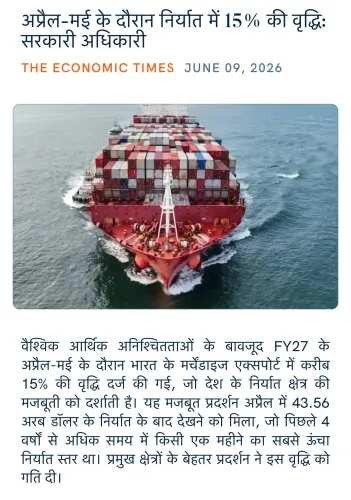
Merchandise exports in April 2026 reportedly hit a record $43.56 billion , the highest single-month figure cited by the minister.
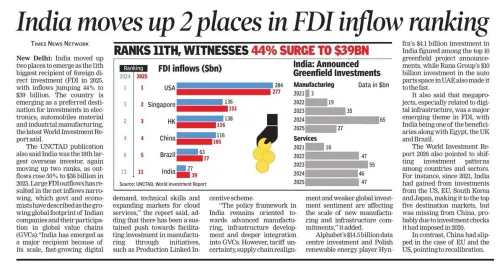
FDI inflows in FY26 were stated at a historic $95 billion , up from previous fiscal benchmarks.
The post invokes both Atmanirbhar Bharat (self-reliant India, launched May 2020) and Viksit Bharat (developed India by 2047) as the policy frameworks behind the numbers.
Formal verification of both figures awaits official Commerce Ministry trade and FDI data releases.
The figures are expected to feature prominently in government messaging ahead of the monsoon session of Parliament .
Union Textiles Minister Giriraj Singh on Monday, June 1, 2026 cited record merchandise exports and foreign direct investment figures to credit Prime Minister Narendra Modi's economic policies, posting on X that India is advancing on a growth path under what he called 'strong and empowering policies.'
Context
In his post, Singh stated that exports in April 2026 touched a record $43.56 billion, while FDI inflows in FY26 reached a historic $95 billion. Writing in Hindi, he said: 'यह आंकड़े आत्मनिर्भर और मजबूत भारत के बढ़ते कदमों का प्रतीक हैं' — ['These figures are a symbol of the growing strides of a self-reliant and strong India.']. The post was accompanied by an image and hashtagged #AtmanirbharBharat and #ViksitBharat.
Policy Backdrop
The claims fit squarely within a decade-long policy arc. Since the Make in India campaign launched in September 2014, successive administrations under Modi have progressively liberalised FDI norms across sectors, introduced production-linked incentive schemes, and pushed export diversification to embed India deeper into global value chains. The Atmanirbhar Bharat initiative, unveiled in May 2020, sharpened that focus by coupling import substitution with an outward export orientation — a combination the government regularly invokes when presenting trade and investment data.
The Viksit Bharat vision — India's stated goal of becoming a developed economy by 2047 — provides the longer-term narrative frame within which milestones on exports and FDI are routinely contextualised by senior ministers and officials.
Stakeholders and Impact
A sustained rise in merchandise exports directly benefits Indian exporters — from textiles and engineering goods to pharmaceuticals and electronics — by expanding order books and foreign-exchange earnings. Record FDI inflows, if sustained, translate into capital formation, technology transfers, and job creation, particularly in manufacturing corridors that the government has been developing under its industrial policy framework.
For foreign investors, the headline numbers reinforce India's positioning as a preferred destination amid global supply-chain realignments. However, the quality and sectoral composition of FDI — whether it flows into greenfield manufacturing or financial assets — will determine the depth of its economic impact.
What's Next
Formal monthly trade statistics and the annual FDI tally are released by the Commerce Ministry and are expected to provide granular, officially audited breakdowns of the figures cited. Any divergence between ministerial claims and published data will be closely scrutinised. The figures are also likely to feature in government messaging ahead of the monsoon session of Parliament, where the economic record of the ruling dispensation is routinely debated. Sustained performance on both indicators would strengthen India's case for further sovereign credit-rating upgrades and multilateral investment commitments.
Point of View
Viksit Bharat — to hard headline numbers to make abstract policy feel tangible. As a senior cabinet minister whose own portfolio (textiles) is a major export contributor, his amplification of trade data carries more institutional weight than a backbencher's post. The timing, on the first day of June, likely anticipates an official data release cycle and positions the BJP ahead of parliamentary scrutiny. The pattern — record claims followed by formal data confirmation or qualification — has become a recurring feature of India's economic communication strategy since 2014.
NationPress
19 Sept 2026
Frequently Asked Questions
What did Giriraj Singh say about India's economy on June 1 2026?
Union Textiles Minister Giriraj Singh posted on X stating that India recorded exports of $43.56 billion in April 2026 and FDI inflows of $95 billion in FY26, crediting these milestones to PM Narendra Modi's economic policies.
What is India's export figure for April 2026?
According to Giriraj Singh's post, India's merchandise exports in April 2026 reached a record $43.56 billion. Official confirmation is expected from the Commerce Ministry's formal data release.
What is Atmanirbhar Bharat?
Atmanirbhar Bharat, meaning 'self-reliant India,' is an initiative launched by PM Narendra Modi in May 2020 to boost domestic production, reduce import dependence, and strengthen India's position in global supply chains.
What is India's FDI in FY26?
Giriraj Singh cited FDI inflows of $95 billion for FY26, describing it as a historic figure. The official annual FDI tally is released by the Commerce Ministry and will provide a verified breakdown.
What is Viksit Bharat?
Viksit Bharat is the Indian government's vision to transform India into a fully developed nation by 2047, the centenary of independence, and is frequently cited as the long-term goal underpinning current economic policies.