Giriraj Singh Hails 44% FDI Jump, India Climbs UN Rankings
Synopsis
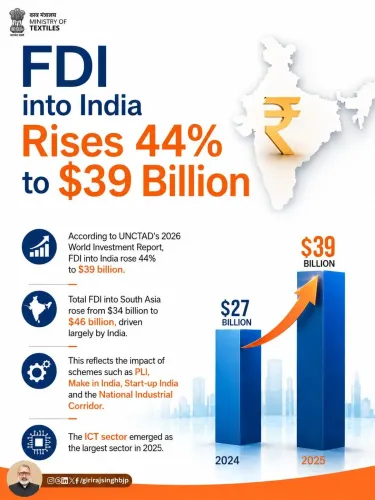
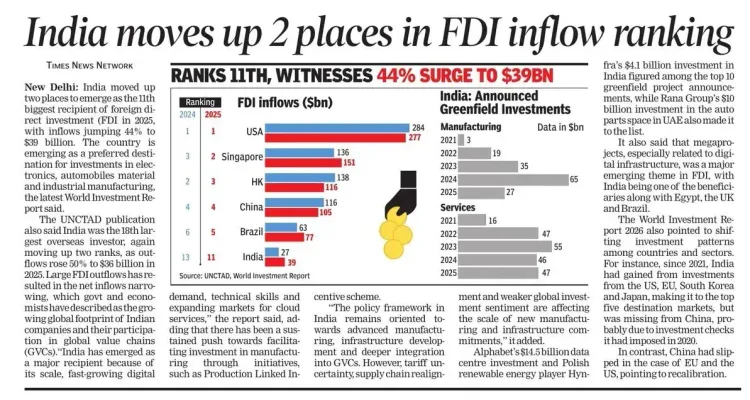
Union Textiles Minister Giriraj Singh cited a UN report showing India's FDI inflows rose 44% from $27 billion to $39 billion in one year, lifting India from 13th to 11th in global rankings. He credited PM Modi's reforms and industry-friendly policies for making India a preferred investment destination.
Key Takeaways
Union Textiles Minister Giriraj Singh posted on 8 July 2026 citing a UN report on India's FDI performance.
India's FDI inflows reportedly rose from $27 billion to $39 billion in one year, a 44% increase.
India's global FDI ranking improved from 13th to 11th according to the cited UN report.
Singh credited PM Narendra Modi's reforms and industry-friendly policies for the surge.
The post is linked to the government's Make in India and Viksit Bharat 2047 initiatives.
The next UNCTAD World Investment Report will be a key independent benchmark for these figures.
Union Textiles Minister Giriraj Singh on Wednesday, 8 July 2026 cited a United Nations report to highlight a sharp rise in foreign direct investment into India, stating that FDI inflows grew from $27 billion to $39 billion in a single year — a 44 per cent increase — and that India's global FDI ranking improved from 13th to 11th place.
Posting in Hindi on X, Singh wrote: 'विदेशी निवेशकों का भारत पर बढ़ता विश्वास देश की मजबूत अर्थव्यवस्था का प्रमाण है' ['The growing confidence of foreign investors in India is proof of the country's strong economy']. He attributed the trend to reforms and industry-friendly policies under Prime Minister Narendra Modi, describing India as an increasingly preferred destination for global investment.
Context
Singh's post references figures he attributes to a United Nations report, noting India's climb in global FDI rankings. The UN's trade and investment body, UNCTAD, publishes an annual World Investment Report that tracks FDI inflows by country and assigns global rankings — India has featured prominently in recent editions as inflows have grown. The minister's post is tagged with #FDI, #MakeInIndia, and #ViksitBharat2047, situating the data within the government's long-term economic narrative.
Policy Backdrop
India's FDI policy has undergone successive rounds of liberalisation since the 1991 balance-of-payments reforms. The Make in India programme, launched in September 2014, sought to raise manufacturing's share of GDP and ease investment norms across 25 sectors, with the government subsequently expanding the automatic approval route to cover most sectors and raising sectoral caps in areas such as single-brand retail and aviation.
Post-2014 policy changes also included production-linked incentive schemes designed to attract manufacturers seeking alternatives to established supply chains. India has positioned itself as a beneficiary of global supply-chain diversification, particularly as multinational companies explore options beyond a single dominant manufacturing geography.
Stakeholders and Impact
A sustained rise in FDI inflows benefits foreign investors seeking growth markets, domestic manufacturing sector players who gain technology and capital partnerships, and workers who may see job creation in new facilities. For the government, higher FDI figures reinforce the policy credibility of the Viksit Bharat 2047 vision — the Modi administration's stated goal of transforming India into a developed economy by the centenary of independence.
Improved UN rankings also carry diplomatic and commercial weight, influencing the decisions of institutional investors and sovereign wealth funds that benchmark destination countries before committing capital.
What's Next
Analysts and investors will watch the release of the next UNCTAD World Investment Report for independently verified figures confirming India's ranking and inflow trajectory. Any new FDI policy adjustments in the forthcoming Union Budget could further shape the investment climate. If the upward trend holds, India could consolidate its position within the global top ten FDI destinations — a milestone the government has publicly targeted under the Make in India and Viksit Bharat 2047 frameworks.
Point of View
Deploying UN-sourced data to reinforce the BJP's core governance narrative ahead of what is likely to be a budget season dominated by growth credentials. The 44% FDI jump framing, if independently confirmed by UNCTAD, would represent a significant data point for a government that has staked considerable political capital on investor confidence as a proxy for policy success. The move also reflects a broader pattern of senior ministers — not just the Finance or Commerce portfolios — amplifying economic wins, signalling coordinated communications across the cabinet. Crucially, independent verification of the specific figures cited will determine whether this becomes a durable talking point or a contested claim.
NationPress
6 Oct 2026
Frequently Asked Questions
How much did India's FDI increase according to Giriraj Singh?
According to Minister Giriraj Singh's post, India's FDI inflows rose from $27 billion to $39 billion in one year, representing a 44% increase. He attributed this figure to a United Nations report.
What is India's current global FDI ranking?
Singh's post states that India has moved from 13th to 11th in global FDI rankings, citing a UN report. Independent confirmation from UNCTAD's World Investment Report would be the authoritative source for this ranking.
What is Make in India and how does it relate to FDI?
Make in India is a central government programme launched in September 2014 to boost manufacturing and attract foreign investment across 25 sectors. It is one of the primary policy frameworks Singh cited in crediting the FDI growth.
What is Viksit Bharat 2047?
Viksit Bharat 2047 is the Modi government's long-term vision to make India a developed economy by 2047 , the centenary of Indian independence. Rising FDI inflows are seen as a key indicator of progress toward this goal.
Which UN body tracks India's FDI ranking?
UNCTAD — the United Nations Conference on Trade and Development — publishes an annual World Investment Report that ranks countries by FDI inflows and is the primary UN body monitoring global investment trends including India's position.