Giriraj Singh Credits Modi for FDI, Export and Power Gains
Synopsis
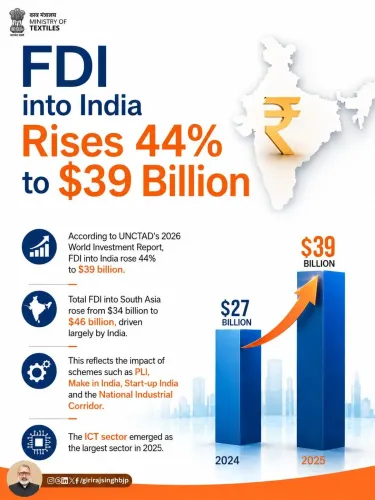
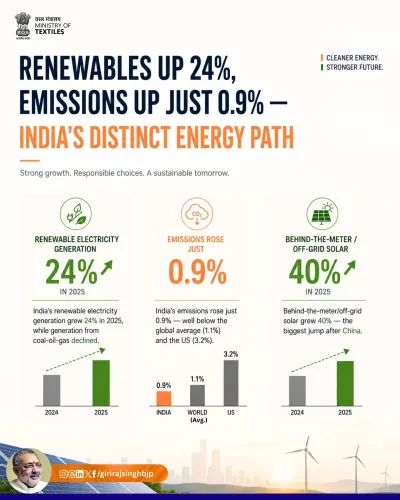
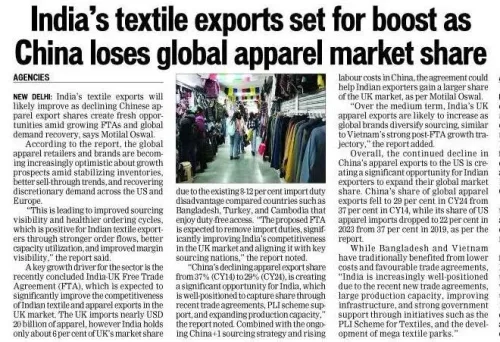
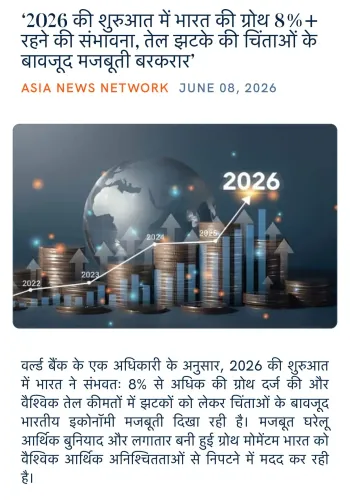
Union Textiles Minister Giriraj Singh on 15 June 2026 cited FDI, global exports, and power generation as proof of unprecedented progress under PM Modi, urging that political debate focus on measurable development outcomes rather than empty rhetoric.
Key Takeaways
Giriraj Singh , Union Textiles Minister and Begusarai MP, posted on 15 June 2026 crediting PM Narendra Modi for gains in FDI, exports, and power generation.
He coined the term 'thatharology' to describe hollow political posturing, contrasting it with data-driven debate.
FDI norms have been progressively liberalised since 2014 , with most sectors on the automatic approval route.
The Production-Linked Incentive (PLI) scheme, launched from 2020 , targets higher manufacturing output and export growth across 14 sectors.
Singh tagged #Begusarai and #Teghra alongside national hashtags, signalling a dual national-local messaging strategy.
Upcoming DPIIT FDI data and CEA power statistics will be key benchmarks for the government's development narrative.
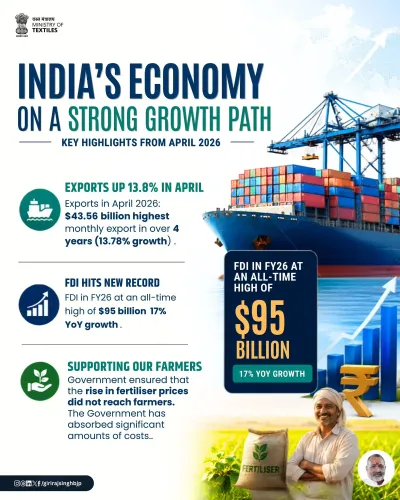
Union Textiles Minister Giriraj Singh on Monday, 15 June 2026 credited Prime Minister Narendra Modi's leadership for what he described as unprecedented progress across foreign direct investment, global exports, and power generation, urging that political discourse be anchored in such measurable development outcomes rather than empty rhetoric.
Context
Posting in Hindi on X, the Begusarai MP wrote that under Modi's 'able leadership' (kaushal netritva), the country has achieved 'unprecedented progress' (abhootpoorva pragati) in every major sector including FDI, global exports, and electricity generation. He called these 'clear and authentic examples of a changing India that no one can deny.'
Singh also took a pointed dig at what he termed 'thatharology' — a colloquial Hindi coinage for hollow posturing — saying that while such rhetoric has its place in politics, a healthy democracy demands debate grounded in 'real benchmarks of development and concrete changes visible on the ground.'
Policy Backdrop
The three indicators Singh highlighted — FDI, exports, and power generation — sit at the centre of the BJP-led government's economic narrative since 2014. Foreign investment norms were progressively liberalised, with most sectors placed on the automatic approval route, reducing the regulatory burden on incoming capital.
The Production-Linked Incentive (PLI) scheme, rolled out from 2020 onward across fourteen sectors, was designed explicitly to raise manufacturing output and push India's share of global exports higher. On the power side, revised National Electricity Plan targets combined with an accelerated renewable-energy push have driven capacity addition over the same period.
India's Foreign Trade Policy — first set for 2015–20 and succeeded by a 2023 edition — established explicit targets for expanding the country's footprint in world trade, providing the policy scaffolding Singh's remarks implicitly reference.
Stakeholders and Impact
The constituencies most directly affected by the three indicators are foreign investors seeking stable entry conditions, exporters dependent on incentive continuity, and power consumers and producers whose fortunes track generation capacity. Singh's post, tagged with #Begusarai and #Teghra alongside the national #VikasKiRajneeti (Politics of Development) hashtag, signals that the development-data argument is being deployed at both the national and local constituency level.
The framing is consistent with a broader BJP communication strategy of presenting macroeconomic indicators as a rebuttal to opposition criticism, particularly ahead of electoral cycles. By invoking the Teghra assembly segment specifically, Singh also appears to be reinforcing his local connect in Bihar.
What's Next
The next quarterly FDI data release by the Department for Promotion of Industry and Internal Trade (DPIIT) and monthly power-generation statistics from the Central Electricity Authority (CEA) will be closely watched as the government builds its data-led narrative. Parliament's next session is also expected to see these figures cited in floor debates. Singh's post suggests central ministers will continue pressing the 'real benchmarks' frame as the primary terrain on which they wish to contest political arguments.
Point of View
Singh implicitly positions his own party as the adult in the room. The dual tagging of Begusarai and Teghra alongside national hashtags reveals how central BJP messaging is localised for constituency-level consumption. As electoral cycles approach, expect this data-first framing to intensify, particularly if DPIIT and CEA numbers remain favourable.
NationPress
20 Sept 2026
Frequently Asked Questions
What did Giriraj Singh say about India's FDI and exports?
Giriraj Singh said that under PM Modi's leadership, India has achieved unprecedented progress in FDI, global exports, and power generation, calling these undeniable proof of a changing India.
What is 'thatharology' that Giriraj Singh mentioned?
'Thatharology' is a Hindi colloquial term Singh used to describe empty political posturing or hollow rhetoric, contrasting it with substantive, data-driven political debate.
What is India's FDI policy under the Modi government?
Since 2014, the government has progressively liberalised FDI norms, placing most sectors on the automatic approval route to reduce regulatory barriers for foreign investors.
What is the Production-Linked Incentive scheme and how does it relate to exports?
The PLI scheme, launched from 2020 across 14 sectors, provides financial incentives to manufacturers to boost domestic production and increase India's share in global exports.
Why did Giriraj Singh tag Begusarai and Teghra in his post?
Singh represents Begusarai in the Lok Sabha, and Teghra is an assembly segment within that constituency; tagging both localises his national development message for his home electorate in Bihar.