Giriraj Singh Hails India's April Export Surge
Synopsis
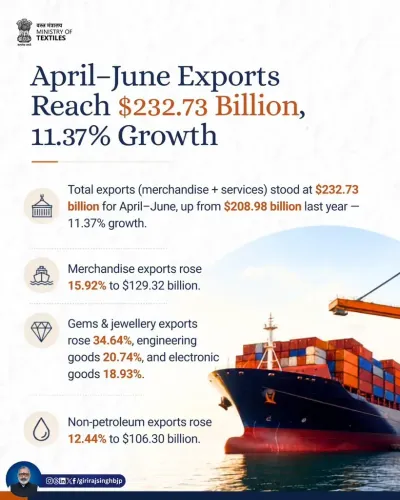
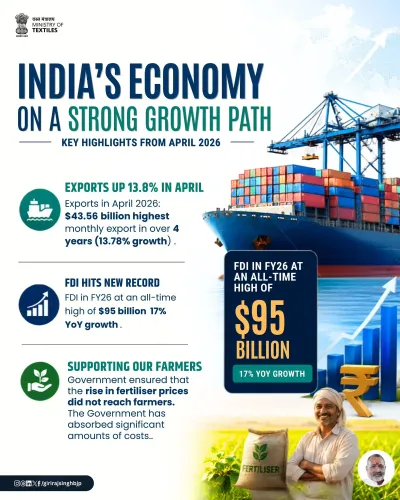
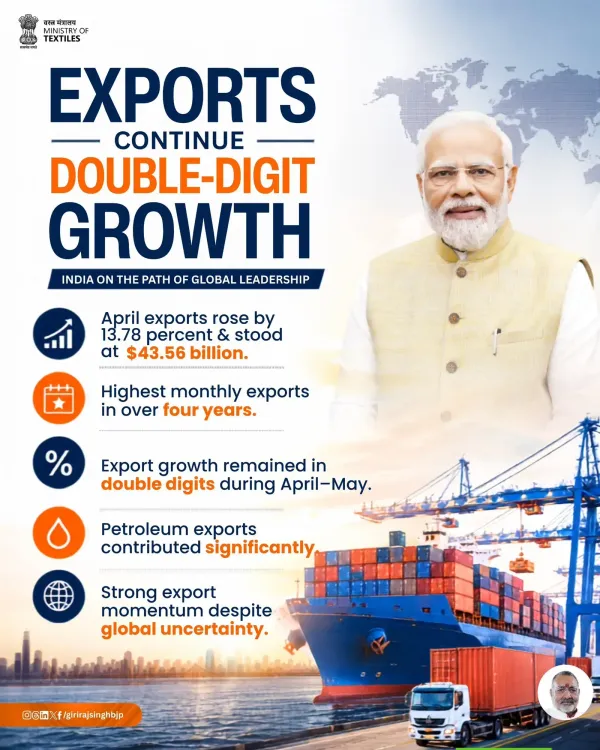
Union Textiles Minister Giriraj Singh on 9 June 2026 cited April merchandise exports of $43.56 billion and double-digit growth as proof of India's rising global manufacturing footprint, attributing the milestone to PM Modi's economic leadership and Atmanirbhar Bharat policies.
Key Takeaways
Union Textiles Minister Giriraj Singh posted on 9 June 2026 highlighting India's export performance.
April merchandise exports were cited at $43.56 billion with consecutive double-digit year-on-year growth.
The minister attributed the milestone to PM Narendra Modi's leadership and Atmanirbhar Bharat policy framework.
India's Foreign Trade Policy 2023 targets $2 trillion in merchandise and services exports by 2030 .
PLI schemes across 14 sectors and Make in India remain the primary policy instruments driving export-oriented manufacturing.
Key beneficiaries include Indian exporters, MSMEs , and the broader manufacturing sector, including textiles.
Union Textiles Minister Giriraj Singh on Tuesday, 9 June 2026 highlighted India's rising export performance, citing April merchandise exports of $43.56 billion and sustained double-digit growth as evidence of the country's deepening integration into global manufacturing and supply chains.
Posting on X, the minister wrote: 'Bharat ki badhti niryat kshamata aaj vishwa manch par uski aarthik mazbooti ki nayi pahchaan ban rahi hai' ('India's growing export capacity is today becoming a new identity of its economic strength on the world stage'). He attributed the milestone to the leadership of Prime Minister Narendra Modi, framing the data as proof that India is becoming an 'indispensable part of global manufacturing and supply chains.'
Context
The post comes as India's trade data for April 2026 reportedly showed merchandise exports touching $43.56 billion, with the government claiming consecutive months of double-digit year-on-year growth. Singh invoked the hashtags #AtmanirbharBharat, #ViksitBharat2047, and #RisingIndia, anchoring the data point within the government's broader economic narrative.
India's export ambitions have been a consistent policy priority since 2014, when the Make in India initiative was launched to raise manufacturing's share of GDP and attract foreign direct investment. The Foreign Trade Policy 2023 subsequently set a target of $2 trillion in combined merchandise and services exports by 2030.
Policy Backdrop
The Atmanirbhar Bharat Abhiyan, announced in May 2020, introduced five pillars — economy, infrastructure, demand, demographics, and supply-chain resilience — to reduce import dependence and scale up domestic production. Complementing it, Production Linked Incentive (PLI) schemes were rolled out across 14 sectors from 2020 onwards, offering financial incentives tied to incremental output and exports.
The Viksit Bharat 2047 vision, which aims to transform India into a fully developed economy by the centenary of independence, has become a recurring reference point in ministerial communications, framing near-term trade data within a long-horizon national goal.
Stakeholders and Impact
The export surge, if sustained, carries the most direct benefit for Indian exporters, the broader manufacturing sector, and micro, small and medium enterprises (MSMEs), which account for a significant share of export volumes in labour-intensive sectors including textiles, garments, and handicrafts — areas that fall squarely within Singh's ministerial portfolio.
Global supply-chain diversification trends, accelerated by geopolitical realignments, have created openings for India to absorb orders shifting away from single-source dependencies. Sustained double-digit export growth would strengthen India's case to trading partners and investors evaluating alternative manufacturing bases.
What's Next
Attention will now turn to the Ministry of Commerce and Industry's monthly trade data releases, which will confirm whether the double-digit growth trajectory holds through the first quarter of FY 2026-27. Progress reports on PLI scheme utilisation and the status of pending bilateral trade agreements will also be closely watched as indicators of whether policy instruments are translating into durable export competitiveness.
If India maintains this export momentum, it would materially advance the $2 trillion export target by 2030 — and lend further weight to the government's argument that Atmanirbhar Bharat is delivering measurable economic results on the global stage.
Point of View
The minister is doing double duty: validating a flagship 2020 crisis-response programme and keeping the 2047 horizon in public discourse. The framing of India as an 'indispensable' node in global supply chains is deliberate, targeting investor and trading-partner audiences as much as domestic voters. This pattern of ministerial amplification of positive trade data has become a consistent feature of the current government's communications strategy, suggesting coordinated messaging rather than an isolated observation.
NationPress
23 Oct 2026
Frequently Asked Questions
What were India's exports in April 2026?
Union Textiles Minister Giriraj Singh stated that India's merchandise exports reached $43.56 billion in April 2026, with the government claiming sustained double-digit year-on-year growth.
What is Atmanirbhar Bharat and how does it relate to exports?
Atmanirbhar Bharat Abhiyan , launched in May 2020 , is a self-reliance campaign built on five pillars including supply-chain resilience and domestic manufacturing, aimed at reducing import dependence and boosting India's export capacity.
What is India's export target by 2030?
India's Foreign Trade Policy 2023 sets a combined merchandise and services export target of $2 trillion by 2030 , underpinned by PLI schemes and trade facilitation measures.
What is Viksit Bharat 2047?
Viksit Bharat 2047 is the government's long-term vision to transform India into a fully developed economy by 2047 , the centenary of independence, with export growth as a key pillar.
How do PLI schemes support India's manufacturing exports?
Production Linked Incentive (PLI) schemes , introduced from 2020 across 14 sectors , offer financial incentives tied to incremental domestic production and export output, aiming to make Indian manufacturers globally competitive.