Giriraj Singh flags easing import reliance under Make in India
Synopsis
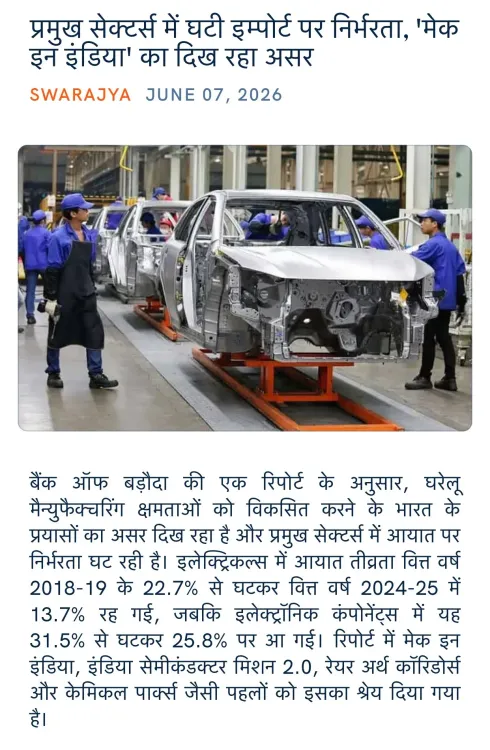
Union Textiles Minister Giriraj Singh on June 7, 2026, cited a Bank of Baroda research note showing eased import reliance in key sectors, framing it as evidence of Make in India bearing fruit after more than a decade of domestic manufacturing incentives including PLI schemes and the Atmanirbhar Bharat initiative.
Key Takeaways
Giriraj Singh shared a Bank of Baroda report on June 7, 2026 citing reduced import dependence in key economic sectors.
The post attributes the trend to the Make in India initiative, launched by PM Modi in September 2014 .
PLI schemes across 14 sectors , rolled out from 2020 , have been central to India's import-substitution strategy.
The Atmanirbhar Bharat package announced in May 2020 extended Make in India goals across domestic supply chains.
Key beneficiaries include domestic manufacturers and MSME exporters in textiles, electronics, pharmaceuticals, and defence.
Commerce Ministry trade data and the next Union Budget 's PLI announcements will be critical markers to watch.
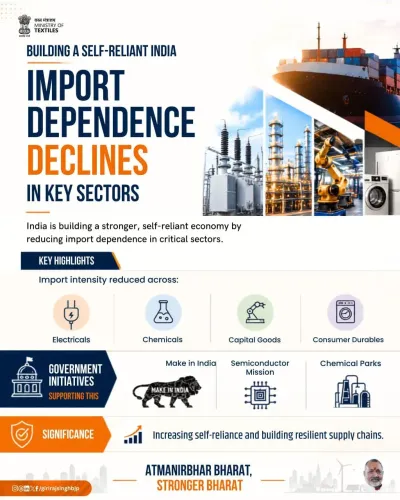
Union Textiles Minister Giriraj Singh on Sunday, June 7, 2026, shared a report citing reduced import dependence across key economic sectors, attributing the trend to the decade-long Make in India initiative. The minister posted the finding via the NaMo App, underlining the ruling dispensation's continued emphasis on domestic manufacturing.
Context
The post, shared in Hindi, reads: 'Pramukh sectors mein ghati import par nirbharta, Make in India ka dikh raha asar' — 'Import dependence has eased in key sectors, the impact of Make in India is visible.' Singh linked to a Bank of Baroda research note that reportedly documents sector-wise shifts in India's import composition. The post carries one image and was shared through the NaMo App, a platform frequently used by BJP leaders to amplify government messaging.
While the specific statistics in the cited report cannot be independently confirmed, the broader trend of declining import intensity in select sectors has been a recurring theme in official economic communications since 2014. The minister's amplification signals continued political investment in the Make in India narrative ahead of forthcoming trade data releases.
Policy Backdrop
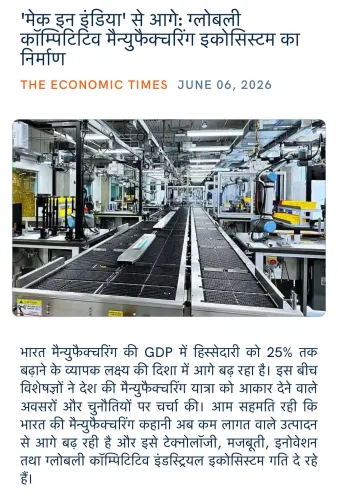
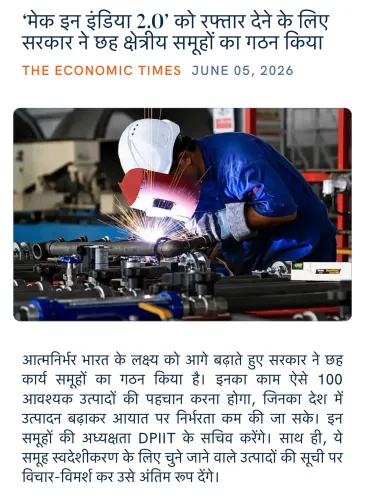
Make in India was launched by Prime Minister Narendra Modi in September 2014 to position India as a global manufacturing destination and reduce dependence on imports, particularly in electronics, textiles, pharmaceuticals, and defence. The initiative was reinforced in May 2020 when the government announced the Atmanirbhar Bharat package — a self-reliance campaign aimed at strengthening indigenous supply chains in the aftermath of the pandemic-era disruption.
From 2020 onward, the government rolled out Production Linked Incentive (PLI) schemes across 14 sectors to incentivise local production and attract capital investment. These schemes have been credited in successive Union Budgets and economic surveys with nudging manufacturers toward domestic sourcing. The geopolitical supply-chain diversification wave post-2020, driven by tensions in global trade corridors, further accelerated India's import-substitution push.
Stakeholders and Impact
The primary beneficiaries of reduced import dependence are domestic manufacturers and MSME exporters, who gain pricing competitiveness and larger order books as import substitution takes hold. For the textiles sector — which Giriraj Singh directly oversees — lower reliance on imported raw materials and machinery translates into improved margins for mills and weavers across states such as Gujarat, Maharashtra, Tamil Nadu, and Uttar Pradesh.
Bank of Baroda, as a public sector lender with deep exposure to manufacturing credit, carries institutional credibility when it publishes sectoral research. Its findings, when amplified by a senior cabinet minister, carry signalling value for industry bodies, investors, and policymakers evaluating the efficacy of the PLI framework.
What's Next
Analysts and industry observers will watch the Commerce Ministry's monthly trade data releases in the coming weeks for corroboration of the import-easing trend at an aggregate level. Any extension or revision of PLI schemes in the next Union Budget will be a key policy marker indicating whether the government intends to deepen import substitution incentives further.
If the Bank of Baroda findings are borne out by official trade statistics, they would provide the government with a data-backed case to argue that its decade-long manufacturing push is delivering measurable structural change — a politically significant claim as India navigates an evolving global trade environment.
Point of View
Using a public-sector bank's research note to lend institutional weight to the government's decade-old manufacturing narrative. By amplifying third-party data rather than making direct claims, the minister insulates the messaging from immediate factual challenge while keeping the Make in India brand prominent. The move fits a broader pattern of BJP ministers using the NaMo App ecosystem to reinforce economic-nationalist messaging, particularly as the government approaches a phase where PLI scheme outcomes face closer scrutiny. The real test will come when official trade data either validates or complicates the import-easing story being built.
NationPress
13 Sept 2026
Frequently Asked Questions
What is Make in India and has it reduced import dependence?
Make in India is a flagship manufacturing initiative launched by PM Narendra Modi in September 2014 to boost domestic production and cut import reliance. Union Textiles Minister Giriraj Singh cited a Bank of Baroda report on June 7, 2026, claiming the initiative has visibly eased import dependence in key sectors, though official trade data confirmation is awaited.
What did Giriraj Singh say about Make in India in June 2026?
Giriraj Singh shared a Bank of Baroda research note stating that import dependence has eased in key sectors, calling it visible proof of Make in India's impact. He posted this on June 7, 2026, via the NaMo App.
What are PLI schemes and how do they relate to import substitution?
Production Linked Incentive (PLI) schemes, rolled out from 2020 across 14 sectors, offer financial incentives to manufacturers who increase domestic production. They are a core tool in India's import-substitution strategy under the Make in India and Atmanirbhar Bharat frameworks.
What is Atmanirbhar Bharat and how is it connected to Make in India?
Atmanirbhar Bharat, announced in May 2020, is a self-reliance campaign that extends Make in India goals by strengthening indigenous supply chains. It was launched in response to pandemic-era global supply chain disruptions.
Which sectors benefit most from India's reduced import dependence?
Textiles, electronics, pharmaceuticals, and defence are among the key sectors cited in the government's import-substitution narrative. Domestic manufacturers and MSME exporters stand to gain the most from reduced reliance on imported materials and machinery.