Giriraj Singh: Import Dependence Falling in Key Sectors
Synopsis
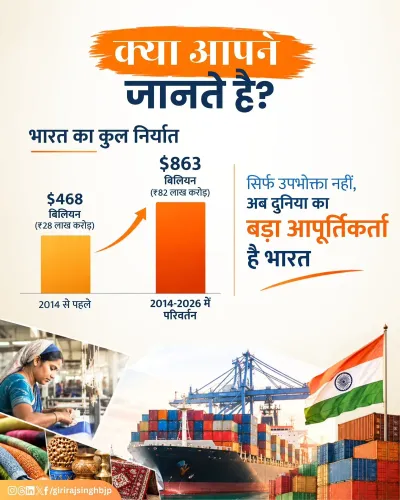
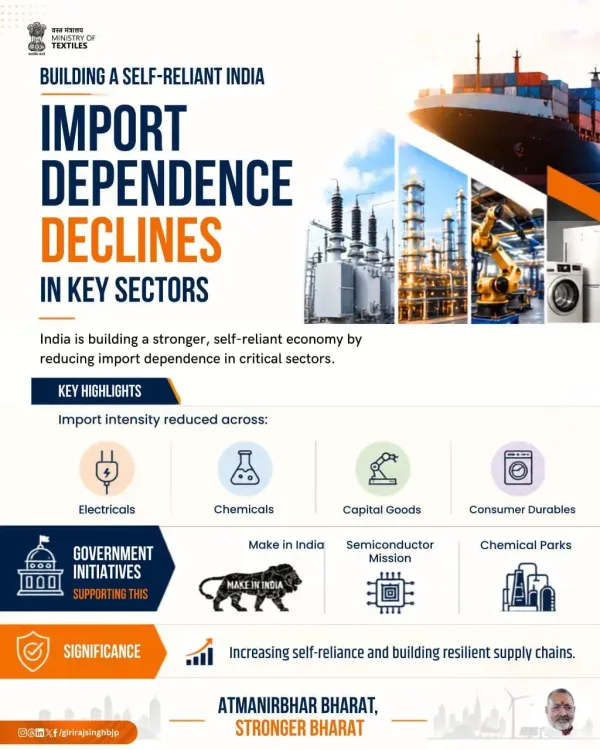
Union Textiles Minister Giriraj Singh says India is advancing toward a stronger economy under the Atmanirbhar Bharat resolve, with import dependence falling in electricals, chemicals, capital goods and consumer durables, driven by Make in India and related government initiatives.
Key Takeaways
Union Textiles Minister Giriraj Singh posted on June 12, 2026 highlighting India's reduced import dependence in key industrial sectors.
Sectors specifically cited: electricals, chemicals, capital goods, and consumer durables .
Make in India (launched September 2014 ) and Atmanirbhar Bharat Abhiyan (launched May 2020 ) were credited for building domestic supply chains.
Production Linked Incentive (PLI) schemes have been the primary policy instrument driving import substitution across these sectors.
Domestic manufacturers and MSME suppliers are the principal stakeholders benefiting from supply-chain localisation.
Key data checkpoints ahead include the next Economic Survey and Union Budget for sector-wise import figures.
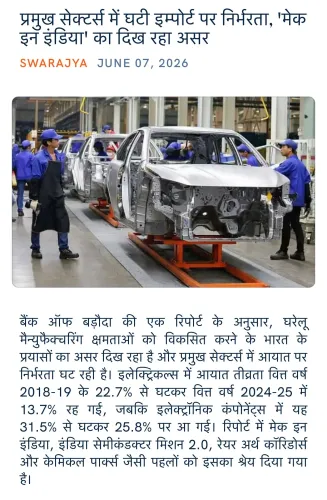
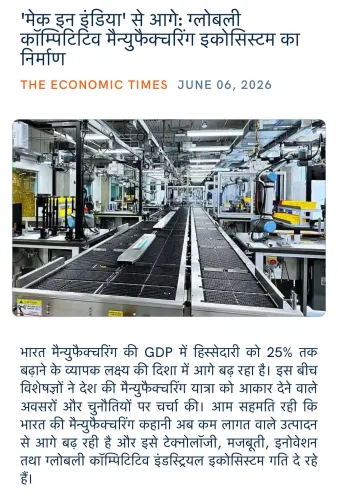
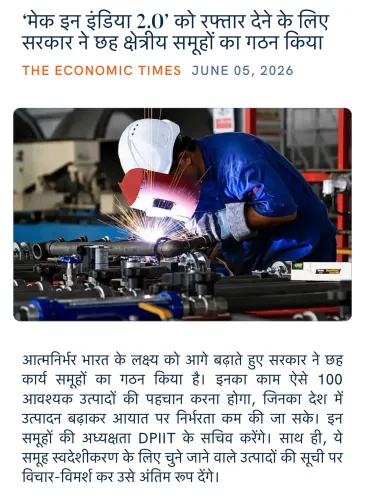
Union Textiles Minister Giriraj Singh on Friday, June 12, 2026 highlighted India's progress toward economic self-reliance, asserting that import dependence in major industrial sectors has declined sharply under the Atmanirbhar Bharat and Make in India initiatives.
Context
Posting in Hindi, the minister wrote: 'आत्मनिर्भर भारत' के संकल्प के साथ देश एक मजबूत अर्थव्यवस्था की ओर अग्रसर है — 'With the resolve of Atmanirbhar Bharat, the country is moving toward a strong economy.' He specifically named electricals, chemicals, capital goods, and consumer durables as sectors where reliance on imports has fallen rapidly. The minister credited government-led initiatives, particularly Make in India, for building a robust domestic supply chain.
Policy Backdrop
Make in India was launched in September 2014 to attract foreign direct investment and promote domestic manufacturing across sectors. The Atmanirbhar Bharat Abhiyan followed in May 2020, introducing a sweeping economic stimulus package designed to reduce India's dependence on imports and build supply-chain resilience in the wake of the pandemic. Both programmes have since been reinforced through Production Linked Incentive (PLI) schemes rolled out across more than a dozen sectors, including electronics, chemicals, and capital goods — the very sectors Giriraj Singh cited in his post.
Stakeholders and Impact
The primary beneficiaries of this policy push have been domestic manufacturers and MSME suppliers, who have gained market share as import substitution policies made local sourcing more competitive. Sectors such as electricals and consumer durables have seen increased investment in local component manufacturing, anchoring supply chains within India. The shift has also aligned with broader geopolitical trends that have made supply-chain diversification a strategic priority for governments worldwide.
For Bihar-based industries and MSMEs, Giriraj Singh's advocacy for these national programmes carries particular resonance, as the state has been targeted for industrial development under several central government schemes. His role as a senior BJP leader and Lok Sabha MP from Begusarai positions him as a vocal proponent of the ruling party's economic nationalism agenda.
What's Next
Analysts and industry observers will watch for concrete data on import reduction in the sectors named — electricals, chemicals, capital goods, and consumer durables — in the forthcoming Economic Survey and the next Union Budget. Updates on PLI scheme disbursements and fresh FDI figures will be the clearest indicators of whether the supply-chain localisation trend is accelerating. Continued ministerial messaging of this kind also signals that Atmanirbhar Bharat remains a central plank of the government's economic communication heading into the budget cycle.
Point of View
Chemicals, and capital goods, the minister moves beyond generic patriotic rhetoric toward a claim that is, in principle, measurable — raising the stakes for official data to back it up. The framing also reflects a broader pattern in which multiple ministries amplify the Atmanirbhar Bharat brand, suggesting a centralised communications strategy ahead of the budget cycle. For the opposition, the absence of specific figures in the post leaves room to contest the claim, making forthcoming Economic Survey data politically significant.
NationPress
26 Oct 2026
Frequently Asked Questions
What is Atmanirbhar Bharat and what sectors does it cover?
Atmanirbhar Bharat, or 'Self-Reliant India,' is a government initiative launched in May 2020 to reduce import dependence and strengthen domestic manufacturing across sectors including electricals, chemicals, capital goods, consumer durables, pharmaceuticals, and electronics.
What did Giriraj Singh say about import dependence in India?
Giriraj Singh stated that import dependence in electricals, chemicals, capital goods, and consumer durables has fallen rapidly, crediting Make in India and other government initiatives for building a robust domestic supply chain.
What is the Make in India scheme?
Make in India is a flagship manufacturing promotion programme launched in September 2014 to attract foreign direct investment, boost domestic production, and create jobs by encouraging companies to manufacture their products in India.
How do PLI schemes help reduce India's import dependence?
Production Linked Incentive schemes offer financial incentives to manufacturers based on incremental sales from domestically produced goods, making local manufacturing more competitive and reducing the need for imports in targeted sectors.
Which sectors are seeing reduced import dependence in India?
According to Giriraj Singh's statement, electricals, chemicals, capital goods, and consumer durables are among the major sectors where India's reliance on imports has declined significantly under current government policies.