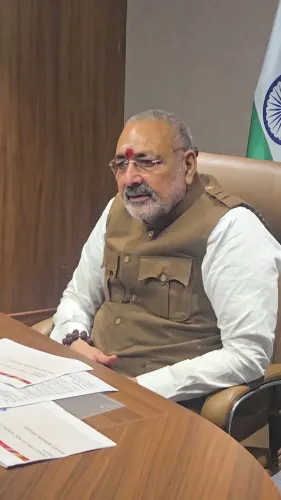
Giriraj Singh flags services' 67% share in India's export growth
Synopsis
Union Textiles Minister Giriraj Singh on 18 June 2026 amplified data showing services drove 67% of India's export growth over a decade, spotlighting IT and software's dominance even as his ministry pushes manufacturing competitiveness through schemes like PLI for textiles and PM MITRA parks.
Key Takeaways
Union Textiles Minister Giriraj Singh shared on 18 June 2026 that the services sector contributed 67 per cent of India's export growth over the past decade.
India's services exports — led by IT-BPM — account for over 40 per cent of total exports in recent years, consistently outpacing goods growth.
The trend spans the decade since the Make in India launch in 2014 and the Foreign Trade Policy 2015-20 , which targeted export diversification.
The IT services industry directly employs roughly 50 lakh professionals, primarily in Bengaluru , Hyderabad , Pune , and Chennai .
The Textiles Ministry is simultaneously running the PLI for textiles and PM MITRA parks programme to strengthen goods-export competitiveness.
Upcoming quarterly trade data and any revision to the Foreign Trade Policy (current edition through 2030 ) will indicate how policy balances services and manufacturing priorities.
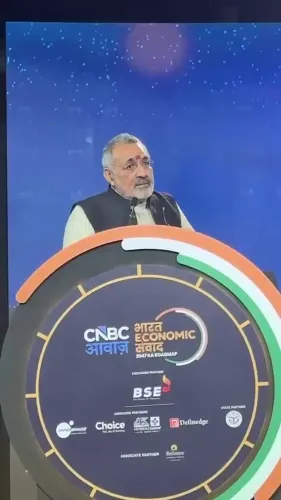
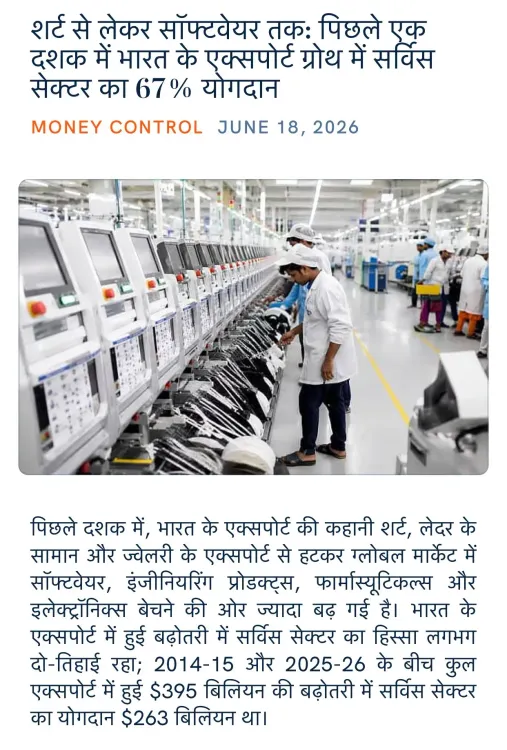
Union Textiles Minister Giriraj Singh on Thursday, 18 June 2026 shared data highlighting that the services sector has driven 67 per cent of India's export growth over the past decade — a figure that underscores how the country's trade story has shifted well beyond traditional goods such as garments and textiles.
Context
Posting via the NaMo App, Giriraj Singh shared a headline — 'Shirt se lekar software tak' ('From shirts to software') — pointing to a decade-long trend in which services exports, led by information technology and software, have outpaced merchandise trade in incremental growth. The minister's decision to amplify this data point is notable given his portfolio: as head of the Textiles Ministry, he oversees a sector that remains a cornerstone of India's goods-export basket, making his acknowledgement of services' dominance a candid policy signal.
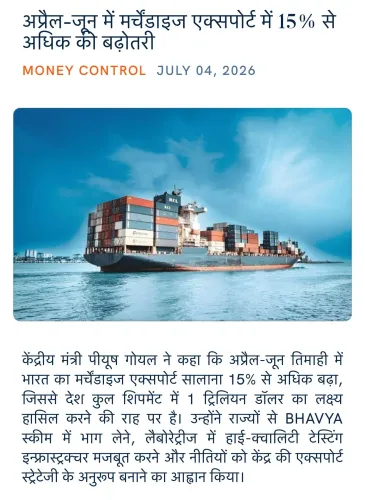
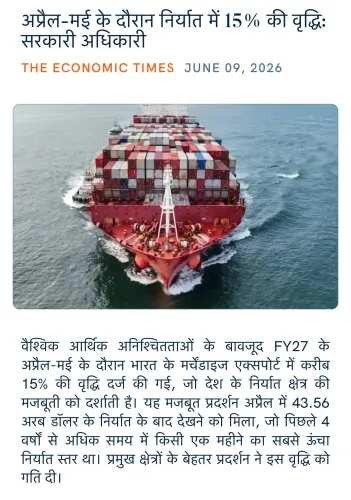
India's services exports, particularly the IT-BPM (Information Technology and Business Process Management) segment, have expanded steadily since the liberalisation of the 1990s and gained further momentum after 2014. Official trade data in recent years show services accounting for over 40 per cent of total exports, frequently outpacing goods growth on a year-on-year basis.
Policy Backdrop
The decade in question coincides almost precisely with the tenure of the National Democratic Alliance government, which launched the flagship Make in India initiative in 2014 to boost manufacturing and diversify the export basket. The Foreign Trade Policy 2015-20 set explicit targets for expanding both goods and services trade, with a stated ambition of lifting India's share in global exports.
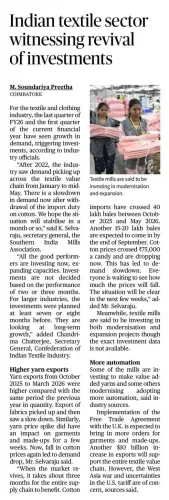
Despite the manufacturing push, the data now being cited suggest that software and services firms — rather than factories — delivered the larger share of incremental export earnings over this period. The Textiles Ministry has simultaneously pursued schemes such as the Production Linked Incentive (PLI) for textiles and the PM MITRA (Mega Integrated Textile Region and Apparel) parks programme to strengthen garment and fabric exports, which remain India's second-largest merchandise export category.
Stakeholders and Impact
The IT services industry, employing roughly 50 lakh professionals directly, emerges as the primary driver behind the statistic. Software exporters concentrated in hubs such as Bengaluru, Hyderabad, Pune, and Chennai have seen sustained demand from North America and Europe, insulating overall export figures even during periods of global goods-trade slowdown.
For textile exporters — the constituency most directly under Giriraj Singh's watch — the implication is a dual challenge: competing for policy bandwidth and investment alongside a services sector that has organically scaled, while also demonstrating that goods manufacturing can deliver comparable incremental value. Apparel and textile clusters in Tiruppur, Surat, Ludhiana, and Panipat will be watching whether this data point translates into renewed policy urgency around manufacturing competitiveness.
What's Next
The Ministry of Commerce and Industry is expected to release the next quarterly trade data, which will offer a more granular breakdown of services versus goods performance in the current fiscal year. Any revision to the Foreign Trade Policy — the current edition runs through 2030 — could recalibrate incentive structures to either sustain services momentum or tilt support toward manufacturing sectors including textiles.
The minister's post signals that the government is comfortable owning the services-led export narrative, even as it continues to invest in schemes designed to make India a global manufacturing hub. How that balance is struck in upcoming budget allocations and trade-policy reviews will be the key indicator to watch.
Point of View
Shared via the NaMo App, frames the statistic as a government achievement rather than a structural imbalance, suggesting the BJP is pivoting to own the services-led growth story ahead of trade-policy reviews. For the textiles lobby, however, the figure is a quiet reminder that apparel and fabric exporters remain secondary contributors to incremental trade earnings despite years of targeted incentives. The real test will come in budget and FTP revisions: whether the data triggers a course-correction toward manufacturing or simply reinforces the status quo.
NationPress
19 Sept 2026
Frequently Asked Questions
What did Giriraj Singh say about India's export growth?
Union Textiles Minister Giriraj Singh shared data on 18 June 2026 indicating that the services sector — covering IT, software, and related industries — contributed 67 per cent of India's total export growth over the past decade, far outpacing the contribution of goods like textiles and garments.
How much of India's exports are services?
Services have accounted for over 40 per cent of India's total exports in recent years, with IT and BPM being the dominant components. This share has grown steadily since the 1990s liberalisation and accelerated after 2014.
Why is a Textiles Minister talking about software exports?
Giriraj Singh oversees the Textiles Ministry, a core goods-export sector, but shared this data to highlight India's broader trade success under the current government. It signals the BJP's intent to own the services-led export narrative as a policy achievement.
What is India's Foreign Trade Policy and how does it relate to this?
India's Foreign Trade Policy sets targets and incentives for both goods and services exports. The current policy runs through 2030 and is reviewed periodically; the services-versus-goods export data is likely to inform its next revision.
What schemes is the Textiles Ministry running to boost garment exports?
The Textiles Ministry is implementing the Production Linked Incentive scheme for textiles and the PM MITRA (Mega Integrated Textile Region and Apparel) parks programme, both aimed at boosting manufacturing capacity and making India more competitive in global garment and fabric trade.