PLI Textiles scheme draws ₹8,118 crore investment, 33,427 jobs by March 2026
Synopsis
India's PLI Textiles scheme has crossed ₹8,118 crore in investment and generated over 33,400 jobs by March 2026 — with 170 companies on board and exports rising 1.8% to ₹3.25 lakh crore despite global headwinds. The government's data, tabled in Parliament, offers the clearest picture yet of how the scheme is performing on the ground.
Key Takeaways
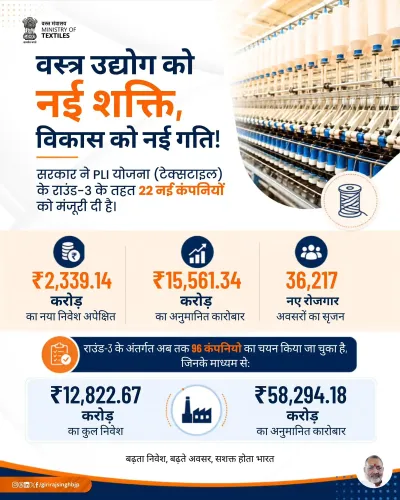
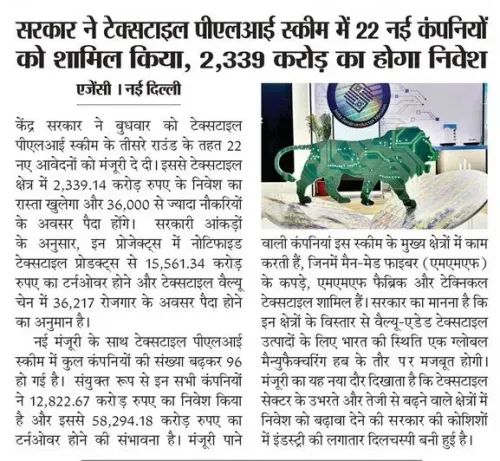
170 companies have been approved under the PLI Scheme for Textiles as of 31 March 2026 .
Total investment under the scheme stands at ₹8,117.64 crore , with 33,427 new jobs generated.
India's textile and apparel exports rose 1.8% year-on-year to ₹3,25,339 crore in 2025-26 .
Exports grew across more than 100 destination markets despite global demand fluctuations.
The RELIEF initiative was launched on 19 March 2026 to support exporters hit by West Asia conflict and Gulf maritime disruptions.
Bihar textile exports rose to ₹409 crore ; Madhya Pradesh held steady at ₹11,751.7 crore in 2025-26 .
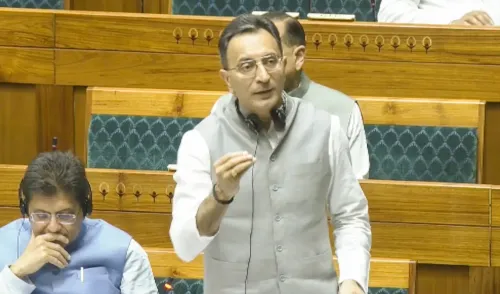
The Production Linked Incentive (PLI) Scheme for Textiles has attracted an investment of ₹8,117.64 crore and generated 33,427 new jobs as of 31 March 2026, the Centre told Parliament on Tuesday, 21 July 2026. The figures were shared by Minister of State for Textiles Pabitra Margherita in a written reply to a question in the Lok Sabha, confirming that 170 companies have been approved under the scheme.
Key Scheme Numbers
Minister Margherita stated: 'Under the PLI for Textiles, a total of 170 companies have been approved. As of March 31, 2026, investment to the tune of ₹8,117.64 crore have been made by PLI companies and 33,427 new jobs has been generated.' The minister noted that both investment and employment generation continue to gather pace.
Textile Exports Show Resilience
Despite global headwinds, India's textile and apparel exports — including handicrafts — rose 1.8% year-on-year to ₹3,25,339 crore in 2025-26, up from ₹3,19,573.2 crore in 2024-25. The government noted that exports recorded growth across more than 100 destination markets during the year, navigating fluctuations in global demand, shifting input costs, and broader trade challenges.
State-Level Export Trends
Exports from Madhya Pradesh remained broadly stable at ₹11,751.7 crore in 2025-26, compared with ₹11,748.9 crore in the previous year. Bihar posted stronger momentum, with textile and apparel exports climbing to ₹409 crore from ₹375.6 crore over the same period.
Government Initiatives Across the Value Chain
The Centre outlined a broad set of programmes supporting the sector, including the PM Mega Integrated Textile Regions and Apparel (PM MITRA) Parks Scheme, the National Technical Textiles Mission, the SAMARTH skill development programme, Silk Samagra-2, the National Handloom Development Programme, the National Handicrafts Development Programme, the Comprehensive Handicrafts Cluster Development Scheme, and export support mechanisms such as RoSCTL and RoDTEP.
The government also highlighted the launch of the Resilience and Logistics Intervention for Export Facilitation (RELIEF) initiative under the Export Promotion Mission on 19 March 2026, designed to support exporters affected by disruptions stemming from the conflict in West Asia and maritime challenges in the Gulf region.
What Comes Next
With investments and job creation described as continuing to accelerate, the Centre's data signals that the PLI Textiles framework is gaining operational traction. Whether the scheme can sustain momentum amid evolving global trade pressures — particularly US tariff uncertainty and West Asia logistics disruptions — will be the key test for the sector in the coming quarters.
Point of View
118 crore invested and 33,427 jobs across 170 companies — are credible but modest relative to the scheme's ambitions. India's textile sector employs over 45 million people; 33,000-odd incremental jobs from a flagship incentive scheme over multiple years is a thin return at that scale. The 1.8% export growth is positive but underwhelming given that competitors like Bangladesh and Vietnam have been aggressively expanding market share. The RELIEF initiative for West Asia-affected exporters is a useful reactive measure, but the structural challenge — moving India up the value chain from commodity yarn to technical textiles — demands more than logistics support. Parliament has the data; the harder question is whether the incentive architecture is calibrated to drive that shift.
NationPress
20 Oct 2026
Frequently Asked Questions
What is the PLI Scheme for Textiles and how is it performing?
The Production Linked Incentive (PLI) Scheme for Textiles is a central government programme that provides financial incentives to companies for incremental production in the sector. As of 31 March 2026, 170 approved companies have collectively invested ₹8,117.64 crore and generated 33,427 new jobs, according to data tabled in Parliament.
How much have India's textile exports grown in 2025-26?
India's textile and apparel exports, including handicrafts, rose 1.8% year-on-year to ₹3,25,339 crore in 2025-26, up from ₹3,19,573.2 crore in 2024-25. Growth was recorded across more than 100 destination markets despite global demand volatility and input cost pressures.
Which states saw notable changes in textile export performance?
Madhya Pradesh's textile exports remained largely stable at ₹11,751.7 crore in 2025-26 versus ₹11,748.9 crore in the previous year. Bihar posted stronger growth, with exports rising to ₹409 crore from ₹375.6 crore over the same period.
What is the RELIEF initiative launched by the Centre?
The Resilience and Logistics Intervention for Export Facilitation (RELIEF) initiative was launched on 19 March 2026 under the Export Promotion Mission to support textile exporters affected by the conflict in West Asia and maritime disruptions in the Gulf region. It aims to cushion exporters from logistics and supply chain shocks.
What other schemes support India's textile sector alongside PLI?
Alongside PLI, the government runs the PM MITRA Parks Scheme, the National Technical Textiles Mission, the SAMARTH skill development programme, Silk Samagra-2, the National Handloom and Handicrafts Development Programmes, the Comprehensive Handicrafts Cluster Development Scheme, and export incentive mechanisms including RoSCTL and RoDTEP.