Textile PLI scheme attracts ₹167.51 crore investment in Maharashtra
Synopsis
Maharashtra's 24 PLI-approved textile companies have collectively invested ₹167.51 crore and created 904 jobs — but the bigger story is the October 2025 reforms that slashed entry barriers and pushed MSME participation to 68% of third-round applications, signalling a structural shift in who the scheme is actually reaching.
Key Takeaways
24 companies from Maharashtra are approved under the Centre's Textile PLI Scheme , with investments of ₹167.51 crore as of 31 March 2026 .
The Maharashtra cohort has generated a turnover of ₹177.75 crore and created 904 jobs .
Microtex Processors Private Limited (Kolhapur) invested ₹91.02 crore ; Spica Industries (Satara) created 640 jobs .
Nationwide, 170 companies have been approved under the scheme across all states.
October 2025 reforms cut minimum investment threshold by 50% and lowered incremental turnover requirement from 25% to 10% .
In the third round, 65 of 96 applications (68%) came from MSMEs , reflecting wider scheme access.
24 companies from Maharashtra have been approved under the Centre's Production Linked Incentive (PLI) Scheme for Textiles, with cumulative investments of ₹167.51 crore recorded in the state as of 31 March 2026, the government disclosed in Parliament on Tuesday, 28 July 2026. The figures were shared in a written reply in the Lok Sabha by Minister of State for Textiles Pabitra Margherita.
Maharashtra's Performance Under the Scheme
The 24 Maharashtra-based approved companies have collectively generated a turnover of ₹177.75 crore and created employment for 904 people. This places the state among the active participants in a scheme that has seen 170 companies approved nationwide.
Among the top performers, Microtex Processors Private Limited in Kolhapur recorded the highest investment in the state at ₹91.02 crore. Spica Industries Private Limited in Satara invested ₹76.37 crore, reported a turnover of ₹177.75 crore, and created 640 jobs — making it the single largest employment contributor among Maharashtra's approved companies.
What the PLI Textiles Scheme Covers
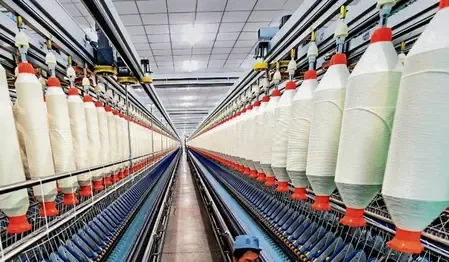
The PLI Scheme for Textiles is designed to boost production of man-made fibre (MMF) apparel, MMF fabrics, and technical textile products. It does so by incentivising investments, scaling up manufacturing capacity, improving sectoral competitiveness, and enhancing value addition along the supply chain.
The Ministry of Textiles monitors scheme implementation through periodic reviews, weekly open-house sessions, and monthly workshops with beneficiary companies to resolve execution bottlenecks.
Key Reforms Introduced in October 2025
To broaden investor participation, the government rolled out several amendments to the scheme in October 2025. These included adding 17 new HSN codes under MMF apparel and fabrics, cutting the minimum investment threshold by 50 per cent, reducing the incremental turnover requirement for incentives from 25 per cent to 10 per cent, and removing the requirement to register a new company to avail of scheme benefits.
The application portal was also reopened until 31 March, and outreach programmes were conducted with industry associations to widen participation. Notably, the government also reopened the application portal and ran targeted outreach with industry bodies to encourage broader uptake.
MSME Participation Surges in Third Round
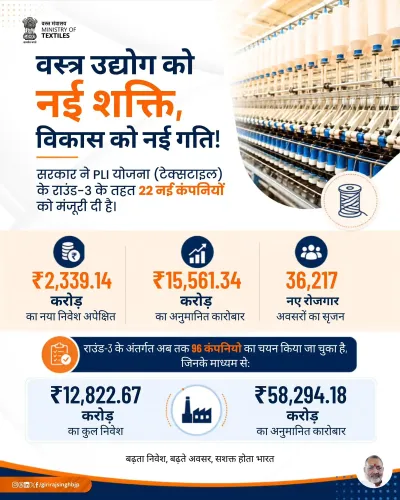
The reforms appear to have had a measurable impact on smaller enterprises. Of the 96 applications received during the third round, 65 — approximately 68 per cent — came from MSMEs, according to Minister Margherita. This marks a significant shift in the scheme's reach, which had earlier been skewed toward larger players.
With MSME participation rising sharply and state-level investments gaining traction, the scheme's third round signals a broadening of India's textile manufacturing base beyond traditional hubs.
Point of View
But the October 2025 reforms are the more consequential data point. Halving the investment threshold and slashing the turnover bar were textbook corrections to a scheme that had, in earlier rounds, effectively excluded the MSME segment that dominates Indian textiles. The 68% MSME share in round three suggests the recalibration is working — though 904 jobs across 24 companies remains a thin return on a nationally-funded incentive. The real test will be whether turnover translates into export competitiveness in MMF, where India still trails China and Bangladesh by a significant margin.
NationPress
27 Oct 2026
Frequently Asked Questions
How much has been invested under the Textile PLI scheme in Maharashtra?
As of 31 March 2026, 24 Maharashtra-based companies approved under the Centre's Textile PLI Scheme have collectively invested ₹167.51 crore, generated a turnover of ₹177.75 crore, and created 904 jobs, according to a government reply in the Lok Sabha.
Which companies are the top investors under the Textile PLI scheme in Maharashtra?
Microtex Processors Private Limited in Kolhapur recorded the highest investment at ₹91.02 crore, while Spica Industries Private Limited in Satara invested ₹76.37 crore and created 640 jobs — the most by any single company in the state under the scheme.
What changes were made to the Textile PLI scheme in October 2025?
The government introduced several reforms in October 2025, including adding 17 new HSN codes, cutting the minimum investment threshold by 50%, reducing the incremental turnover requirement for incentives from 25% to 10%, and removing the need to set up a new company to avail benefits. The application portal was also reopened.
How has MSME participation changed under the Textile PLI scheme?
MSME participation rose sharply in the third round: 65 of 96 applications received — around 68% — came from MSMEs. This is a significant increase attributed to the October 2025 reforms that lowered entry barriers for smaller enterprises.
What is the total number of companies approved under the Textile PLI scheme nationwide?
A total of 170 companies have been approved under the PLI Scheme for Textiles across India, of which 24 are based in Maharashtra, according to Minister of State for Textiles Pabitra Margherita's written reply in the Lok Sabha on 28 July 2026.