Giriraj Singh: PLI Draws ₹8,118 Cr, 33,427 Jobs in Textiles
Synopsis
Union Textiles Minister Giriraj Singh announced on 22 July 2026 that 170 companies have invested ₹8,118 crore under the PLI scheme for textiles, generating over 33,427 new jobs — citing it as proof of accelerating momentum toward Aatmanirbhar Bharat and Viksit Bharat 2047 goals.
Key Takeaways
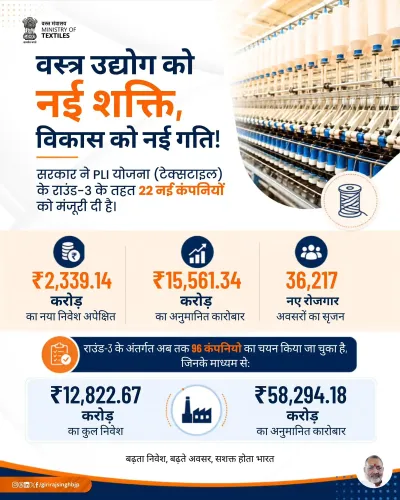
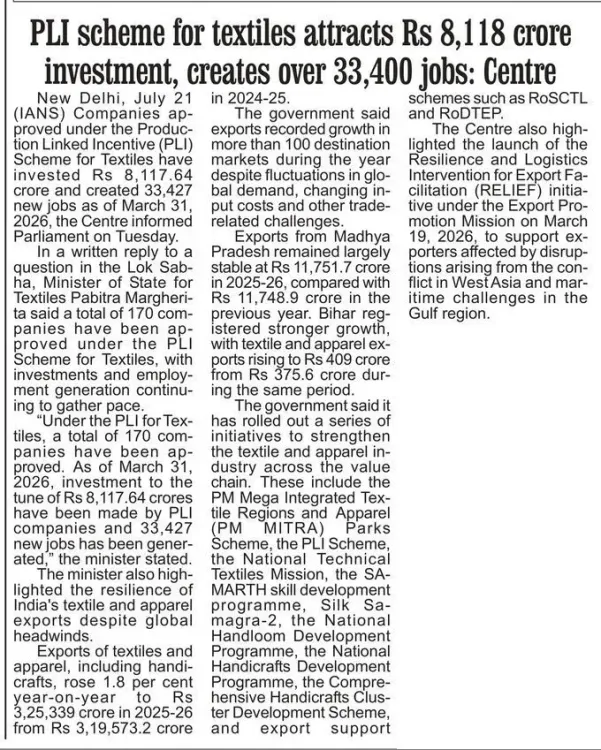
170 companies have participated in the PLI scheme for textiles, according to Minister Giriraj Singh's post dated 22 July 2026 .
Total investment under the scheme has reached approximately ₹8,118 crore .
More than 33,427 new jobs have been created in the textile sector under PLI.
The PLI scheme for textiles was launched in 2021 with a total outlay exceeding ₹10,000 crore , targeting man-made fibre and technical textiles.
The announcement is framed within the government's Aatmanirbhar Bharat and Viksit Bharat 2047 policy frameworks.
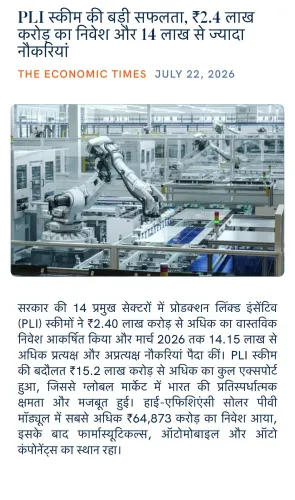
Textiles is one of 14 sectors covered under India's broader PLI incentive architecture introduced since 2020.
Union Textiles Minister Giriraj Singh on Wednesday, 22 July 2026, highlighted that 170 companies have invested approximately ₹8,118 crore under the Production Linked Incentive (PLI) scheme for textiles, generating more than 33,427 new jobs across the sector.
Posting on X, the minister wrote — 'कपड़ा क्षेत्र में भारत लगातार नई ऊंचाइयों की ओर बढ़ रहा है' ('India is continuously moving towards new heights in the textiles sector') — and credited the PLI scheme for accelerating investment and creating employment opportunities for youth.
Context
Giriraj Singh, a senior BJP leader and Lok Sabha MP from Begusarai, Bihar, has been an active proponent of expanding domestic textile manufacturing under the Aatmanirbhar Bharat framework. His post frames the PLI milestone as evidence that the government's industrial incentive strategy is yielding measurable results in one of India's most employment-intensive sectors. The minister emphasised that investment is rising and job opportunities for young Indians are 'continuously growing', aligning the progress with the long-term Viksit Bharat 2047 vision of transforming India into a developed economy by the centenary of independence.Policy Backdrop
The PLI scheme for textiles was announced in 2021 as part of a broader push to attract fresh capital into man-made fibre (MMF) apparel and technical textiles — two segments identified as high-growth and import-dependent. The scheme carries a total outlay exceeding ₹10,000 crore. The textiles PLI sits within a wider architecture of 14 manufacturing sectors covered by PLI incentives since 2020, a strategy designed to deepen domestic value addition and build resilient supply chains. Textiles were prioritised because of their dual importance: a significant share of India's merchandise exports and a large base of direct and indirect employment, particularly for women workers in states such as Tamil Nadu, Gujarat, Maharashtra, and Telangana. The Aatmanirbhar Bharat package of 2020 had already included dedicated measures for the textiles and apparel sector, making the PLI scheme a continuation and deepening of that policy direction.Stakeholders and Impact
For textile manufacturers, the PLI framework offers performance-linked financial incentives that reduce the effective cost of scaling up production in MMF and technical textiles — categories where India has historically lagged behind competitors such as China, Vietnam, and Bangladesh. For Indian youth, particularly those entering the labour market in smaller towns and semi-urban clusters, the jobs created under PLI-linked facilities represent a pathway into formal manufacturing employment. With more than 33,427 positions reported so far, the scheme is beginning to demonstrate scale, though the broader target remains significantly larger relative to the sector's total workforce. Investors and industry bodies will watch whether the momentum translates into export order gains, especially as global buyers diversify supply chains away from single-country dependence.What's Next
Quarterly progress reports from the Ministry of Textiles will be the primary barometer for tracking whether investment commitments convert into sustained production and additional hiring. Any scheme extension or fresh capital allocation in the next Union Budget would signal the government's confidence in the PLI model for textiles. With Viksit Bharat 2047 as the overarching policy horizon, the Ministry is likely to use milestones such as these to build the case for deeper integration of Indian textiles into global value chains — and potentially for expanding PLI coverage to additional sub-sectors.Point of View
Using concrete investment and jobs figures to validate the PLI model ahead of what is likely to be a budget cycle conversation about scheme extensions. The choice to invoke both Aatmanirbhar Bharat and Viksit Bharat 2047 in a single post signals an effort to connect near-term industrial data to the government's long-horizon development narrative. For the BJP, textiles carry particular political weight because the sector's workforce is concentrated in electorally significant states and among demographic groups the party courts. The announcement also arrives at a moment when India is actively positioning itself as an alternative sourcing destination for global apparel buyers, making domestic investment numbers a diplomatic as well as economic talking point.
NationPress
21 Oct 2026
Frequently Asked Questions
What is the PLI scheme for textiles in India?
The Production Linked Incentive (PLI) scheme for textiles was launched in 2021 with an outlay exceeding ₹10,000 crore to attract investment in man-made fibre apparel and technical textiles, offering financial incentives linked to incremental production.
How many companies have invested under the textiles PLI scheme?
According to Union Textiles Minister Giriraj Singh's post on 22 July 2026, 170 companies have invested approximately ₹8,118 crore under the PLI scheme for textiles.
How many jobs has the textiles PLI scheme created?
Minister Giriraj Singh stated that more than 33,427 new jobs have been generated in the textile sector under the PLI scheme as of July 2026.
What is Viksit Bharat 2047?
Viksit Bharat 2047 is the Indian government's vision to transform India into a fully developed economy by 2047, the centenary of independence, with manufacturing growth and self-reliance as core pillars.
What is Aatmanirbhar Bharat and how does it relate to textiles?
Aatmanirbhar Bharat, launched in 2020, is India's self-reliance initiative aimed at boosting domestic manufacturing and reducing import dependence; textiles were among the priority sectors, with the PLI scheme serving as a key instrument under this framework.