CM Bhupendra Patel backs Alang ship recycling policy reforms

Synopsis
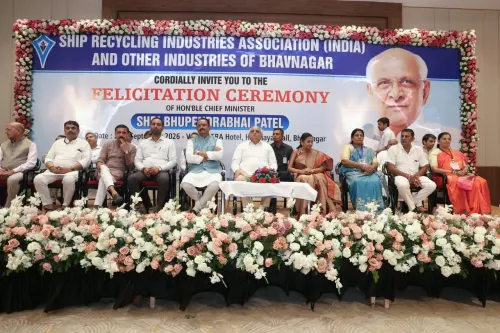
Gujarat CM Bhupendra Patel attended a Ship Recycling Industries Association ceremony in Bhavnagar on 25 September 2026, celebrating a new Gujarat Maritime Board policy that extends plot-use tenures to 15 years, simplifies plot mergers and ownership transfers, and reduces charges for Alang operators.
Key Takeaways
Gujarat Maritime Board announced a new policy for the Alang ship recycling sector.
Plot-use permission tenures extended to 15 years , providing long-term operational certainty.
Policy includes simplified plot-merger procedures, streamlined ownership transfers, and charge reductions.
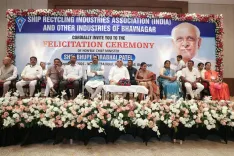
CM Bhupendra Patel attended the felicitation ceremony in Bhavnagar hosted by the Ship Recycling Industries Association.
Alang is one of the world's largest ship recycling facilities and a key source of recycled steel for India.
Reforms follow Gujarat's established pattern of ease-of-doing-business incentives for industrial clusters.
At Alang — the world's largest ship-breaking coast — a new Gujarat Maritime Board policy is quietly rewriting the rules for one of India's most strategically important heavy industries. Gujarat Chief Minister Bhupendra Patel on Friday, 25 September 2026 attended a special felicitation ceremony in Bhavnagar, hosted by the Ship Recycling Industries Association, where sector leaders welcomed the state government's sweeping package of regulatory reforms.
What the new GMB policy actually changes for Alang operators
The policy's headline measure extends plot-use permission tenures to 15 years — a significant jump that gives operators long-term planning certainty they have long demanded. Alongside that, the Gujarat Maritime Board has introduced simplified plot-merger procedures, streamlined ownership-transfer processes, and reductions in multiple charges that had been friction points for businesses along the yard.
In his remarks, Chief Minister Patel described the reforms as the government delivering 'a positive solution for industrialists' — framing the changes as a product of mutual trust between the state and the business community. 'સરકાર અને ઉદ્યોગકારો વચ્ચેનો આ પરસ્પર વિશ્વાસ જ રાજ્યના ઔદ્યોગિક વિકાસની સાચી તાકાત છે' — 'This mutual trust between government and industrialists is the true strength of the state's industrial development,' he wrote.
Alang's weight in Gujarat's industrial fabric
Alang, in Bhavnagar district, handles a large share of global shipbreaking volume and feeds recycled steel into India's broader manufacturing supply chain. The yard has been central to Gujarat's industrial identity since the 1980s, when the state first began developing formal recycling policies for the site. Employment along the coast runs into the tens of thousands, making policy shifts here consequential not just for yard owners but for the wider regional economy.
The reforms fit a pattern Gujarat has pursued consistently: using targeted regulatory simplifications to reinforce existing industrial clusters rather than building from scratch. The ease-of-doing-business framework, sharpened under former Gujarat Chief Minister and now Prime Minister Narendra Modi and carried forward by Patel, treats procedural friction — lengthy tenures, complex mergers, opaque charges — as costs the state can directly reduce.
The government's pitch: simpler, faster, time-bound
Chief Minister Patel explicitly credited Prime Minister Modi's guidance for orienting state processes toward transparency and time-bound delivery for industrialists. The framing positions Alang's upgrade as part of a national-level ease-of-business ambition, not merely a local administrative fix.
The test now is rollout. Operators will be watching whether the extended plot permissions and charge relaxations translate quickly into operational relief — and whether follow-up measures bring state rules closer into alignment with evolving national and international ship-recycling standards.
Gujarat has set the frame. Alang's recyclers will determine whether the trust holds.
Point of View
Extend planning horizons, and let existing clusters deepen rather than diversifying risk into new sectors. By framing 15-year plot tenures and charge reductions as a trust-building exercise rather than mere administrative revision, Chief Minister Patel is consciously investing in the political economy of Bhavnagar's industrial belt ahead of any future electoral calculus. The linkage to Prime Minister Modi's ease-of-business doctrine also serves a dual purpose: it reinforces continuity of the Gujarat model at the national level while insulating state-level reforms from criticism. The real watch-item is whether state rules will now converge with tighter international ship-recycling standards — that alignment would determine whether Alang grows its global market share or remains a domestic-supply play.
NationPress
25 Sept 2026
Frequently Asked Questions
What is the new Gujarat Maritime Board policy for Alang ship recycling?
The new GMB policy extends plot-use permission tenures to 15 years, introduces simplified plot-merger procedures, streamlines ownership-transfer processes, and reduces various charges for ship recycling operators at Alang in Bhavnagar district.
Why is Alang significant for India's economy?
Alang in Bhavnagar district, Gujarat, is one of the world's largest ship recycling facilities. It employs tens of thousands of workers and supplies recycled steel to India's broader manufacturing sector, making it strategically important for both regional employment and industrial supply chains.
What did CM Bhupendra Patel say at the Bhavnagar ceremony on 25 September 2026?
CM Bhupendra Patel said the state government has delivered a positive solution for industrialists through the new policy, and described the mutual trust between government and industrialists as the true strength of Gujarat's industrial development.
What is the Ship Recycling Industries Association?
The Ship Recycling Industries Association is an industry body that represents ship recycling operators at Alang. It organised the special felicitation ceremony in Bhavnagar to welcome the new Gujarat Maritime Board policy reforms.
How does the Alang policy reform relate to India's ease of doing business push?
CM Patel linked the Alang reforms to Prime Minister Narendra Modi's guidance on making government processes simpler, more transparent, and time-bound for industrialists — positioning them within the broader national ease-of-doing-business framework.