CM Bhupendra Patel Hails Revenue Talatis as Village Backbone
Synopsis
Gujarat Chief Minister Bhupendra Patel on 2 July 2026 described revenue Talatis as the 'spine of the administration' and the 'Chief Secretary of the village,' spotlighting the critical role of grassroots revenue officials in Gujarat's governance structure.
Key Takeaways
CM Bhupendra Patel called revenue Talatis the 'spine of the administration' at the village level in a post on 2 July 2026 .
He equated the revenue Talati's role to that of a 'Chief Secretary of the village,' the highest-ranking civil servant designation in a state.
Gujarat has maintained the Talati system since state formation in 1960 , inherited from the former Bombay Presidency .
Talatis operate within a revenue hierarchy that runs through Mamlatdars and Prant Officers up to the state Revenue Department .
The statement comes amid broader national efforts to digitise land records and strengthen last-mile governance delivery.
Observers are watching for follow-up announcements on Talati recruitment, training, or land-record digitisation integration.
Gujarat Chief Minister Bhupendra Patel on Thursday, 2 July 2026, paid tribute to the role of revenue Talatis in the state's administrative structure, describing them as the 'spine of the administration' at the grassroots level. In a post on X, he underscored the indispensable position these village-level officials occupy in Gujarat's governance machinery.
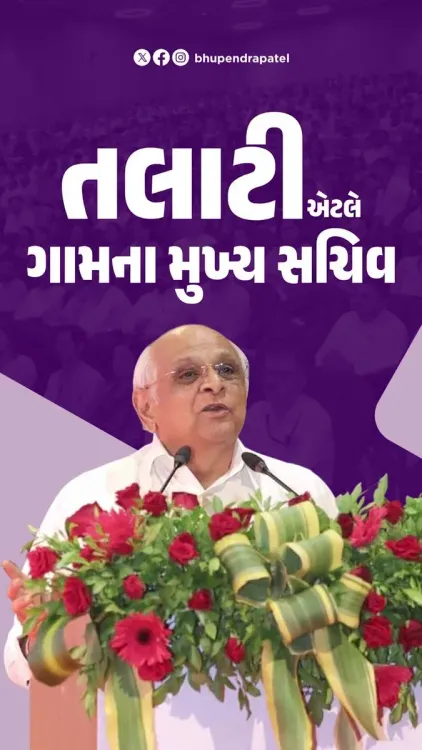
Writing in Gujarati, CM Patel stated: 'ગ્રામ્ય કક્ષાએ મહેસૂલી તલાટીની ભૂમિકા વહીવટીતંત્રના કરોડરજ્જુ સમાન છે. મહેસૂલી તલાટી એટલે ગામના મુખ્ય સચિવ.' ['At the village level, the role of the revenue Talati is like the spine of the administration. The revenue Talati is the Chief Secretary of the village.'] The comparison to a Chief Secretary — the highest-ranking civil servant in a state government — signals the weight CM Patel attaches to these grassroots functionaries.
Context
Gujarat has maintained the Talati post as the lowest tier of its revenue administration since the state's formation in 1960, inheriting the system from the former Bombay Presidency. Revenue Talatis serve as village accountants and the first point of contact for rural citizens on matters of land records, revenue collection, and certificate issuance. Their role places them at the centre of everyday governance for millions of rural households across the state.
The post by CM Patel draws attention to a cadre that operates largely out of public view, even as it underpins the delivery of welfare schemes and land-related services at the last mile. By elevating the Talati's status to that of a 'village Chief Secretary,' the Chief Minister frames grassroots revenue officials as partners in governance rather than merely clerical staff.
Policy Backdrop
Gujarat's revenue hierarchy runs from the Talati at the village level upward through Mamlatdars and Prant Officers to the state Revenue Department. This chain of command has remained structurally consistent across successive governments, providing administrative continuity in rural areas. Talatis are responsible for maintaining land records, processing mutation entries, and supporting the implementation of centrally and state-sponsored schemes.
Across India, states have periodically spotlighted village-level revenue staff, particularly as land-record digitisation drives — such as the central government's Digital India Land Records Modernisation Programme — seek to integrate grassroots officials into technology-enabled platforms. Gujarat has been among the states pursuing modernisation of its land-record systems, making the human layer of Talatis a critical link in that chain.
Stakeholders and Impact
The statement is directly relevant to Gujarat's estimated several thousand serving revenue Talatis, whose professional recognition and morale can be influenced by public acknowledgement from the Chief Minister. For rural landowners and farmers — who interact with Talatis for everything from land mutation to income certificates — the post signals that the state's top executive is attentive to the functioning of village-level administration.
Civil society groups focused on rural governance and land rights have long argued that the effectiveness of welfare delivery depends heavily on the capacity and accountability of officials like Talatis. A public statement of this nature from CM Patel may reinforce institutional respect for the cadre at a time when recruitment and training in revenue services remain active policy concerns.
What's Next
Observers will watch for any follow-up policy announcements from the Gujarat government, including initiatives around Talati recruitment, structured training modules, or deeper integration of Talatis with land-record digitisation platforms. CM Patel's remarks, while ceremonial in tone, could precede concrete administrative decisions aimed at strengthening the revenue machinery at the village level. The statement also sets a political tone ahead of any future engagement with the state's revenue administration workforce.
Point of View
Particularly ahead of recruitment cycles or policy reforms. For Gujarat, where land-record digitisation is an ongoing priority, reinforcing the human layer of revenue administration is also a governance signal: technology works best when the officials operating it are motivated and valued. The post is low-key in form but pointed in its message to both the bureaucracy and the rural electorate.
NationPress
1 Oct 2026
Frequently Asked Questions
Who is a revenue Talati in Gujarat?
A revenue Talati in Gujarat is the lowest-tier official in the state's revenue administration, responsible for maintaining village land records, processing mutation entries, collecting revenue, and issuing certificates to rural residents.
What did Gujarat CM Bhupendra Patel say about Talatis?
CM Bhupendra Patel said on 2 July 2026 that the revenue Talati is the 'spine of the administration' at the village level and described the role as equivalent to the 'Chief Secretary of the village.'
What is the role of a Talati in village administration?
A Talati serves as the primary government contact for rural citizens on land and revenue matters, maintaining records, supporting welfare scheme delivery, and functioning as the first administrative link between the state and village-level populations.
How does Gujarat's revenue administration hierarchy work?
Gujarat's revenue hierarchy starts with the Talati at the village level, followed by the Mamlatdar at the taluka level, then the Prant Officer , and ultimately the state Revenue Department , providing a structured chain of administrative oversight.
Why are Talatis important for land record digitisation in Gujarat?
Talatis are the ground-level officials who maintain and update land records, making them a critical human link in Gujarat's efforts to digitise land records and integrate village-level data into modern administrative platforms.