CM Bhupendra Patel Hails Modi's 12-Year Defence Record

Synopsis
Gujarat Chief Minister Bhupendra Patel on 17 June 2026 lauded PM Narendra Modi's 12-year tenure, highlighting gains in counter-terrorism, border infrastructure, military modernisation, and indigenous defence production under the Aatmanirbhar Bharat initiative.
Key Takeaways
Gujarat CM Bhupendra Patel posted on 17 June 2026 crediting PM Modi with transforming India's defence landscape over 12 years .
The post is part of the #12YearsOfSurakshitBharat campaign marking over a decade of BJP governance at the Centre.
Key policy milestones cited include Make in India (2014) , Defence Procurement Procedure 2016 , and the Aatmanirbhar Bharat Abhiyan (2020) .
India's negative import lists and new Defence and Aerospace Corridors — including one in Gujarat — underpin the indigenisation drive.
Doctrinal shifts such as the 2016 surgical strikes and 2019 Balakot action are part of the government's stated counter-terrorism record.
Upcoming markers include the next Defence Procurement Manual and progress on indigenous fighter and submarine programmes.
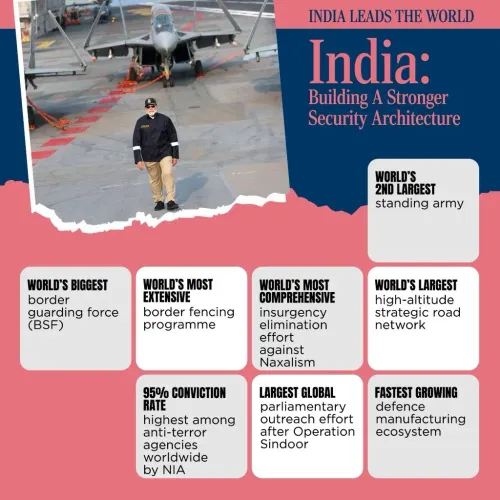
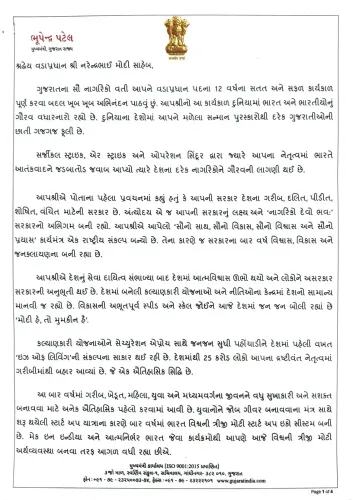
Gujarat Chief Minister Bhupendra Patel on Wednesday, 17 June 2026, credited Prime Minister Narendra Modi with transforming India's defence landscape over the past 12 years, citing advances in counter-terrorism policy, border infrastructure, military modernisation, and the Aatmanirbhar Bharat initiative in defence manufacturing.
Context
Patel's post, tagged #12YearsOfSurakshitBharat, marks a decade-plus of BJP-led governance at the Centre under Prime Minister Modi, who assumed office in May 2014. The hashtag — translating broadly to '12 Years of a Secure India' — reflects a coordinated party effort to highlight the government's national-security credentials. The Chief Minister described India as 'stronger, safer and more capable than ever before,' attributing this to what he called Modi's 'unwavering commitment to national security and self-reliance.'
The post arrives amid an active political calendar and follows a period in which defence readiness, border security, and domestic arms production have remained central to the ruling party's public messaging.
Policy Backdrop
The policy lineage Patel alludes to stretches back to the Make in India programme launched in September 2014, which identified defence manufacturing as a priority sector. The Defence Procurement Procedure 2016 subsequently revised procurement rules to give substantially higher preference to indigenously designed and produced equipment.
A significant escalation came with the Aatmanirbhar Bharat Abhiyan announced in May 2020, which introduced multiple new defence production corridors, raised foreign direct investment limits in the sector, and published negative import lists — categories of equipment that must now be sourced domestically. These measures were designed to reduce India's historically high dependence on foreign arms suppliers and to grow a domestic defence-industrial base capable of meeting the armed forces' requirements.
On the border infrastructure front, successive budgets have channelled increased allocations toward road construction, airfield upgrades, and logistics connectivity along India's northern and eastern frontiers. Doctrinal shifts, including the 2016 surgical strikes across the Line of Control and the 2019 Balakot air action, have also been cited by the government as markers of a more assertive counter-terrorism posture.
Stakeholders and Impact
The primary beneficiaries of the indigenisation push are domestic defence manufacturers — both public-sector undertakings and a growing cohort of private firms — as well as the Indian Army, Navy, and Air Force, which have been directed to prioritise locally produced platforms. The shift has also opened export opportunities, with India targeting a significant rise in defence exports over the medium term.
For Gujarat specifically, the state hosts one of the two designated Defence and Aerospace Corridors and has attracted investment commitments from several aerospace and defence component manufacturers, giving Patel's endorsement a local economic dimension beyond the national political message.
What's Next
Analysts and industry observers will watch for the release of the next Defence Procurement Manual, progress updates on indigenous fighter aircraft and submarine programmes, and any state-level defence manufacturing investment announcements tied to forthcoming Union and state budgets. The #12YearsOfSurakshitBharat campaign is likely to intensify in the coming days as the BJP uses the anniversary to consolidate its national-security narrative ahead of future electoral cycles. Whether the messaging translates into fresh policy announcements or remains commemorative will be a key indicator of the government's near-term defence agenda.
Point of View
With state-level leaders lending regional credibility to a central government anniversary campaign. The framing around 'self-reliance' and 'decisive' counter-terrorism policy is deliberate — it ties economic nationalism to hard-security credentials, a combination the BJP has consistently used to broaden its electoral coalition. Gujarat's own role as a designated Defence Corridor state gives Patel's endorsement a material, not merely rhetorical, basis. The campaign's durability will depend on whether tangible programme milestones — indigenous aircraft, submarine inductions, export figures — can be announced to sustain the narrative beyond social-media momentum.
NationPress
19 Sept 2026
Frequently Asked Questions
What is the #12YearsOfSurakshitBharat hashtag about?
The hashtag marks 12 years of PM Narendra Modi's government at the Centre since May 2014, with BJP leaders highlighting achievements in national security, border infrastructure, and defence indigenisation.
What is Aatmanirbhar Bharat in defence?
Aatmanirbhar Bharat in defence refers to the self-reliance initiative launched in May 2020, which includes negative import lists requiring domestic sourcing of certain equipment, new defence production corridors, and higher FDI limits to grow India's domestic arms industry.
What did Gujarat CM Bhupendra Patel say about PM Modi's defence record?
Patel said Modi's 'unwavering commitment to national security and self-reliance' has transformed India's defence landscape, pointing to counter-terrorism policy, border infrastructure upgrades, military modernisation, and the Aatmanirbhar Bharat initiative.
What are India's Defence and Aerospace Corridors?
India has established Defence and Aerospace Corridors — including one in Gujarat — to attract investment from defence manufacturers, boost domestic production, and reduce reliance on imported military equipment.
What defence policy changes did India make after 2014?
After 2014, India launched Make in India with defence as a priority, revised the Defence Procurement Procedure in 2016 to favour indigenous products, introduced the Aatmanirbhar Bharat Abhiyan in 2020 with negative import lists, and increased spending on border road and airfield construction.