CM Bhupendra Patel hails Modi as longest-serving elected PM
Synopsis
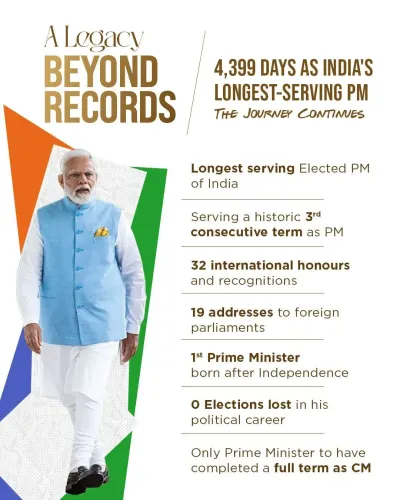
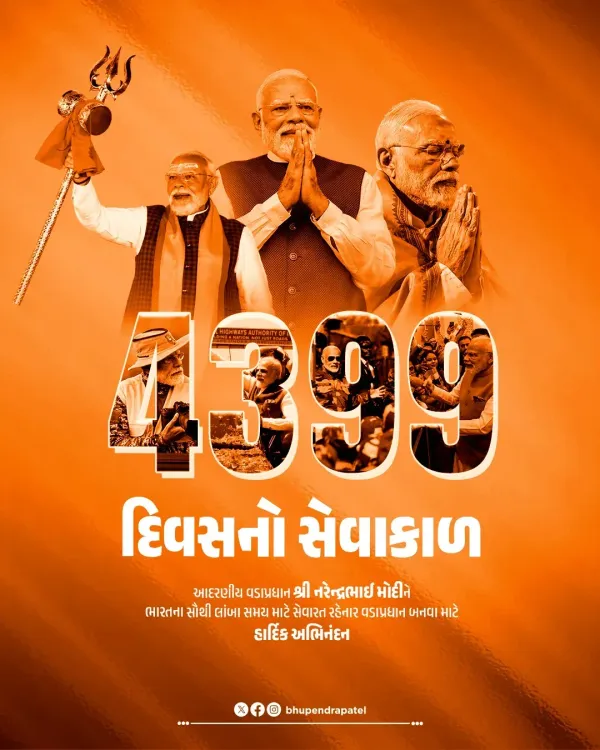
Gujarat Chief Minister Bhupendra Patel on 10 June 2026 hailed Prime Minister Narendra Modi's completion of 4,399 days in office, calling him India's longest-serving elected Prime Minister and linking the milestone to welfare delivery, women's empowerment, infrastructure and the Viksit Bharat vision.
Key Takeaways
Gujarat CM Bhupendra Patel posted a tribute on 10 June 2026 marking PM Modi's 4,399 days as Prime Minister.
Patel described Modi as India's longest-serving elected Prime Minister , framing the tenure as a sign of unbreakable public trust.
The tribute cited Garib Kalyan , women's empowerment , infrastructure and economic prosperity as the pillars of Modi's governance record.
The post invoked the Viksit Bharat goal of India achieving developed-nation status by 2047 .
The hashtag #LongestServingElectedPMModi signals a coordinated BJP social-media campaign around the milestone.
Modi has served continuously since first being sworn in on 26 May 2014 , winning re-election in 2019 and 2024 .
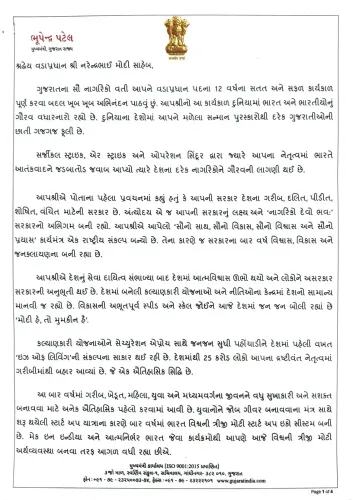
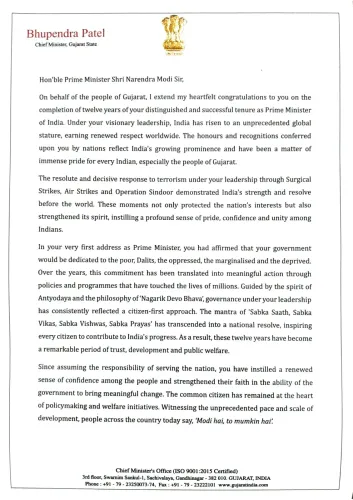
Gujarat Chief Minister Bhupendra Patel on Wednesday, 10 June 2026, congratulated Prime Minister Narendra Modi on completing 4,399 days in office, marking a milestone the CM described as making Modi the longest-serving elected Prime Minister in India's history. Patel posted the tribute on X, calling the achievement a symbol of the unbreakable trust of every citizen in the Prime Minister.
Context
Writing in Gujarati, Patel declared the milestone as 'ભારતના વિકાસ, સુશાસન અને રાષ્ટ્રનિર્માણને સમર્પિત ૪,૩૯૯ દિવસો' ['4,399 days dedicated to India's development, good governance and nation-building']. He stated that Modi has become 'the longest-serving elected Prime Minister of the country', framing the extended tenure as a direct reflection of popular confidence rather than mere political longevity. The post carried the hashtag #LongestServingElectedPMModi, a coordinated messaging marker used by BJP leaders across social media.
Narendra Modi was first sworn in as Prime Minister on 26 May 2014 following the BJP-led NDA's decisive general election victory. He was re-elected in 2019 and again in 2024, making his uninterrupted tenure the longest for any elected occupant of the office in independent India's history.
Policy Backdrop
Patel's tribute specifically anchors the tenure milestone to four policy pillars: Garib Kalyan (welfare of the poor), women's empowerment, world-class infrastructure, and economic prosperity. These themes map directly onto flagship central programmes — from direct-benefit transfers and the PM Awas Yojana to large-scale infrastructure corridors — that have defined the BJP government's domestic agenda since 2014.
Patel also invoked the Viksit Bharat vision, the central government's stated goal of transforming India into a fully developed nation by 2047, the centenary of independence. He wrote that the country is 'steadily moving forward towards becoming a Viksit Bharat' — placing the longevity milestone within a longer arc of national ambition rather than treating it as a purely political achievement.
Stakeholders and Impact
Bhupendra Patel, who has served as Chief Minister of Gujarat since 2021, is among the senior BJP state leaders whose public messaging consistently reinforces the party's central narrative on governance continuity. His post is part of a broader pattern of state-level BJP figures amplifying milestones related to Modi's tenure, particularly ahead of electoral cycles.
For ordinary citizens — especially women and low-income households who are the stated beneficiaries of welfare schemes cited in the post — the political significance of the milestone is filtered through the on-ground performance of those programmes. The tribute implicitly ties the longevity of leadership to the delivery record of schemes reaching these groups across states including Gujarat.
What's Next
The milestone tribute is likely to be echoed by BJP leaders at both national and state levels as the party builds a governance narrative around continuity and delivery. Attention will turn to the state-level rollout of Viksit Bharat-aligned schemes, with Gujarat expected to showcase model implementations of central welfare and infrastructure programmes. The broader question is whether the political capital of a record tenure translates into measurable outcomes on the ground in the months ahead.
Point of View
Timed to amplify a tenure milestone as a governance credential. By tethering 4,399 days to Viksit Bharat, the party attempts to convert a statistical record into a forward-looking promise — shifting the conversation from how long Modi has governed to what that governance is still meant to achieve. For the BJP, this kind of milestone messaging serves a dual purpose: it consolidates the party's identity around a single leadership figure while pre-empting opposition narratives about incumbency fatigue. The real test, however, lies in whether the welfare and infrastructure benchmarks cited by Patel are seen by voters as fulfilled or still aspirational.
NationPress
26 Oct 2026
Frequently Asked Questions
Who is India's longest-serving elected Prime Minister?
Narendra Modi is recognised as India's longest-serving elected Prime Minister, having served continuously since 26 May 2014 across three successive terms. Gujarat CM Bhupendra Patel highlighted this milestone on 10 June 2026 , noting Modi had completed 4,399 days in office.
What is the Viksit Bharat vision?
Viksit Bharat is the central government's national vision to transform India into a fully developed nation by 2047 , the centenary of independence. It encompasses goals around economic growth, infrastructure, welfare delivery and social development.
Why did Bhupendra Patel post a tribute to PM Modi in June 2026?
Gujarat Chief Minister Bhupendra Patel posted the tribute to mark PM Modi's completion of 4,399 days as Prime Minister — a record that makes him India's longest-serving elected PM. Patel called it a symbol of the unbreakable trust of every Indian citizen.
When was Narendra Modi first sworn in as Prime Minister?
Narendra Modi was first sworn in as Prime Minister of India on 26 May 2014 , following the BJP -led NDA 's victory in the general elections that year.
What welfare programmes did CM Patel link to Modi's tenure milestone?
In his tribute, CM Bhupendra Patel cited Garib Kalyan (welfare of the poor), women's empowerment , world-class infrastructure and economic prosperity as the defining achievements of Modi's record tenure.