CM Bhupendra Patel Flags Off Mission Five Million Trees in Ahmedabad

Synopsis
Gujarat Chief Minister Bhupendra Patel attended the World Environment Day launch of Mission Five Million Trees and the flag-off of a Mobile Source Apportionment Laboratory by the Ahmedabad Municipal Corporation on 5 June 2026, marking a dual push on urban greening and air quality monitoring.
Key Takeaways
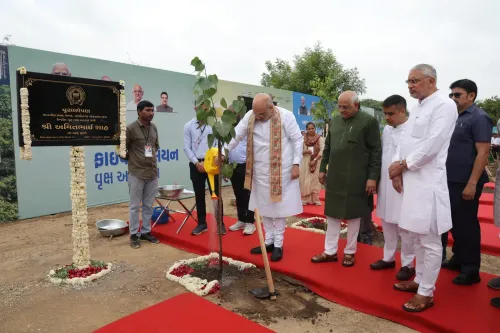
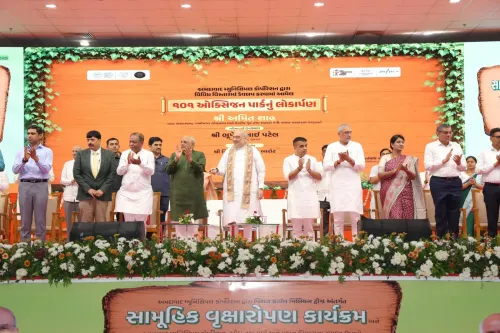
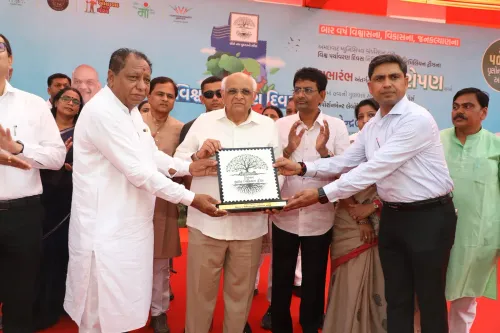
Gujarat Chief Minister Bhupendra Patel was present at the Ahmedabad Municipal Corporation's World Environment Day event on 5 June 2026 .
AMC formally launched Mission Five Million Trees , a city-scale urban afforestation drive, at the event.
A Mobile Source Apportionment Laboratory was flagged off to identify and quantify sources of air pollution across Ahmedabad .
Ahmedabad is a designated non-attainment city under the Centre's National Clean Air Programme (NCAP) , launched in 2019 .
The initiative builds on Gujarat's participation in the Green India Mission framework active since 2015 .
Data from the mobile laboratory is expected to inform AMC's targeted pollution control and resource allocation in future annual air quality reports.
Gujarat Chief Minister Bhupendra Patel attended the launch of Mission Five Million Trees on World Environment Day, 5 June 2026, organised by the Ahmedabad Municipal Corporation (AMC). The event also saw the flag-off of a Mobile Source Apportionment Laboratory aimed at improving air quality monitoring across the city.
Context
The Chief Minister's post, shared live from the event, announced his presence at the tree-plantation drive and the flag-off ceremony. In Gujarati, the post reads: 'Vishwa Paryavaran Divas nimitte Mission Five Million Trees na shubharambh antargat vruksharopan ane shahermaan havani gunvatta sudharvaa Mobile Source Apportionment Laboratoryno flag-off karyakram' — loosely translated as 'On the occasion of World Environment Day, a tree-plantation drive under the launch of Mission Five Million Trees and the flag-off of a Mobile Source Apportionment Laboratory to improve air quality in the city.'
World Environment Day, observed annually on 5 June, is a United Nations initiative to promote global awareness on environmental protection. Indian states and urban local bodies routinely use the occasion to announce or launch sustainability programmes.
Policy Backdrop
The Ahmedabad Municipal Corporation is the primary civic body managing urban services and environmental projects in Ahmedabad, one of India's fastest-growing metros. The city is among the non-attainment cities identified under the Centre's National Clean Air Programme (NCAP), launched in 2019 by the Ministry of Environment, Forest and Climate Change, which targets measurable reductions in particulate matter levels.
Gujarat has also been an active participant in the Green India Mission framework, with state-level afforestation efforts running since 2015. The Mission Five Million Trees initiative, launched formally on this occasion, represents AMC's city-scale contribution to that broader afforestation push. The Mobile Source Apportionment Laboratory is designed to identify and quantify pollution sources — such as vehicular emissions, construction dust, and industrial output — enabling more targeted interventions.
Stakeholders and Impact
Ahmedabad's residents stand to benefit most directly from both initiatives. Expanded urban tree cover can mitigate the urban heat island effect, improve local biodiversity, and absorb carbon emissions, while source-specific air quality data allows the municipal corporation to prioritise enforcement and remediation measures where they matter most.
Environmental non-governmental organisations and urban local bodies across Gujarat are also stakeholders, as successful implementation in Ahmedabad could serve as a replicable model for other cities in the state. The initiative aligns with Smart Cities Mission goals that emphasise data-driven urban environmental management.
What's Next
The rollout milestones for the five-million-tree target and the data outputs from the Mobile Source Apportionment Laboratory will be closely watched in Ahmedabad's annual air quality reports. If the laboratory's findings are integrated into municipal planning, they could shape how AMC allocates resources for pollution control in the coming years.
As Indian cities face mounting pressure to meet air quality standards ahead of national deadlines under NCAP, Ahmedabad's dual-track approach — expanding green cover while deploying diagnostic pollution tools — may set a benchmark for urban environmental governance in Gujarat and beyond.
Point of View
Particularly as Ahmedabad faces scrutiny under the National Clean Air Programme. Pairing a mass tree-plantation drive with a diagnostic pollution laboratory is a notably more data-driven approach than ceremonial greening exercises, suggesting the state is orienting toward measurable outcomes. This dual-track model — expanding green cover while identifying pollution sources — mirrors a broader national shift toward evidence-based urban environmental management. How consistently the laboratory's findings are acted upon will determine whether this marks a genuine policy inflection or a well-staged World Environment Day announcement.
NationPress
19 Sept 2026
Frequently Asked Questions
What is Mission Five Million Trees in Ahmedabad?
Mission Five Million Trees is an urban afforestation initiative launched by the Ahmedabad Municipal Corporation on World Environment Day, 5 June 2026, aiming to plant five million trees across the city. Specific targets and timelines were announced at the launch event attended by Gujarat Chief Minister Bhupendra Patel.
What is a Mobile Source Apportionment Laboratory?
A Mobile Source Apportionment Laboratory is a specialised vehicle-mounted facility used to identify and measure the contribution of different pollution sources — such as vehicles, construction dust, and industries — to a city's overall air pollution levels, enabling more targeted remediation.
Why is Ahmedabad considered a non-attainment city?
Ahmedabad is classified as a non-attainment city under the Centre's National Clean Air Programme because its particulate matter levels have consistently exceeded national ambient air quality standards, making it one of 131 cities prioritised for pollution reduction efforts since 2019.
What is the National Clean Air Programme?
The National Clean Air Programme (NCAP) is a central government scheme launched in 2019 by the Ministry of Environment, Forest and Climate Change. It targets measurable reductions in PM2.5 and PM10 levels in 131 cities, including Ahmedabad, through city-specific action plans.
What is Bhupendra Patel's role in Gujarat's environmental policy?
Bhupendra Patel has served as Gujarat's Chief Minister since 2021 and has aligned the state with central schemes such as NCAP and the Green India Mission. His attendance at the AMC's World Environment Day event underscores the state government's involvement in urban environmental initiatives.