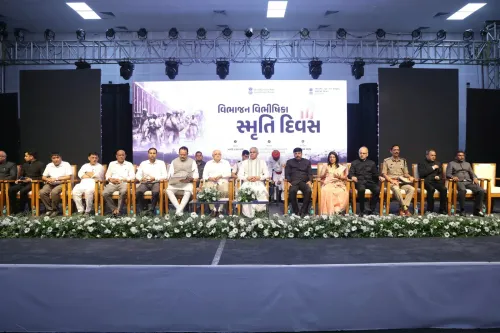
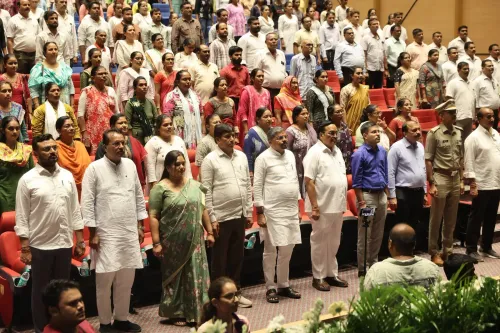
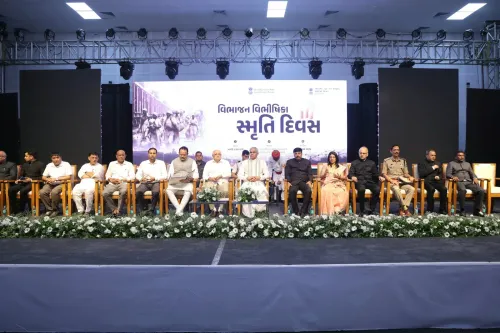
CM Bhupendra Patel Pays Tribute on Partition Horrors Remembrance Day
Synopsis
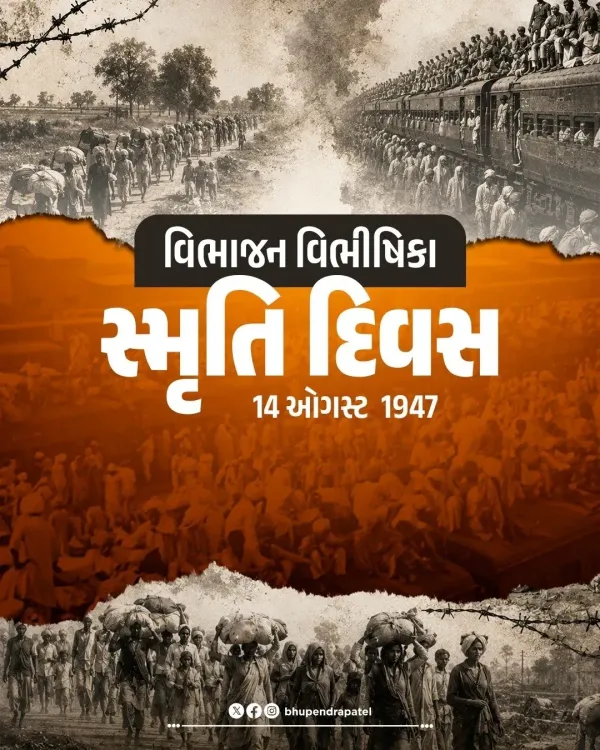
On Partition Horrors Remembrance Day, 14 August 2026, Gujarat Chief Minister Bhupendra Patel posted a Gujarati tribute honouring those who died or were displaced in the 1947 Partition, saluting survivors who rebuilt India with courage and patience.
Key Takeaways
Partition Horrors Remembrance Day falls on 14 August each year, formally notified by the Government of India in 2021 .
Gujarat CM Bhupendra Patel posted his tribute in Gujarati on 14 August 2026 , offering homage to victims and saluting survivors.
The 1947 Partition displaced an estimated 10 to 20 million people and killed hundreds of thousands in communal violence.
Gujarat has a direct historical connection to Partition through communities displaced from Sindh , now in Pakistan.
The observance focuses on the human cost of Partition — pain, displacement, and loss — rather than its political history.
State-level BJP leaders routinely issue regional-language tributes, bringing national commemorations into local cultural contexts.
Seventy-nine years after one of history's most traumatic mass displacements, the wounds of 1947 still demand acknowledgment. On Partition Horrors Remembrance Day, 14 August 2026, Gujarat Chief Minister Bhupendra Patel offered a solemn tribute to the millions who suffered, perished, and yet rebuilt — posting in Gujarati on X to mark the annual observance.
Translating his words: 'દેશનું વિભાજન એ માત્ર ભૌગોલિક સીમાઓનું રેખાંકન ન હતું' — 'The partition of the nation was not merely the drawing of geographical boundaries, but a dark chapter of immense pain, displacement, and inhuman suffering for crores of citizens.' He offered 'humble homage' to all who lost their lives in that tragedy, and saluted those who endured the unbearable anguish of losing their homeland, loved ones, and homes — yet rebuilt the nation with courage, toil, and patience.
A Day Declared to Remember What History Risks Forgetting
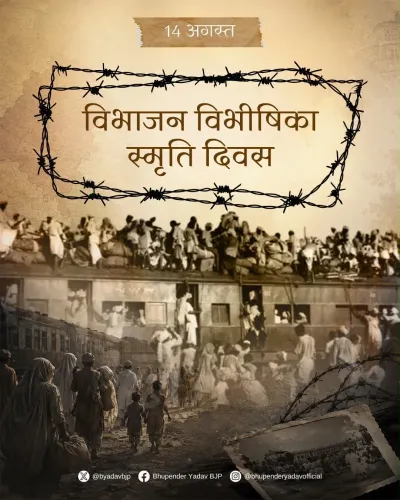
The Government of India formally notified 14 August as Partition Horrors Remembrance Day in 2021, creating an institutional anchor for grief that had long lived only in family memory. The date — the eve of Independence Day — is deliberate: it places the cost of freedom alongside its celebration. The observance centres on the human toll rather than the political mechanics of Partition, a distinction that gives it a different moral weight from conventional historical commemoration.
The 1947 Partition of British India into India and Pakistan triggered one of the largest forced migrations in recorded history — an estimated 10 to 20 million people displaced, and hundreds of thousands killed in communal violence. Entire communities were uprooted overnight. Families were severed across new borders that few had drawn and fewer had chosen.
Gujarat's Voice in a National Moment of Reckoning
CM Patel's message, written in Gujarati, reflects the state-level dimension of a nationally observed day. Gujarat itself absorbed large numbers of displaced families from what became Pakistan's Sindh province — communities whose descendants still carry the memory of that rupture. His tribute, posted the morning of 14 August 2026, is part of a broader pattern of ruling-party leaders issuing regional-language commemorations that bring the observance closer to local lived histories.
The kicker: as long as survivors and their children are alive, Partition Horrors Remembrance Day is not history — it is testimony. And every August, India chooses to listen.
Point of View
Introduced in 2021, represents a conscious effort by the central government to institutionalise memory of the 1947 tragedy as a civic obligation rather than a partisan exercise. State-level tributes like CM Patel's Gujarati post extend that framework into regional identities — Gujarat's Sindhi diaspora gives the commemoration particular local resonance. The pattern of ruling-party leaders issuing such statements in regional languages signals a deliberate outreach to communities for whom Partition is still living memory, not distant textbook history. Whether the observance deepens into structured public events or remains largely a social-media ritual is the question that will define its long-term institutional weight.
NationPress
29 Sept 2026
Frequently Asked Questions
What is Partition Horrors Remembrance Day?
Partition Horrors Remembrance Day is observed every year on 14 August to honour the victims and survivors of the 1947 Partition of India . The Government of India formally declared the observance in 2021 to acknowledge the mass displacement, violence, and loss of life that accompanied the division of British India into India and Pakistan.
Why did Bhupendra Patel post about Partition Remembrance Day?
Gujarat CM Bhupendra Patel posted a Gujarati tribute on 14 August 2026 as part of the annual Partition Horrors Remembrance Day observance, offering homage to those who died and saluting survivors who helped rebuild the nation despite immense suffering.
Why is Partition Remembrance Day on 14 August and not 15 August?
14 August — the eve of India's Independence Day — was chosen deliberately, so that the human cost of Partition is remembered alongside the celebration of freedom. It places grief and gratitude side by side on the national calendar.
How many people were displaced in the 1947 Partition?
The 1947 Partition triggered one of the largest forced migrations in recorded history, with estimates of 10 to 20 million people displaced and hundreds of thousands killed in communal violence as British India was divided into India and Pakistan.
What is Gujarat's connection to the 1947 Partition?
Gujarat has a direct historical link to Partition through large communities displaced from Sindh , which became part of Pakistan in 1947. Many Sindhi families settled in Gujarat, making the annual remembrance personally significant for a substantial part of the state's population.