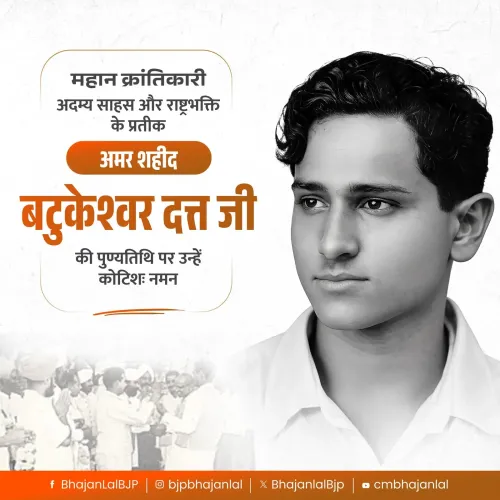
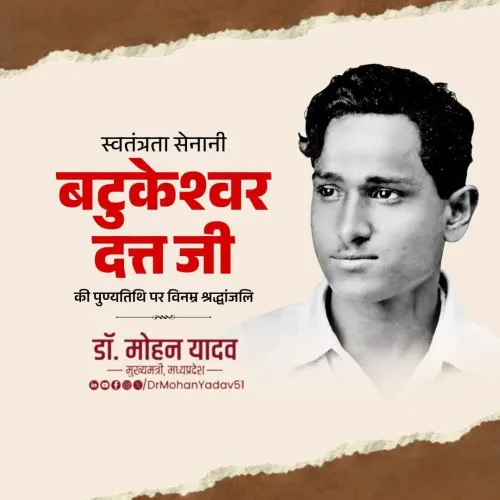
CM Bhupendra Patel pays tribute to revolutionary Batukeshwar Dutt

Synopsis
Gujarat Chief Minister Bhupendra Patel honoured revolutionary Batukeshwar Dutt on his birth anniversary, recalling the 1929 Central Legislative Assembly bombing alongside Bhagat Singh and Dutt's imprisonment in the Cellular Jail.
Key Takeaways
Gujarat CM Bhupendra Patel paid tribute to revolutionary Batukeshwar Dutt on his birth anniversary on 18 November 2026 .
Dutt and Bhagat Singh threw smoke bombs in the Central Legislative Assembly on 8 April 1929 to protest repressive British legislation.
Both revolutionaries courted arrest deliberately, turning the act into a landmark moment of India's armed resistance movement.
Dutt was sentenced to life transportation and endured years in the Cellular Jail, Andaman Islands — colonial India's harshest prison.
CM Patel described Dutt's sacrifice and patriotism as a 'perpetual source of inspiration,' reflecting the BJP's consistent honouring of revolutionary freedom fighters.
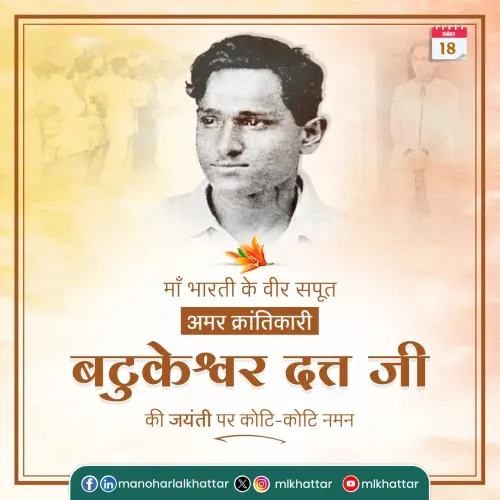
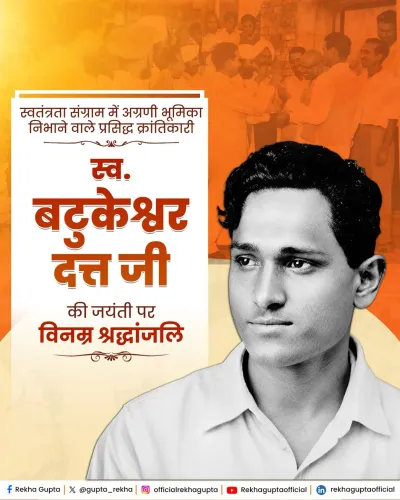
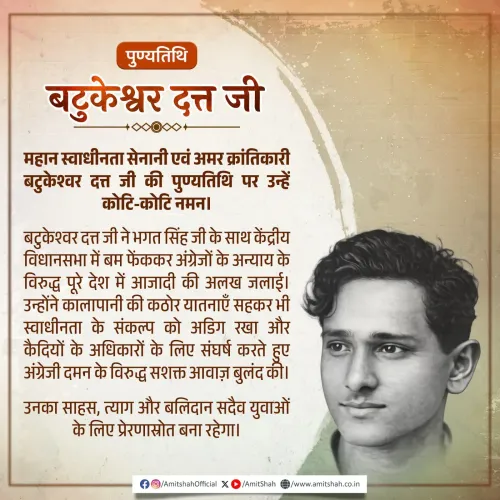
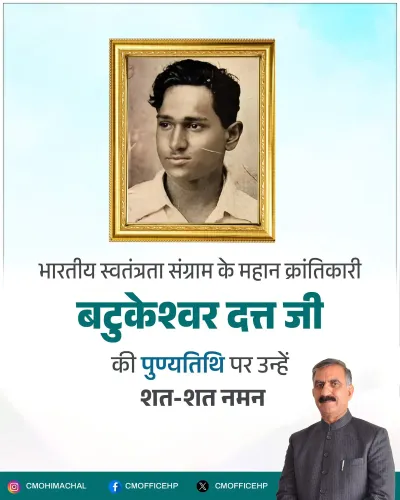
A bomb in the Central Legislative Assembly, a life sentence to the Cellular Jail, and a defiance that never bent — Batukeshwar Dutt embodied resistance in its rawest form. On his birth anniversary, Gujarat Chief Minister Bhupendra Patel offered a respectful salute to the revolutionary on Wednesday, 18 November 2026.
Posting in Gujarati, CM Patel wrote: 'મહાન ક્રાંતિકારી બટુકેશ્વર દત્તજીની જયંતીએ તેમને સાદર નમન' — 'Respectful salutations to the great revolutionary Batukeshwar Dutt on his birth anniversary.' He recalled how Dutt, alongside Bhagat Singh, raised a thunderous cry of freedom against British rule and infused the independence struggle with new energy, enduring the brutal hardships of kala pani (the cellular penal colony) without wavering in his devotion to the motherland.
The assembly bombing that shook colonial India
On 8 April 1929, Batukeshwar Dutt and Bhagat Singh walked into the Central Legislative Assembly in Delhi and threw smoke bombs into the chamber, deliberately avoiding casualties. The act was designed as a political statement — to 'make the deaf hear,' as their own leaflets declared — against the repressive Public Safety Bill and the Trade Disputes Bill. Both men chose to stay and court arrest rather than flee, turning a dramatic gesture into a defining moment of the armed-resistance strand of India's freedom movement.Cellular Jail and the cost of conviction
Sentenced to transportation for life, Dutt was sent to the Cellular Jail in the Andaman Islands — the colonial empire's most feared prison, where solitary confinement, forced labour, and isolation were tools of psychological destruction. While Bhagat Singh was hanged in 1931 after the Lahore Conspiracy Case, Dutt survived those years of incarceration, was eventually released, and lived to see independence — a witness to the country he had bled for.A routine tribute with a consistent political signal
Indian political leaders across the spectrum regularly mark the birth anniversaries of independence-era revolutionaries, and Gujarat's chief ministers have followed this practice for national figures regardless of regional origin. By invoking Dutt's sacrifice alongside Bhagat Singh's, CM Patel underscores a political tradition that places armed revolutionary courage on the same pedestal as the mainstream non-violent movement — a framing that resonates strongly with the BJP's nationalist register. Batukeshwar Dutt gave a generation its proof that conviction, even under the harshest punishment an empire could devise, does not break — it echoes.Point of View
Distinct from but complementary to the Gandhian tradition. By invoking Dutt's 'unshakeable devotion' even under Cellular Jail conditions, Patel reinforces a narrative of unyielding resistance to colonial power. This anniversary messaging also serves a civic-educational function, keeping lesser-known figures like Dutt visible in public consciousness. The consistency of such tributes across BJP-governed states suggests a coordinated cultural calendar around India's revolutionary heritage.
NationPress
18 Nov 2026
Frequently Asked Questions
Who was Batukeshwar Dutt?
Batukeshwar Dutt was an Indian revolutionary who, along with Bhagat Singh, threw smoke bombs in the Central Legislative Assembly on 8 April 1929 to protest British repressive laws. He was sentenced to life imprisonment and sent to the Cellular Jail in the Andaman Islands.
What did Batukeshwar Dutt do with Bhagat Singh?
Together, Batukeshwar Dutt and Bhagat Singh staged the 1929 Central Legislative Assembly bombing in Delhi, deliberately avoiding casualties to make a political statement against the Public Safety Bill and Trade Disputes Bill. Both chose to court arrest rather than escape.
What is Cellular Jail and why is it significant?
The Cellular Jail, located in the Andaman Islands, was a British colonial prison notorious for solitary confinement and brutal conditions. Dozens of Indian freedom fighters, including Batukeshwar Dutt, were imprisoned there, making it a powerful symbol of colonial oppression and revolutionary sacrifice.
Why did Gujarat CM Bhupendra Patel pay tribute to Batukeshwar Dutt?
CM Bhupendra Patel paid tribute on Batukeshwar Dutt's birth anniversary, honouring his role in the independence struggle alongside Bhagat Singh. Indian political leaders across parties regularly mark such anniversaries to commemorate freedom fighters.
When did Bhagat Singh die?
Bhagat Singh was hanged by British authorities on 23 March 1931, following his conviction in the Lahore Conspiracy Case, which was connected to the 1929 Central Legislative Assembly bombing.