CM Pema Khandu Reflects on a Decade of Governance in Arunachal
Synopsis
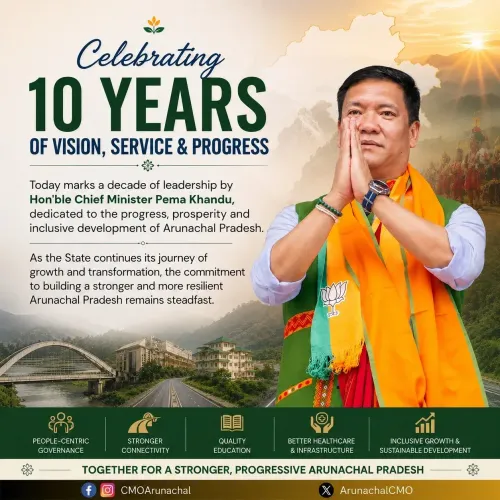
Arunachal Pradesh Chief Minister Pema Khandu marked a decade in public service on 18 July 2026 by sharing a personal governance reflection centred on Seva, Antyodaya, connectivity, transparency, and youth — linking the state's journey to the national Viksit Bharat vision.
Key Takeaways
Pema Khandu has served as Arunachal Pradesh Chief Minister since 2016 , completing a decade in public service.
His reflection, titled 'Ten Lessons from 10 Years in the Land of the Rising Sun,' cites Seva, Antyodaya, connectivity, good governance, transparency, and youth investment as guiding pillars.
The post explicitly links the state's governance record to the national Viksit Bharat vision for a developed India by 2047 .
Khandu tagged PM Narendra Modi, Home Minister Amit Shah, and several Union ministers, underlining close central-state alignment on the Northeast agenda.
The Act East Policy and Antyodaya Anna Yojana have been key central frameworks supporting Arunachal Pradesh's border connectivity and welfare delivery over the past decade.
Progress on the Trans-Arunachal Highway and frontier skill centres will be closely watched as indicators of the next decade's priorities.
Arunachal Pradesh Chief Minister Pema Khandu on Saturday, 18 July 2026, shared a personal reflection on his decade in public service, publishing an opinion piece titled 'Ten Lessons from 10 Years in the Land of the Rising Sun' and inviting citizens to engage with the ideas that have shaped his tenure as the state's longest-serving Chief Minister.
Context
Pema Khandu has led Arunachal Pradesh since 2016, making him one of the longest-serving incumbent chief ministers in the Northeast. In his post, he described the decade as 'a journey of learning, and responsibility to the people of Arunachal Pradesh,' anchoring his reflection around core values including Seva (service), Antyodaya (uplift of the last person), connectivity, good governance, transparency, and investment in youth. The piece is framed as both a personal account and a governance document, directed at a broad audience including senior central government figures.
Khandu tagged Prime Minister Narendra Modi, Home Minister Amit Shah, Defence Minister Rajnath Singh, and several other Union ministers in the post, signalling that the reflection is also addressed to the national BJP leadership that has closely partnered with his administration over the past ten years.
Policy Backdrop
The values Khandu cites — Seva and Antyodaya — are central to the BJP's ideological framework since 2014, when the NDA government elevated the Northeast as a strategic and developmental priority under the Act East Policy. Antyodaya as a governing principle, rooted in the philosophy of Pandit Deendayal Upadhyaya, has been operationalised through schemes such as Antyodaya Anna Yojana and last-mile welfare delivery programmes that have been prominently cited in Arunachal Pradesh's budget speeches.
The reflection also aligns with the Viksit Bharat national vision — the central government's goal of a developed India by 2047 — which was given fresh momentum through the Viksit Bharat Sankalp Yatra launched in 2023 to reach beneficiaries in border states. Arunachal Pradesh, sharing a sensitive frontier with China, has been a focal point for road, rail, and digital connectivity investments under successive NDA budgets.
Stakeholders and Impact
The primary audience for Khandu's reflection is the youth of Arunachal Pradesh, whom he specifically identifies as a governance priority. The state's young demographic, concentrated in remote and border districts, has been the target of central skill-development and employment schemes rolled out in partnership with the state government over the past decade.
Residents of border districts stand as the most direct stakeholders in the connectivity and transparency agenda Khandu outlines. Infrastructure corridors such as the Trans-Arunachal Highway and frontier road projects have progressively improved access to markets, healthcare, and education for communities that were historically isolated. Khandu's use of hashtags #10YearsOfSeva, #TeamArunachal, #ViksitArunachal, and #ViksitBharat ties the state's developmental narrative explicitly to the national BJP agenda.
What's Next
The publication of this reflective piece is likely to set the tone for Khandu's second-decade policy priorities, with watchers expecting renewed focus on youth employment, skill centres, and the completion of pending frontier connectivity corridors announced in recent state budgets. The explicit linkage to #ViksitBharat and the tagging of central ministers suggests that fresh central-state coordination on infrastructure and welfare delivery in Arunachal Pradesh may follow. How the ideas outlined translate into concrete budget allocations and scheme rollouts in the coming legislative session will be the real measure of the decade's lessons.
Point of View
Who are offered a values-based account of a decade in office, and the national BJP leadership, who are reminded of the state's alignment with the Viksit Bharat template. The explicit tagging of senior Union ministers is less incidental and more a signal of continued political solidarity ahead of what could be a significant phase for central fund flows to the Northeast. The framing around Seva and Antyodaya — ideological cornerstones of the BJP since 2014 — also positions Khandu as a faithful implementer of the party's original governing philosophy rather than an independent regional voice. Taken together, the post reinforces the BJP's decade-long strategy of projecting Northeast chief ministers as frontline partners in the national development narrative.
NationPress
18 Jul 2026
Frequently Asked Questions
How long has Pema Khandu been Chief Minister of Arunachal Pradesh?
Pema Khandu has been Chief Minister of Arunachal Pradesh since 2016, completing a decade in public service as of 2026. He is one of the longest-serving incumbent chief ministers in the Northeast.
What is the 'Ten Lessons from 10 Years' piece by Pema Khandu about?
It is a personal governance reflection by CM Pema Khandu marking ten years in public service. He outlines key values including Seva, Antyodaya, connectivity, good governance, transparency, and investment in youth as the principles that guided his tenure.
What is Antyodaya and why does Pema Khandu mention it?
Antyodaya is a BJP ideological principle focused on uplifting the poorest sections of society, operationalised through schemes such as Antyodaya Anna Yojana. Khandu cites it as a core value of his administration in Arunachal Pradesh.
What is Viksit Arunachal and how does it connect to Viksit Bharat?
Viksit Arunachal is the state-level development vision championed by CM Khandu, aligned with the central government's Viksit Bharat goal of a fully developed India by 2047. The hashtags used in his post explicitly link both frameworks.
What are the key infrastructure priorities in Arunachal Pradesh?
Key priorities include the Trans-Arunachal Highway, frontier road and rail connectivity corridors, and digital infrastructure, all supported under the NDA government's Act East Policy since 2014. Progress on these projects is expected to define the next phase of the state's development.