CM Pinarayi slams Sangh Parivar over CPI(M) Kolkata bookstall attacks

Synopsis
Kerala CM Pinarayi Vijayan denounced alleged Sangh Parivar attacks on CPI(M) bookstalls in Kolkata as an assault on free thought, expressing solidarity with Bengal comrades and declaring that ideas will outlast what he called the 'bulldozers of fascists.'
Key Takeaways
Kerala Chief Minister Pinarayi Vijayan posted on October 19, 2026 condemning alleged Sangh Parivar attacks on CPI(M) bookstalls in Kolkata .
He described the attacks as evidence of 'intolerance of free thought and democratic dissent.' Vijayan credited local people, youth, and party workers with mounting united resistance to the incidents.
CPI(M) governed West Bengal for 34 years (1977–2011) before losing power to Trinamool Congress .
The statement reinforces Vijayan's role as the national ideological voice of the CPI(M) from his base in Kerala .
The specific incidents in Kolkata referenced in the post have not been independently verified.
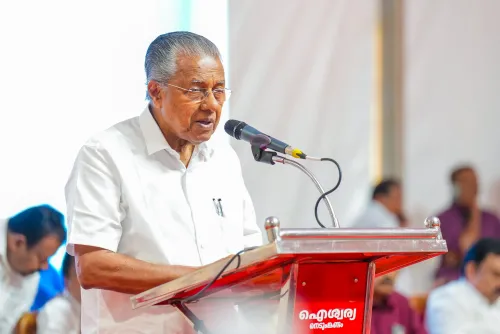
An attack on a bookstall is rarely just about books — it is about who gets to occupy public space, and whose ideas are allowed to exist. Kerala Chief Minister Pinarayi Vijayan fired a sharp political salvo on Monday, October 19, condemning what he described as Sangh Parivar attacks on CPI(M) bookstalls in Kolkata, calling the incidents a direct assault on free thought and democratic dissent.
The charge: 'Bulldozers of fascists' vs. Bengal's bookstalls
Vijayan's statement was unambiguous in its target and its language. 'The Sangh Parivar's attacks on CPI(M) bookstalls in Kolkata expose its intolerance of free thought and democratic dissent,' he wrote, before landing the rhetorical shiv: 'Books and ideas will always outlast the bulldozers of fascists.' The framing — books against bulldozers — is a deliberate political image, casting the episode as civilisational conflict rather than a local scuffle.
He credited the pushback to a coalition of 'local people, youth and party workers,' presenting it as spontaneous popular resistance rather than a coordinated party response. The Kerala CM closed with a solidarity message to 'comrades in Bengal,' reinforcing CPI(M)'s national-party identity even as its West Bengal footprint has contracted significantly since 2011.
Bengal's contested cultural terrain
West Bengal carries a particularly charged history for both the Left and Hindu nationalist organisations. The CPI(M)-led Left Front governed the state for an unbroken 34 years from 1977 to 2011, a period during which party-affiliated cultural activities — bookstalls, reading clubs, street theatre — became embedded in public life. The Trinamool Congress's rise ended that era, but it did not dissolve the underlying rivalry between CPI(M) cadre and Sangh Parivar affiliates over who commands the streets, the fairs, and the public square.
Clashes over cultural spaces — book exhibitions, processions, wall-writing — have been an intermittent feature of Bengal's political calendar, escalating around festivals and election cycles. The specific incident Vijayan references has not been independently confirmed, but the pattern he is invoking has genuine historical weight.
Kerala's CM speaking for Bengal's comrades
That the loudest CPI(M) voice here belongs to Kerala's Chief Minister rather than a Bengal leader is itself telling. The party retains executive power only in Kerala; in West Bengal it is an opposition force struggling to reclaim relevance against both TMC and BJP. Vijayan, as a Politburo member, regularly uses national platforms to project the party's ideological line beyond Kerala's borders — positioning himself as the de facto national face of the Indian left.
The solidarity message also serves a domestic audience: Kerala's own left base, which tracks political violence against party workers across India closely, and for whom the Bengal connection carries deep cultural resonance.
Point of View
The party's Kerala government functions increasingly as its national messaging apparatus. The framing of local incidents as fascist cultural suppression is a well-worn left strategy to consolidate base sentiment and attract liberal opinion — but its credibility hinges on verified facts on the ground, which remain unconfirmed here. The absence of a West Bengal left leader making this statement speaks volumes about the party's diminished organisational standing in the state it once dominated.
NationPress
19 Oct 2026
Frequently Asked Questions
What did Pinarayi Vijayan say about the Kolkata bookstall attacks?
Pinarayi Vijayan condemned alleged Sangh Parivar attacks on CPI(M) bookstalls in Kolkata, calling them an attack on free thought and democratic dissent, and expressed solidarity with Bengal's left workers.
Who is Pinarayi Vijayan?
Pinarayi Vijayan is the Chief Minister of Kerala since 2016 and a senior Politburo member of the Communist Party of India (Marxist), making him one of the most influential left leaders in India.
What is the Sangh Parivar?
The Sangh Parivar is the umbrella of Hindu nationalist organisations that includes the RSS and BJP, and is frequently at ideological loggerheads with left parties like CPI(M) over cultural and political spaces.
When did CPI(M) lose power in West Bengal?
CPI(M)'s Left Front lost power in West Bengal in 2011 after governing the state continuously since 1977, when the Trinamool Congress under Mamata Banerjee won a decisive majority.
Why does Kerala's CM speak for Bengal's CPI(M)?
As Kerala is the only state where CPI(M) holds executive power, Chief Minister Vijayan functions as the party's national voice; West Bengal's CPI(M) is in opposition with limited platform to project messages nationally.