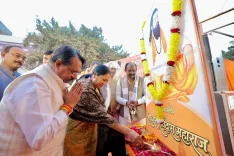
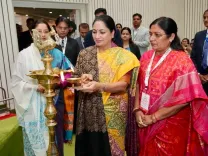
CM Rekha Gupta joins Child Marriage Free India event
Synopsis
Delhi Chief Minister Rekha Gupta attended a national Child Marriage Free India programme at Vigyan Bhawan with Union Minister Annapurna Devi, backing the 2030 target and calling for a mass movement against child marriage.
Key Takeaways
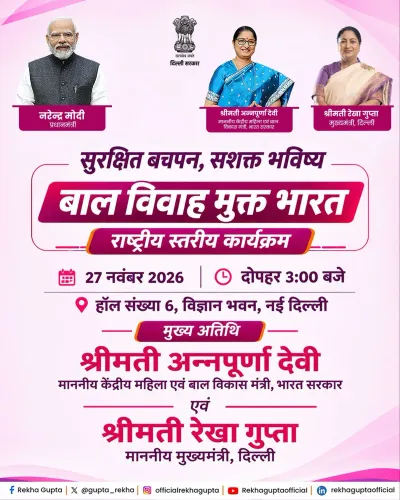
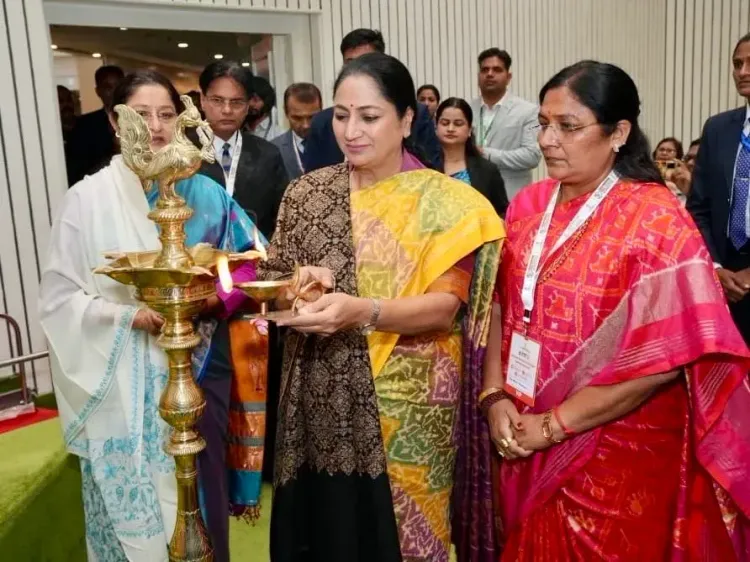
Delhi Chief Minister Rekha Gupta attended a Child Marriage Free India national programme at Vigyan Bhawan in New Delhi on 27 November 2026.
She described the campaign as a resolve to secure every daughter's childhood, education and dreams, with a 2030 end to child marriage.
Union Minister Annapurna Devi and Minister of State Savitri Thakur were present at the event.
The 2030 target sits on the Prohibition of Child Marriage Act, 2006, and aligns with SDG 5.3.
Gupta called for turning awareness against child marriage into a people's movement.
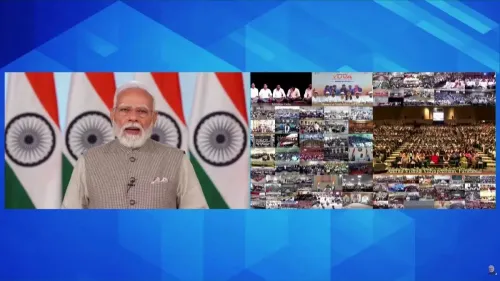
Delhi Chief Minister Rekha Gupta carried a national pledge into Vigyan Bhawan on Friday, 27 November 2026: every daughter's childhood, education and dreams, kept free of early marriage. At a national programme of the Child Marriage Free India campaign, she said the country is advancing toward that goal by 2030 under Prime Minister Narendra Modi. Union Minister Annapurna Devi was present; the call from the hall was to turn awareness into a people's movement.
Gupta's 2030 pledge at Vigyan Bhawan
After the programme, Gupta wrote that Bal Vivah Mukt Bharat (Child Marriage Free India) is a resolve to give every daughter a safe childhood, education and the chance to let her dreams take flight. She said India is moving toward a child-marriage-free nation by 2030 under Modi's leadership, and that she had joined the national event held with Union Minister Annapurna Devi present.
'Come, let us turn awareness against child marriage into a people's movement,' she added, noting that Minister of State Savitri Thakur and other dignitaries were also there.
From the 2006 Act to a 2030 mass drive
India already prohibits the practice under the Prohibition of Child Marriage Act, 2006. The 2030 target layers a campaign on that legal floor: treat child marriage as a mass mobilisation problem, not only a courtroom offence. The deadline also tracks Sustainable Development Goal 5.3, which calls for ending child, early and forced marriage.
Nearly two decades of statute have not closed the gap on their own. Schemes such as Beti Bachao Beti Padhao have tried to change the social math around daughters — keep them in school, delay marriage, raise their public worth. The remaining work sits with adolescent girls and rural families for whom early marriage can still look like custom or protection.
Annapurna Devi and Savitri Thakur at the dais
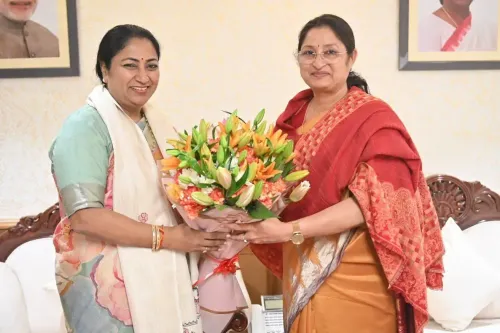
The New Delhi programme was held with Union Minister for Women and Child Development Annapurna Devi present, as Gupta noted. Minister of State Savitri Thakur attended as well. Gupta used the platform to put Delhi's chief minister on the same stage as the Union campaign against child marriage.
The next test is not another slogan but the grind of state-level rollouts, and whether the Ministry of Women and Child Development later puts district-level incidence numbers on the table. That is the only scoreboard that will show if a jan andolan is changing lives, not just banners.
A 2006 law drew the red line. The question by 2030 is whether India can make that line hold in every village, for every girl who still has a childhood left to finish.
Point of View
2006, already drew a legal red line; Beti Bachao Beti Padhao and the 2030 SDG-aligned target try to change household incentives around girls' schooling and delayed marriage. The political bet is that a jan andolan can reach rural families where enforcement alone has not. Watch whether state events are followed by district incidence data from the Ministry of Women and Child Development, the only measure that will show if the slogan is moving numbers.
NationPress
27 Nov 2026
Frequently Asked Questions
What is the Child Marriage Free India campaign?
It is a national campaign that aims to end child marriage in India by 2030 through awareness and enforcement. Delhi Chief Minister Rekha Gupta described it as a resolve to protect every daughter's childhood, education and dreams, and called for turning the drive into a people's movement.
When and where did Rekha Gupta attend the child marriage programme?
She attended a national programme at Vigyan Bhawan in New Delhi on 27 November 2026. Union Minister Annapurna Devi and Minister of State Savitri Thakur were also present.
What is the Prohibition of Child Marriage Act, 2006?
It is the principal Indian law that prohibits child marriages across the country. The 2030 Child Marriage Free India target builds on that statute with mass awareness, alongside schemes such as Beti Bachao Beti Padhao.
Who is Annapurna Devi in this event?
Annapurna Devi is the Union Minister for Women and Child Development. Rekha Gupta said the Vigyan Bhawan national programme was held in her presence.
What is India's 2030 child marriage target?
Under the Child Marriage Free India campaign, the country is working toward ending child marriage by 2030. The date aligns with Sustainable Development Goal 5.3 on ending child, early and forced marriage.