CM Rekha Gupta demands Congress apology for 1984 anti-Sikh riots
Synopsis
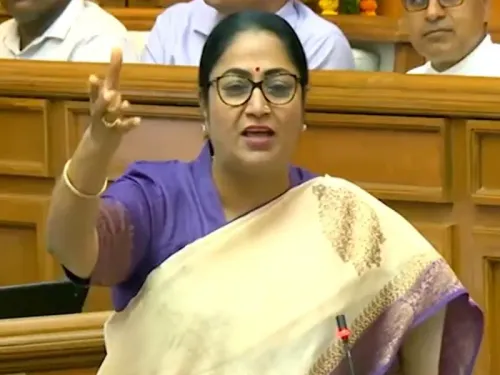
Delhi Chief Minister Rekha Gupta amplified a BJP leader's call for Congress to publicly apologise for the 1984 anti-Sikh riots, condemning reported plans for celebratory events on 1 November — the anniversary of the violence — and accusing Rahul Gandhi of disrupting Diwali trade.
Key Takeaways
Delhi CM Rekha Gupta shared a statement on 29 October 2026 demanding Congress publicly apologise for the 1984 anti-Sikh riots in Delhi.
The statement, attributed to BJP leader Nitin Nabin , alleges Congress is planning celebratory events on 1 November — the anniversary of the violence.
Rajiv Gandhi 's 1984 remark — 'when a big tree falls, the earth shakes' — is directly invoked and rebutted in the statement.
The post also accuses Rahul Gandhi and Congress of disrupting Delhi traders' business during the Diwali season.
The 1984 anti-Sikh riots left thousands dead and have remained a fault-line in BJP–Congress politics for over four decades.
Congress has never issued a direct party-level apology for the riots, keeping the demand politically potent each November.
Forty-two years after the blood-soaked streets of Delhi in November 1984, the wounds of the anti-Sikh violence refuse to close — and on Thursday, 29 October 2026, Delhi Chief Minister Rekha Gupta sharpened that memory into a pointed political demand, sharing a statement that calls on the Congress party to publicly repent and apologise for the riots rather than hold celebrations on 1 November.
The statement shared by CM Gupta is attributed to BJP leader Nitin Nabin, who invoked one of the most contested lines in modern Indian political history. 'Jab bada ped girta hai, to dharti kaanp jaati hai' — 'When a big tree falls, the earth shakes' — a remark made by Rajiv Gandhi in the aftermath of his mother Indira Gandhi's assassination on 31 October 1984, a statement critics have long read as a justification for the violence that followed. Nabin turned the quote back on the Congress, arguing that those who lost families in those riots deserve sensitivity, not spectacle.
What happened on 1 November 1984 — and why the date still cuts
When Indira Gandhi was shot by her own bodyguards on 31 October 1984, mobs swept through Delhi the very next day. Thousands of Sikh men and boys were killed in targeted violence; families were burned out of their homes in neighbourhoods across the capital. Multiple judicial inquiries over the following decades pointed to the role of Congress workers in organising or enabling the attacks, and demands for a formal, unconditional party apology have remained a live political fault-line ever since.
Nabin's statement, as shared by CM Gupta, makes the charge explicit: Congress is reportedly planning 'jalsas' — public gatherings and celebratory events — on 1 November 2026, the very anniversary of the pogrom. 'Those families who bore that day's pain and tragedy deserve compassion as we remember their wounds,' the statement reads. 'Organising celebrations and big programmes on such a day reflects the Congress mindset of today.'
The Diwali trading barb — a second front in the attack
The statement doesn't stop at historical grievance. It opens a second line of attack, accusing Rahul Gandhi and the Congress of 'harming the business of traders' during the Diwali season — a charge that, while unverified in its specifics, slots into a pattern the BJP has deployed repeatedly: linking Congress political activity during festive periods to economic disruption felt by small merchants and shopkeepers.
'The public will give a strong reply,' the statement closes — a line clearly calibrated for the political atmosphere ahead of any upcoming electoral contest in Delhi.
A recurring fault-line in BJP–Congress politics
The 1984 anti-Sikh riots have never fully left Indian political discourse. BJP leaders have consistently demanded a Congress apology as both a moral stand and an electoral wedge — particularly effective in constituencies with significant Sikh populations. Former Prime Minister Manmohan Singh, himself a Sikh, did express regret on behalf of the government in 2005, but a direct, unambiguous party apology from the Congress has never materialised, leaving the wound available to be reopened each November.
CM Gupta's decision to amplify this message just three days before the anniversary ensures the demand stays on Delhi's political front page — at exactly the moment it is hardest for Congress to ignore.
Point of View
Particularly effective around the November anniversary when historical memory is sharpest. By pairing the genocide-accountability demand with a Diwali trader-harm accusation, the message is engineered to reach two distinct voter groups — Sikh community members and small business owners — in a single stroke. CM Gupta's decision to amplify rather than author the statement gives it the reach of her platform while the attribution to Nabin provides a layer of distance. The absence of any Congress rebuttal included in the post leaves the framing entirely unchallenged, which is precisely the point.
NationPress
29 Oct 2026
Frequently Asked Questions
What were the 1984 anti-Sikh riots in Delhi?
The 1984 anti-Sikh riots were a wave of targeted violence against Sikhs in Delhi on 1 November 1984, triggered by the assassination of Prime Minister Indira Gandhi the previous day. Thousands of Sikhs were killed and multiple judicial inquiries later pointed to the involvement of Congress party workers in organising or enabling the attacks.
What did Rajiv Gandhi mean by 'when a big tree falls, the earth shakes'?
Rajiv Gandhi made this remark shortly after his mother Indira Gandhi's assassination in October 1984. Critics have interpreted the statement as an attempt to explain or excuse the anti-Sikh violence that followed, and it has been repeatedly cited by BJP leaders as evidence of Congress's attitude toward the riots.
Why is CM Rekha Gupta demanding a Congress apology now?
The demand comes just days before 1 November 2026, the anniversary of the 1984 anti-Sikh violence. CM Gupta shared a statement by BJP leader Nitin Nabin alleging that Congress is planning public celebrations on that date instead of expressing remorse, making the anniversary a flashpoint for renewed political pressure.
Who is Nitin Nabin and why is he quoted in this context?
Nitin Nabin is a BJP leader whose statement on the 1984 riots and Congress's alleged Diwali-season political activity is quoted in the post shared by CM Gupta. He is referenced in the post as a 'national president' — the full context of his role was attributed in the original statement.
Has Congress ever apologised for the 1984 riots?
Former Prime Minister Manmohan Singh expressed regret on behalf of the government in 2005, but the Congress party has never issued a direct, unconditional public apology, which is why the demand remains a recurring point of contention in Indian politics, especially around each November anniversary.