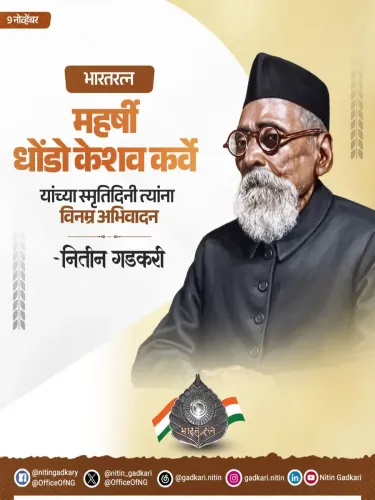
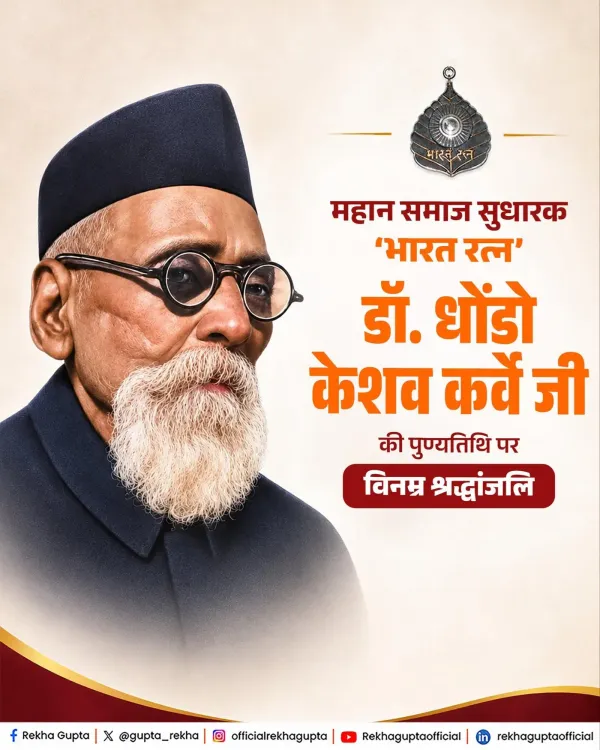
CM Rekha Gupta pays tribute to Bharat Ratna Maharshi Karve
Synopsis
Delhi Chief Minister Rekha Gupta paid her respects to Bharat Ratna Maharshi Dhondo Keshav Karve on his death anniversary, honouring the 19th-century reformer's lifelong campaign for women's education, widow remarriage, and social dignity.
Key Takeaways
Delhi CM Rekha Gupta posted a tribute to Maharshi D.K.
Karve on his death anniversary on 9 November 2026 .
Karve ( 1858–1962 ) is remembered for championing women's education and widow remarriage in 19th- and early 20th-century India.
He founded the SNDT Women's University , one of India's first universities dedicated to women's higher education.
Karve was awarded the Bharat Ratna in 1958 for his contributions to social reform.
CM Gupta described his lifelong struggle as 'an important chapter of transformation in Indian society.'
A life that spanned more than a century — and changed the fate of millions of Indian women — was remembered on Monday morning. Delhi Chief Minister Rekha Gupta posted a tribute on X on 9 November 2026 to mark the death anniversary of Bharat Ratna Maharshi Dhondo Keshav Karve, honouring the reformer's lifelong struggle for women's education, widow remarriage, and a life of dignity for Indian women.
In her post, CM Gupta described Karve as a pioneer of women's education and social reform, writing that his struggle — 'नारी शिक्षा, विधवा पुनर्विवाह और महिलाओं के सम्मानपूर्ण जीवन के लिए' ('for women's education, widow remarriage, and a life of honour for women') — represents 'an important chapter of transformation in Indian society.'
Who was Maharshi D.K. Karve — and why does he still matter
Dhondo Keshav Karve, born in 1858, dedicated his entire adult life to dismantling two of 19th-century India's most entrenched social wrongs: the denial of education to women and the near-total social exclusion of widows. He himself married a widow at a time when such an act invited severe social ostracism, making his conviction impossible to dismiss as merely rhetorical.
His most enduring institutional legacy is the SNDT Women's University, which he founded to give women access to formal higher education at a time when universities were closed to them by custom if not always by law. For this body of work, the Indian government awarded him the Bharat Ratna in 1958 — the country's highest civilian honour. He lived to 1962, reaching the age of 104, and remained active in social causes well into his final years.
A pattern of remembrance — and what it signals
Indian political leaders across parties regularly mark the anniversaries of 19th- and 20th-century social reformers, using the occasions to anchor contemporary policy positions to historical moral authority. Tributes to figures like Karve serve as a reminder that debates about women's rights, access to education, and marriage reform are not new imports — they are deeply rooted in India's own reform tradition.
For a sitting chief minister responsible for the administration of Delhi, invoking Karve's legacy connects the city's governance ambitions to a century-old current of social progressivism. The question his anniversary always implicitly raises is a sharp one: how far has the society he tried to transform actually travelled?
Karve's story is not an abstraction. It is a name, a university, a widow he married, and a hundred-year life spent in stubborn, patient insistence that Indian women deserved better. That insistence still carries weight.
Point of View
This choice of reformer is deliberate: Karve's legacy is non-partisan and deeply rooted in Maharashtra's reform tradition, lending the tribute a moral gravity that transcends electoral optics. The commemoration also quietly reframes women's empowerment as an indigenous Indian value rather than an external import.
NationPress
9 Nov 2026
Frequently Asked Questions
Who was Maharshi Dhondo Keshav Karve?
Maharshi Dhondo Keshav Karve ( 1858–1962 ) was a pioneering Indian social reformer who campaigned for women's education and widow remarriage. He founded the SNDT Women's University and was awarded the Bharat Ratna in 1958 .
Why did Rekha Gupta pay tribute to Maharshi Karve?
Delhi Chief Minister Rekha Gupta posted the tribute on 9 November 2026 to mark Karve's death anniversary, honouring his lifelong contributions to women's education and social reform in India.
When was Maharshi Karve awarded the Bharat Ratna?
Maharshi D.K. Karve was awarded the Bharat Ratna in 1958 , India's highest civilian honour, recognising his decades of work for women's rights and social reform.
What university did Maharshi Karve found?
Maharshi Karve founded the SNDT Women's University , one of India's first universities dedicated entirely to providing higher education to women.
What did Maharshi Karve do for widow remarriage in India?
Karve was a vocal and personal advocate for widow remarriage at a time when it carried severe social stigma. He himself married a widow, making his advocacy a lived commitment rather than mere rhetoric.