CM Rekha Gupta Pays Tribute to Kamaladevi Chattopadhyay
Synopsis
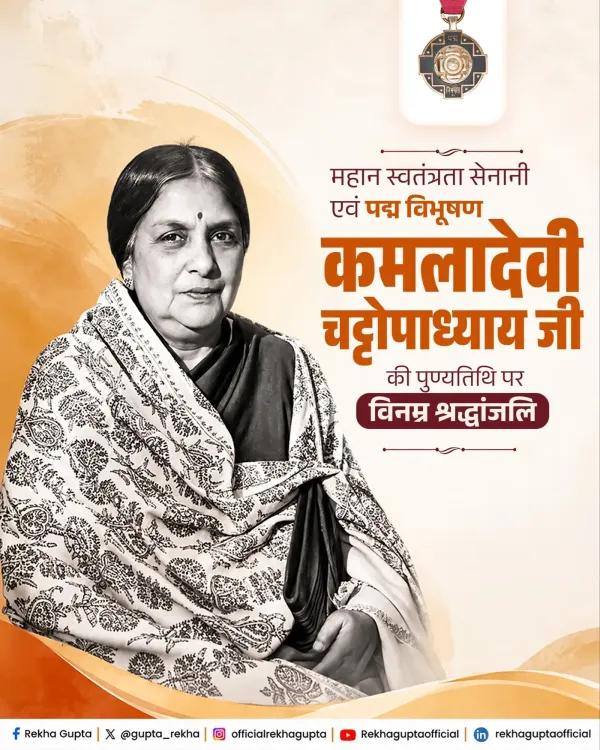
Delhi Chief Minister Rekha Gupta paid tribute to Padma Vibhushan awardee and freedom fighter Kamaladevi Chattopadhyay on her death anniversary, celebrating her enduring legacy in women's empowerment, swadeshi handicrafts, and Indian cultural revival.
Key Takeaways
Delhi CM Rekha Gupta posted a tribute to Kamaladevi Chattopadhyay on her death anniversary on 29 October 2026 .
Kamaladevi Chattopadhyay was a celebrated freedom fighter and Padma Vibhushan recipient.
She is credited with championing women's empowerment and the revival of swadeshi handicrafts and performing arts.
Her institutional efforts gave women artisans an economic voice decades before modern self-help schemes emerged.
Her legacy continues to inform cultural policy and artisan welfare discussions in contemporary India.
On the death anniversary of one of India's most transformative freedom fighters, Delhi Chief Minister Rekha Gupta paused to honour a woman who reshaped what independence meant — not just politically, but culturally and economically — for millions of Indian women.
Posting on Thursday, 29 October 2026, CM Gupta wrote in Hindi: 'Mahan swatantrata senani evam Padma Vibhushan se sammanit Kamaladevi Chattopadhyay ji ki punyatithi par sadar naman' — 'Respectful tribute on the death anniversary of great freedom fighter and Padma Vibhushan awardee Kamaladevi Chattopadhyay.' She added that Kamaladevi's contributions to women's empowerment, swadeshi handicrafts, and the upliftment of Indian art and culture 'will always be remembered.'
Who Was Kamaladevi Chattopadhyay?
Kamaladevi Chattopadhyay was a freedom fighter, social reformer, and recipient of the Padma Vibhushan, India's second-highest civilian honour. She stood at a rare intersection of political activism and cultural revival — equally at home on the frontlines of the independence movement and in the workshops of master weavers and potters across the country.
Her most enduring legacy lies in her crusade for Indian handicrafts. At a time when machine-made goods threatened to erase centuries of artisanal tradition, Kamaladevi championed the swadeshi crafts movement with a fierce institutional energy — helping establish bodies that gave women artisans an economic voice long before 'women's self-help groups' became a policy buzzword. She also played a foundational role in reviving Indian theatre and the performing arts, understanding culture as the connective tissue of a newly independent nation.
A Legacy Woven Into Policy
Indian leaders across the political spectrum have invoked Kamaladevi's name in discussions around gender equity, heritage promotion, and artisan welfare — threads that run directly through contemporary schemes supporting handloom weavers, craft clusters, and women's entrepreneurship. Her documented influence on cultural policy debates stretches from the 1950s to the present.
CM Gupta's tribute is part of a broader pattern of political commemoration that links independence-era figures to living policy concerns — reminding citizens that the ambitions of the freedom movement are still works in progress.
Kamaladevi Chattopadhyay spent her life arguing that a nation's soul lives in the hands of its artisans and the agency of its women. That argument has never been more current.
Point of View
Heritage preservation, artisan welfare — in the moral authority of the independence movement. For CM Rekha Gupta, the tribute also signals a consistent BJP emphasis on cultural nationalism and 'nari shakti' as twin ideological pillars. Kamaladevi's legacy, being non-partisan in its humanitarian breadth, makes her an uncontroversial but powerful reference point. The real test of such tributes is whether they translate into state-level action for the craft communities she devoted her life to building.
NationPress
29 Oct 2026
Frequently Asked Questions
Who was Kamaladevi Chattopadhyay?
Kamaladevi Chattopadhyay was a prominent Indian freedom fighter, social reformer, and Padma Vibhushan awardee known for her role in women's empowerment, the revival of swadeshi handicrafts, and the promotion of Indian performing arts.
Why is Kamaladevi Chattopadhyay remembered today?
She is remembered for her dual legacy as a political activist in India's independence movement and as the driving force behind the institutional revival of Indian handicrafts and theatre, giving artisan communities — especially women — an organised economic voice.
What did Delhi CM Rekha Gupta say about Kamaladevi Chattopadhyay?
CM Rekha Gupta paid respects on Kamaladevi's death anniversary, noting her contributions to women's empowerment, swadeshi handicrafts, and Indian art and culture will 'always be remembered.'
What is the Padma Vibhushan award?
The Padma Vibhushan is India's second-highest civilian honour, awarded for exceptional and distinguished service to the nation. Kamaladevi Chattopadhyay received this honour in recognition of her contributions to Indian society and culture.
What is Kamaladevi Chattopadhyay's connection to Indian handicrafts?
Kamaladevi was instrumental in establishing institutions that supported traditional Indian crafts and provided economic opportunities to women artisans, helping preserve swadeshi craft traditions at a time they were under threat from industrialisation.