CM Rekha Gupta hosts Sri Lanka's JVP delegation in Delhi
Synopsis
Delhi Chief Minister Rekha Gupta hosted a Janatha Vimukthi Peramuna delegation led by General Secretary Tilvin Silva on 30 September 2026, exchanging governance models and public-service best practices in a meeting that reinforces India-Sri Lanka people-to-people ties.
Key Takeaways
Delhi CM Rekha Gupta met a five-member JVP delegation from Sri Lanka on 30 September 2026 .
The delegation was led by JVP General Secretary Tilvin Silva and included an MP and senior party officials.
Discussions covered Delhi Government's ten major initiatives and people-centric governance practices.
The Sri Lankan side shared their own governance experiences, making the exchange bilateral rather than one-directional.
BJP Foreign Affairs Department officials and Cabinet colleague Ashish Sood were present, giving the meeting a formal diplomatic character.
India and Sri Lanka have maintained diplomatic relations since 1948 ; party-level contacts supplement official state diplomacy.
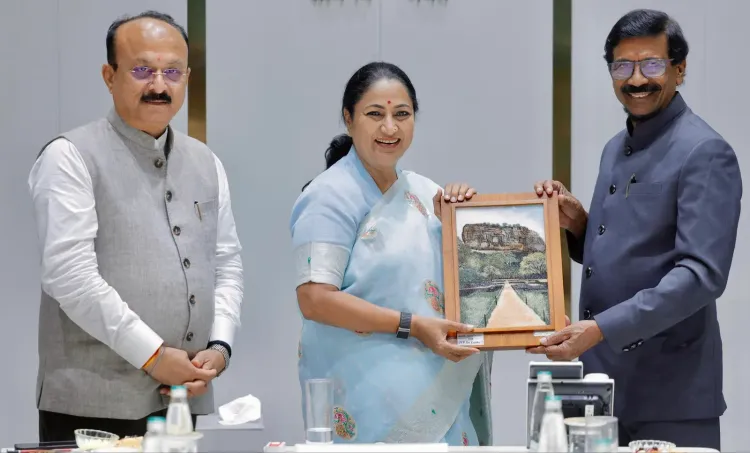
A delegation from Sri Lanka's ruling Janatha Vimukthi Peramuna (JVP) party walked into the Delhi Chief Minister's office on Wednesday, 30 September 2026, and the conversation that followed stretched well beyond pleasantries — touching governance models, public service delivery, and the civilisational thread that binds two neighbours across the Palk Strait. Delhi Chief Minister Rekha Gupta hosted the visiting team, led by JVP General Secretary Mr Tilvin Silva, for what she described as a 'productive interaction' on people-centric governance.
Who came, and what was on the table
The Sri Lankan delegation included Smt Chandrika Adikari, Member of Parliament Shri Aboobucker Athambawa, Shri Kabilan Suntharamoorthy, and Ms Kalpana Madhubhashini — a cross-section of the JVP's legislative and organisational leadership. On the Delhi side, Cabinet colleague Shri Ashish Sood, BJP Foreign Affairs Department in-charge Dr Vijai, and Dr Ashwin Johar from the Foreign Affairs Department were also present, signalling that this was more than a courtesy call.
The agenda centred on Delhi Government's ten major initiatives and the broader philosophy of governance that underpins them. CM Gupta framed the discussion around how people-centric administration translates into tangible change in daily life — a pitch that clearly resonated, as the Sri Lankan visitors reciprocated by sharing their own governance experiences back home.
JVP's arc — from insurgency to ruling party
The Janatha Vimukthi Peramuna is not a conventional party delegation. Founded with Marxist-Leninist roots, the JVP spent decades on the fringes of Sri Lankan politics before steadily mainstreaming into electoral democracy. Its ascent to a share of ruling power represents one of South Asia's more striking political transformations. That its General Secretary is now comparing governance notes with an Indian state capital underlines how far the party has travelled ideologically.
India and Sri Lanka formalised diplomatic ties in 1948, and the relationship has since been layered with cultural, religious, and economic interdependence. Party-level contacts like this one sit alongside official state summits and bilateral economic mechanisms — they are the connective tissue that keeps the relationship warm between the headline moments.
Why Delhi, why now
State-level diplomacy has grown as a distinct channel in India's foreign-engagement playbook. When a foreign political party seeks governance benchmarks, a capital city administration — with visible, auditable schemes — offers something a ministry briefing cannot: ground-level proof of concept. CM Gupta's decision to position Delhi's initiatives as exportable best practices is a soft-power move that costs nothing and earns goodwill.
The meeting also carries a quiet strategic logic. Sri Lanka is navigating its own post-crisis political reset, and the JVP's interest in public-service delivery models reflects the pressures its government faces at home. Learning from a city of over 20 million people — with all its complexity — is not an abstract exercise for a party now responsible for governing an island nation.
Whether the exchange produces a reciprocal visit by Indian representatives to Colombo, or seeds a more structured administrative collaboration, remains to be seen — but the groundwork laid on 30 September is the kind that tends to compound quietly over time.
Point of View
Hosting a left-leaning Sri Lankan ruling party signals a pragmatic, governance-over-ideology approach to bilateral engagement. For the JVP, the visit to Delhi reflects the party's post-insurgency evolution into a mainstream governing force that now actively benchmarks itself against regional peers. The exchange also quietly reinforces India's interest in keeping Colombo's political elite oriented toward New Delhi at a moment when Sri Lanka's post-crisis recovery continues to attract competing external attention.
NationPress
30 Sept 2026
Frequently Asked Questions
Who is Tilvin Silva and why did he visit Delhi?
Tilvin Silva is the General Secretary of Sri Lanka's ruling Janatha Vimukthi Peramuna (JVP) party. He led a delegation to Delhi on 30 September 2026 to exchange governance practices and best practices with Delhi Chief Minister Rekha Gupta.
What is the Janatha Vimukthi Peramuna (JVP)?
The JVP is a Sri Lankan political party with Marxist-Leninist origins that has evolved into a mainstream electoral force and is currently part of Sri Lanka's ruling political arrangement.
What did Delhi CM Rekha Gupta discuss with the Sri Lankan delegation?
CM Rekha Gupta discussed Delhi Government's ten major initiatives, governance best practices, and people-centric public service delivery. The Sri Lankan delegation also shared their own governance experiences in return.
What is the significance of India-Sri Lanka party-level diplomatic meetings?
Party-level contacts supplement formal state diplomacy by building people-to-people and institutional links. India and Sri Lanka have maintained diplomatic relations since 1948, and such exchanges reinforce the broader bilateral partnership.
Who else was present at the meeting with the JVP delegation?
Delhi Cabinet colleague Ashish Sood, BJP Foreign Affairs Department in-charge Dr Vijai, and Dr Ashwin Johar from the Foreign Affairs Department were present alongside CM Rekha Gupta.