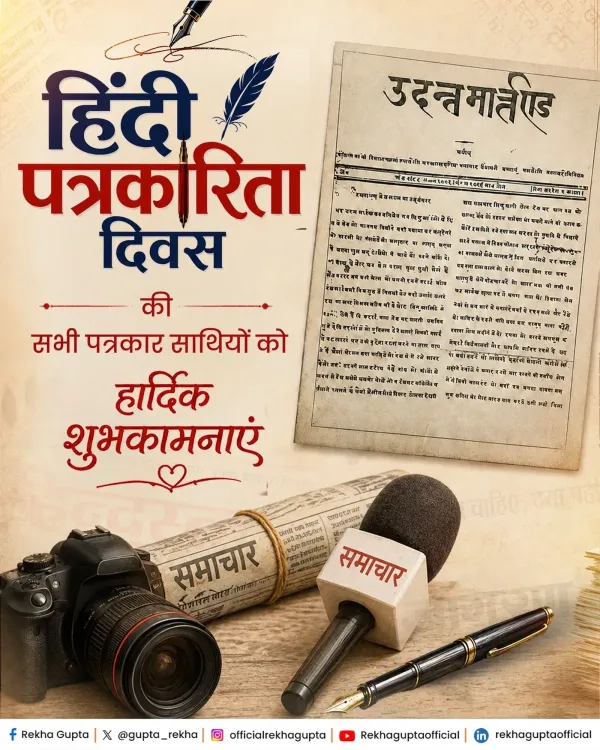
CM Rekha Gupta Greets Journalists on Hindi Journalism Day
Synopsis
Delhi Chief Minister Rekha Gupta marked Hindi Journalism Day on 30 May 2026 by saluting journalists, editors, and media professionals, describing Hindi journalism as an unceasing resolve to awaken society, uphold truth, and preserve Indian language and culture.
Key Takeaways
Delhi CM Rekha Gupta extended greetings to all Hindi journalists and editors on Hindi Journalism Day, 30 May 2026 .
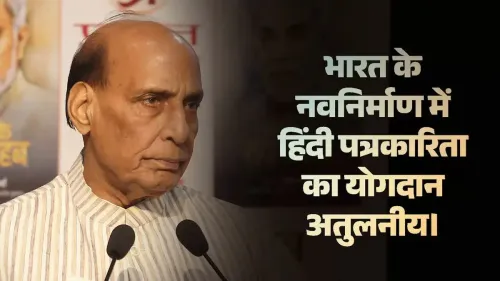
She described Hindi journalism as the fourth pillar of democracy and credited it with nation-building and public awareness.
Hindi Journalism Day commemorates the launch of Udant Martand , the first Hindi newspaper, in 1826 .
Gupta praised journalists committed to impartial, fearless, and public-interest reporting.
The message fits a broader BJP pattern of linking Hindi press contributions to cultural preservation and national integration on language observances.
Delhi Chief Minister Rekha Gupta extended greetings to journalists, editors, and media professionals on the occasion of Hindi Journalism Day on Saturday, 30 May 2026, honouring the press as the fourth pillar of democracy and acknowledging its contribution to nation-building, public awareness, and the preservation of Hindi language and culture.
Context
Hindi Journalism Day is observed annually on 30 May to mark the launch of Udant Martand — widely regarded as the first Hindi-language newspaper — in 1826. The day serves as an occasion for political leaders, cultural organisations, and civil society to reflect on the role of Hindi media in shaping public discourse across the country.
In her post, Rekha Gupta described Hindi journalism as 'ek anwarat sankalp' ('an unceasing resolve') to awaken society and bring truth to the fore. She offered what she called 'sadhuvad' — a formal salutation of appreciation — to all writers and journalists dedicated to impartial, fearless, and public-interest reporting.
Policy Backdrop
The constitutional recognition of Hindi as an official language of the Union under the Constitution of India (1950) laid the legal foundation for state-level promotion of Hindi media and education. Successive governments at both the Centre and in Hindi-belt states have used language observances to reinforce policy commitments around Hindi's role as a unifying medium.
BJP-led governments have consistently framed such occasions within a narrative of cultural preservation and national integration, drawing a direct line between a free Hindi press and the health of Indian democracy. Rekha Gupta's message follows this established pattern, linking journalism's social function to the broader project of 'rashtra nirman' ('nation-building').
Stakeholders and Impact
The message directly addresses Hindi journalists, editors, and media professionals across Delhi and the wider Hindi-speaking belt, which spans some of India's most populous states. For working journalists, official acknowledgements on this day carry symbolic weight, affirming the press's constitutionally recognised role even as debates around media freedom and editorial independence continue in public discourse.
Civil society groups focused on language rights and press freedom view such statements as an opportunity to hold governments accountable to the values — impartiality, fearlessness, and public-interest reporting — that leaders publicly endorse on occasions like this one.
What's Next
Observers will watch whether the Delhi government follows ceremonial greetings with concrete policy steps — such as support for Hindi-language media training, journalist welfare schemes, or Hindi promotion initiatives in the upcoming 2026–27 assembly session. Across BJP-governed states, similar messaging on language days has at times preceded announcements on Hindi education and media infrastructure, making the weeks ahead a period to watch for any substantive follow-through.
Point of View
Impartial' journalism, she signals alignment with press-freedom values while also embedding that praise within a nation-building and cultural-preservation frame that is central to her party's ideological identity. The message arrives as Delhi's new BJP administration is still consolidating its governance agenda, making symbolic outreach to the Hindi media ecosystem — a significant constituency in the capital — strategically useful. Whether the rhetoric translates into journalist welfare policies or Hindi media support schemes will be the real test of intent.
NationPress
15 Oct 2026
Frequently Asked Questions
Why is Hindi Journalism Day celebrated on 30 May?
Hindi Journalism Day is observed on 30 May each year to mark the anniversary of the publication of Udant Martand in 1826 , which is recognised as the first Hindi-language newspaper in India.
What did Delhi CM Rekha Gupta say on Hindi Journalism Day 2026?
Rekha Gupta extended greetings to journalists, editors, and media professionals, calling Hindi journalism an 'unceasing resolve' to awaken society and bring truth forward, and saluted those committed to impartial and fearless reporting.
What is the significance of Hindi journalism as the fourth pillar of democracy?
The phrase 'fourth pillar of democracy' refers to the press's role — alongside the legislature, executive, and judiciary — as a watchdog that holds power accountable, informs citizens, and amplifies public interest. Rekha Gupta invoked this concept to underscore Hindi journalism's democratic function.
What is Udant Martand?
Udant Martand was the first Hindi-language newspaper, launched in 1826 , and is widely regarded as the origin point of Hindi print journalism in India. Its founding is commemorated annually on Hindi Journalism Day .