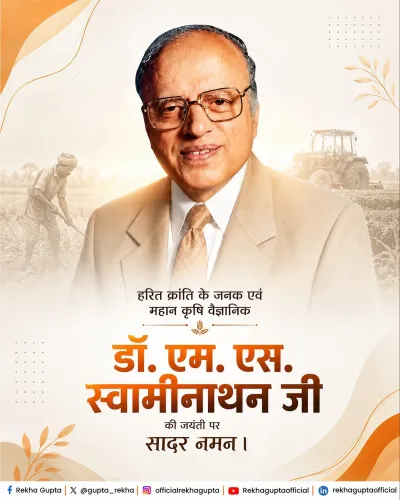
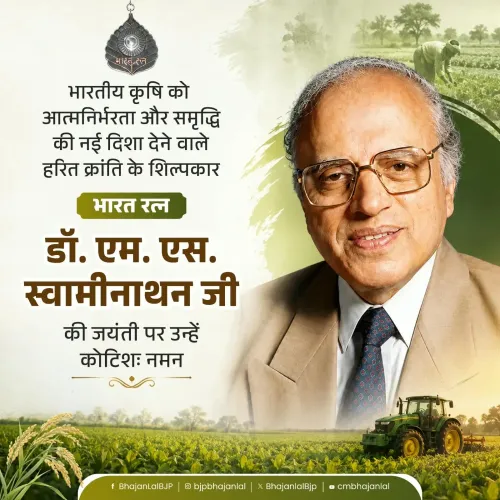
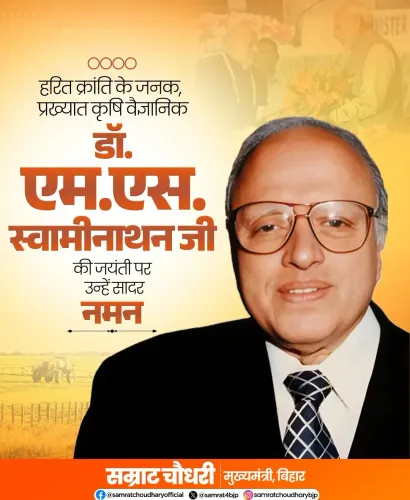
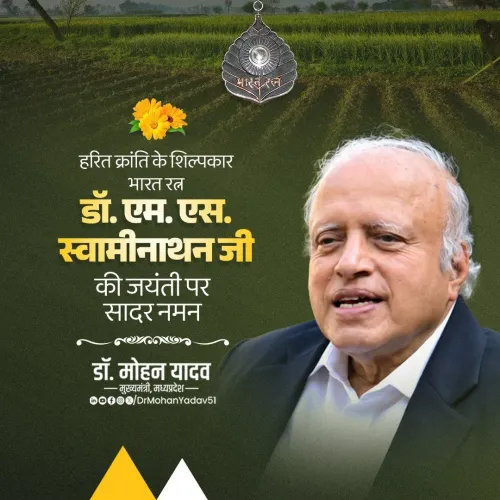
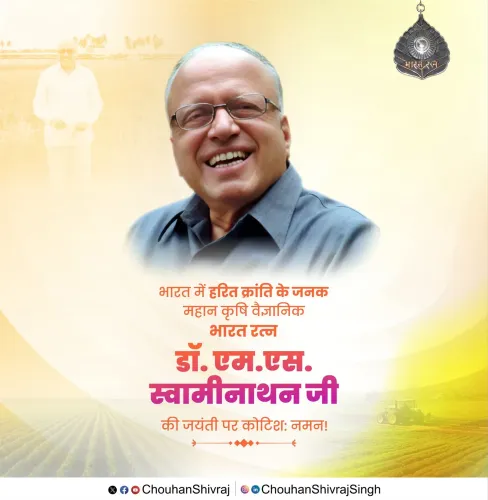
CM Rekha Gupta pays tribute to Dr. M.S. Swaminathan
Synopsis
Delhi Chief Minister Rekha Gupta paid a tribute to Dr. M.S. Swaminathan on his death anniversary, honouring the Bharat Ratna agronomist whose Green Revolution transformed India's food security in the 1960s and whose legacy continues to shape agricultural policy.
Key Takeaways
Delhi CM Rekha Gupta posted a tribute to Dr.
Swaminathan on his death anniversary on 28 September 2026 .
Swaminathan ( 1925–2023 ) is recognised as the father of India's Green Revolution and was awarded the Bharat Ratna .
He pioneered the introduction of high-yielding wheat and rice varieties in the 1960s , enabling India's transition to food grain self-sufficiency.
Leaders across political parties routinely commemorate Swaminathan's death anniversary, reflecting broad national recognition of his contributions.
His legacy remains relevant to ongoing debates on sustainable farming, farm incomes, and food security in India.
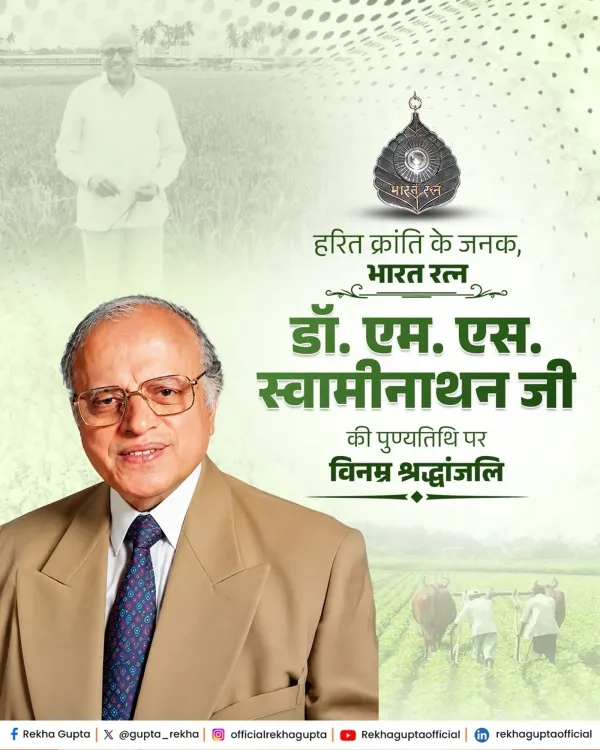
The man who helped feed a hungry nation is remembered today. Delhi Chief Minister Rekha Gupta paid her respects on the death anniversary of Dr. M.S. Swaminathan, the legendary agronomist who is widely credited as the father of India's Green Revolution and a recipient of the Bharat Ratna, India's highest civilian honour.
In her post on X, CM Gupta wrote: 'भारत में हरित क्रांति के जनक एवं भारत रत्न डॉ. एम. एस. स्वामीनाथन जी की पुण्यतिथि पर विनम्र श्रद्धांजलि।' — 'A humble tribute on the death anniversary of Dr. M.S. Swaminathan, the father of India's Green Revolution and recipient of the Bharat Ratna.'
The scientist who changed India's food story
Dr. M.S. Swaminathan (1925–2023) transformed India from a nation on the edge of famine into one capable of feeding itself. In the 1960s, he championed the introduction of high-yielding varieties of wheat and rice, a breakthrough that became the backbone of the Green Revolution and secured India's food grain self-sufficiency for decades to come.
His work touched the lives of millions of Indian farmers — not through policy papers, but through seeds that actually grew. The scale of that achievement is difficult to overstate: India was importing food grain when the Green Revolution began; it was exporting within a generation.
Why leaders across parties invoke his legacy
Tributes to Swaminathan on his death anniversary have become a consistent thread across India's political spectrum, cutting across party lines. The acknowledgement reflects a shared national recognition that his scientific contributions remain foundational to any serious conversation about food security, rural development, and sustainable agriculture.
As debates around farm income, climate-resilient crops, and rural distress continue to shape national policy, Swaminathan's legacy serves as both a benchmark and a challenge — a reminder of what targeted agricultural science can accomplish when aligned with political will.
Point of View
Leading a BJP government in a city-state where urban voters dominate, the gesture nonetheless connects to a national BJP emphasis on farmer welfare and food security. Swaminathan's complicated late-career legacy — including his advocacy for farmer income support through the Swaminathan Commission report, which saw a contentious political journey — adds layers that such tributes rarely acknowledge. The annual convergence of cross-party homage underscores how scientific achievement can become a neutral, unifying symbol even when underlying agricultural policy remains deeply contested.
NationPress
28 Sept 2026
Frequently Asked Questions
Who was Dr. M.S. Swaminathan?
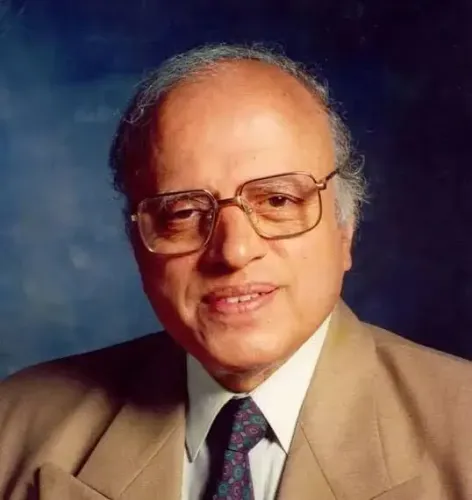
Dr. M.S. Swaminathan (1925–2023) was an Indian agronomist widely known as the father of India's Green Revolution. He led the introduction of high-yielding wheat and rice varieties in the 1960s that helped India achieve food grain self-sufficiency. He was awarded the Bharat Ratna, India's highest civilian honour.
When did Dr. M.S. Swaminathan pass away?
Dr. M.S. Swaminathan passed away in 2023. His death anniversary falls on 28 September, when political leaders and agricultural institutions across India pay tribute to his contributions.
What was the Green Revolution in India?
India's Green Revolution was a period of rapid agricultural transformation in the 1960s and 1970s, driven by the adoption of high-yielding crop varieties, improved irrigation, and modern farming practices. Dr. Swaminathan was its central scientific figure, helping India move from food grain imports to self-sufficiency.
Why did Delhi CM Rekha Gupta pay tribute to Swaminathan?
Delhi Chief Minister Rekha Gupta paid tribute on 28 September 2026, the death anniversary of Dr. M.S. Swaminathan, honouring his contributions as the father of India's Green Revolution and a Bharat Ratna recipient.
What is Dr. Swaminathan's legacy for Indian farmers?
Dr. Swaminathan's Green Revolution work directly improved the livelihoods of millions of Indian farmers by enabling higher crop yields and national food security. His later work through the Swaminathan Commission also addressed farm income support and continues to influence agricultural policy debates in India.