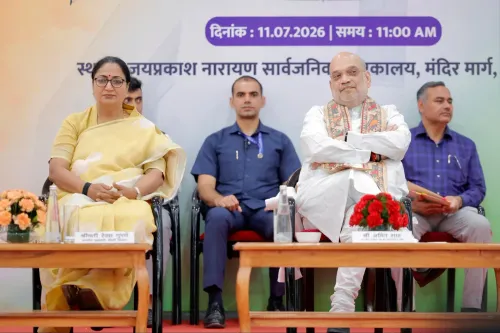
CM Rekha Gupta Pushes for Digital Courts, Smart Judicial Tech in Delhi

Synopsis
Delhi Chief Minister Rekha Gupta has declared digital judicial infrastructure — including e-courts, tech-based case management and smart court facilities — a top government priority, building on India's two-decade-old e-Courts Mission Mode Project.
Key Takeaways
CM Rekha Gupta announced on August 10, 2026 that expanding digital judicial infrastructure is a priority for the Delhi government.
The push covers e-courts, technology-based case management and smart court facilities .
India's e-Courts Mission Mode Project dates to 2007 ; a second phase launched in 2014 expanded digitization and video conferencing.
Delhi courts already participate in the National Judicial Data Grid , which tracks case pendency nationwide.
The announcement aligns with the broader Digital India programme launched in 2015 to digitize governance processes.
Budget allocations and implementation timelines for Delhi's smart court rollout remain to be detailed.
India's capital is staking its claim in the country's judicial modernization race. Delhi Chief Minister Rekha Gupta on Monday, August 10, 2026, declared that expanding digital judicial infrastructure — from e-courts and tech-driven case management to smart court facilities — is a top priority for her government.
In her post, CM Gupta stated: 'Expanding the digital judicial system with modern judicial infrastructure, e-courts, technology-based case management and smart court facilities is our government's priority.' The statement, brief but pointed, signals the Delhi government's intent to align with — and build upon — a national push that has been underway for nearly two decades.
A National Blueprint Delhi Is Now Doubling Down On
India's e-courts journey began in 2007 under the e-Courts Mission Mode Project, launched as part of the National e-Governance Plan to bring ICT infrastructure to district and subordinate courts nationwide. By 2014, a second phase expanded the focus to digitization, video conferencing, and structured case management systems. Delhi's courts have been part of this architecture for years, feeding data into the National Judicial Data Grid — a publicly accessible repository tracking case pendency across the country.
The broader driver is hard to ignore: India carries one of the world's heaviest judicial backlogs, with millions of cases pending at various court levels. Technology has been positioned, across successive governments, as the most scalable lever to compress that backlog and widen access to justice — particularly for litigants who cannot afford repeated court visits.
What 'Smart Courts' Could Mean for Delhi Litigants
Delhi, as the national capital, hosts some of the country's busiest courts. For ordinary litigants and judicial officers alike, the promise of smart court facilities — integrated case tracking, digital filings, virtual hearings — translates directly into fewer adjournments, lower travel costs, and faster resolution. The Digital India programme, launched in 2015, provided the wider governance scaffold into which judicial digitization efforts slot.
The critical question now is execution: what budget allocations back this priority, which courts get upgraded first, and how quickly Delhi's infrastructure integrates with the evolving national e-courts phases. Gupta's statement sets the direction; the implementation timeline will determine whether it reshapes the experience inside Delhi's courtrooms.
For a city that doubles as the country's legal nerve centre, getting this right is not just an administrative milestone — it is a test of whether digital governance can deliver where it matters most.
Point of View
Demonstrating tangible urban governance wins on access to justice carries electoral weight. The real test will be whether Delhi moves from participation in central e-courts phases to originating its own smart court investments — a distinction that would mark genuine policy ambition rather than messaging.
NationPress
10 Aug 2026
Frequently Asked Questions
What did Delhi CM Rekha Gupta say about e-courts?
On August 10, 2026, CM Rekha Gupta stated that expanding the digital judicial system — including e-courts, technology-based case management and smart court facilities — is a top priority for her government.
What is the e-Courts Mission Mode Project in India?
The e-Courts Mission Mode Project was launched in 2007 under the National e-Governance Plan to provide ICT infrastructure to district and subordinate courts across India. A second phase approved in 2014 expanded digitization, video conferencing and case management systems.
Are Delhi courts part of the National Judicial Data Grid?
Yes, Delhi's courts have participated in the National Judicial Data Grid for several years. The grid is a publicly accessible system that tracks case pendency across courts nationwide.
What are smart courts and how do they help litigants?
Smart courts integrate digital case tracking, electronic filings and virtual hearing infrastructure. For litigants, this means fewer adjournments, reduced travel costs and faster case resolution.
How does Digital India relate to judicial modernization?
The Digital India programme, launched in 2015, provides the broader governance framework for digitizing public services, including judicial processes. Judicial digitization efforts like e-courts slot into this wider national infrastructure push.