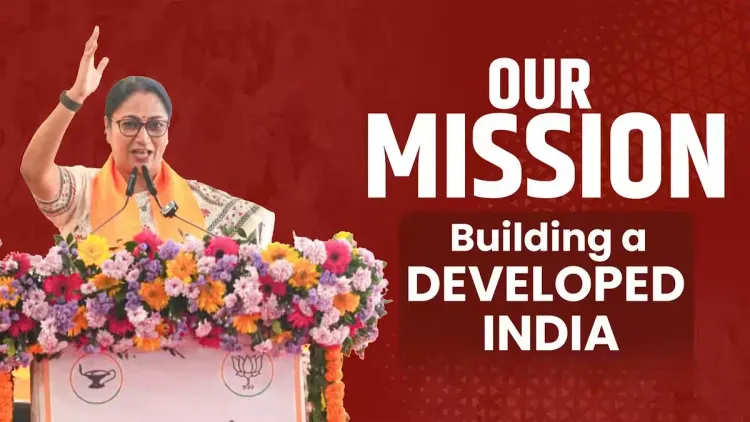
CM Rekha Gupta Reaffirms BJP's Identity as Family, Mission and Service
Synopsis
Delhi CM Rekha Gupta posted five declarative equations defining the BJP — family, mission, social service, empowerment, and new India — invoking the party's Jana Sangh lineage under the hashtag 'From Jana Sangh to every last person'.
Key Takeaways
Delhi Chief Minister Rekha Gupta posted on X on 21 October 2026 reaffirming the BJP's core identity through five Hindi declarations.
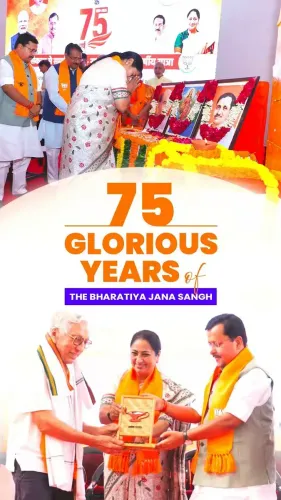
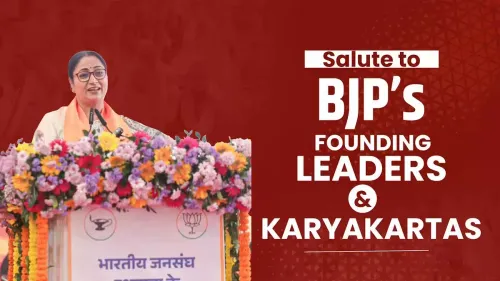
The hashtag #जनसंघ_से_जनजन_तक ('From Jana Sangh to every last person') explicitly links the BJP to its predecessor, the Bharatiya Jana Sangh , founded in 1951 .
The BJP was formed in 1980 as a successor to the Jana Sangh's ideological tradition after the Janata Party period ended.
The five themes — family, mission, social service, societal empowerment, and building a new India — mirror a messaging template the party has consistently deployed since 1998 .
Such ideological reinforcement is typically associated with party membership drives or upcoming organisational events at the state level.
From its roots in the Bharatiya Jana Sangh to its present claim as the architect of a 'new India', the Bharatiya Janata Party has always wrapped its politics in the language of service and nation-building — and on Wednesday, 21 October 2026, Delhi Chief Minister Rekha Gupta distilled that entire arc into five crisp equations.
Posting on X in Hindi under the hashtag #जनसंघ_से_जनजन_तक ('From Jana Sangh to every last person'), CM Gupta laid out the BJP's self-image in declarative strokes: 'BJP means family. BJP means mission. BJP means social service. BJP means the empowerment of society. BJP means the building of a new India.'
The Jana Sangh Thread That Runs Through BJP's DNA
The hashtag is not decorative — it is a lineage claim. The Bharatiya Jana Sangh, founded in 1951 by Syama Prasad Mookerjee as a political expression of RSS ideology, gave the BJP its ideological skeleton. When the Janata Party experiment collapsed, the Jana Sangh's political heir was reborn as the BJP on 6 April 1980. That founding mythology — of continuity, sacrifice, and civilisational purpose — is precisely what the phrase 'Jana Sangh to every last person' invokes. The party did not begin in 1980, the messaging insists; it merely continued.Five Equations, One Consistent Playbook
Gupta's five-point formulation tracks closely with a messaging template the BJP has refined across decades of internal communication. Since the party's first national government in 1998 and, more intensively, from 2014 onward as the ruling party at the Centre, it has consistently paired ideological identity ('mission', 'new India') with grassroots warmth ('family', 'social service'). The effect is deliberate: frame governance as seva, and party membership as a moral calling rather than a political affiliation. For a party with a cadre base in the crores, that framing matters enormously in holding together a sprawling, diverse volunteer network. The timing of such messaging — with the hashtag gesturing toward the party's founding-era legacy — also typically precedes membership drives or state-level organisational events, moments when the party renews its contract with its ground-level workers. As a chief minister of a high-profile, politically contested capital, Rekha Gupta's amplification of this message carries weight beyond routine social media activity. Delhi is both a symbol and a battleground, and reaffirming the party's foundational identity from that platform signals that the ideological refresh is as much for the activist in the booth as for the voter scrolling a feed. The Jana Sangh is history. The message it seeded, clearly, is not.Point of View
The party reinforces a narrative of unbroken civilisational purpose rather than mere electoral ambition. For a chief minister governing India's capital — a city that has historically swung away from the BJP at the assembly level — projecting this identity loudly serves both an internal mobilisation function and an external brand-signalling one. It is less a news event than a sustained ideological drumbeat that the BJP has learned, over decades, never to let go quiet.
NationPress
21 Oct 2026
Frequently Asked Questions
What did Delhi CM Rekha Gupta post about BJP?
CM Rekha Gupta posted five Hindi declarations on X defining the BJP as family, mission, social service, empowerment of society, and the building of a new India, using the hashtag 'From Jana Sangh to every last person'.
What is the connection between BJP and Jana Sangh?
The Bharatiya Jana Sangh, founded in 1951 by Syama Prasad Mookerjee, was the ideological predecessor of the BJP. The BJP was formed in 1980 after the Jana Sangh dissolved into the Janata Party and that experiment ended.
Who founded the Bharatiya Jana Sangh?
Syama Prasad Mookerjee founded the Bharatiya Jana Sangh in 1951 as a political party aligned with RSS ideology; it later provided the ideological foundation for the BJP.
What does the hashtag जनसंघ_से_जनजन_तक mean?
The Hindi hashtag translates to 'From Jana Sangh to every last person', invoking the BJP's political lineage from its 1951 predecessor all the way to its current mass base.
Why does BJP frequently invoke its Jana Sangh origins?
Invoking the Jana Sangh grounds the BJP's identity in a longer ideological tradition than its 1980 founding date suggests, reinforcing a narrative of continuity, sacrifice, and civilisational purpose that resonates strongly with the party's cadre.