CM Rekha Gupta shares BL Santhosh on Mookerjee's legacy

Synopsis
Delhi CM Rekha Gupta amplified BJP National General Secretary BL Santhosh's remarks positioning Dr Syama Prasad Mookerjee as the architect of BJP's nationalist identity — invoking his stance on West Bengal's creation as a model of ideological truthfulness over secular accommodation.
Key Takeaways
Delhi CM Rekha Gupta shared a video clip featuring remarks by BJP National General Secretary (Organisation) BL Santhosh on 21 October 2026 .
Santhosh credited Dr Syama Prasad Mookerjee with giving the BJP its core 'political identity' rooted in nationalism.
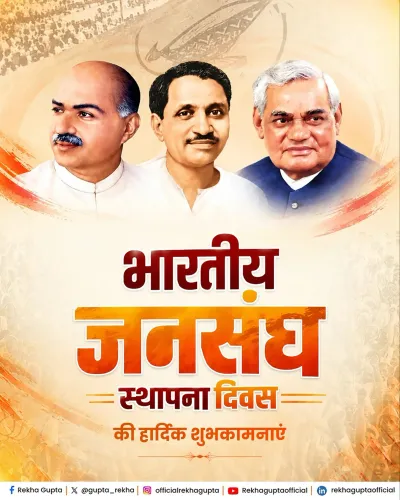
Mookerjee founded the Bharatiya Jana Sangh in 1951 , the direct ideological predecessor of the BJP.
Santhosh quoted Mookerjee's position that West Bengal was created for Hindu welfare, framing his refusal of secular optics as 'truthfulness to society.' BJP leaders periodically invoke Mookerjee to reinforce ideological consistency, particularly in the context of the party's eastern-state outreach.
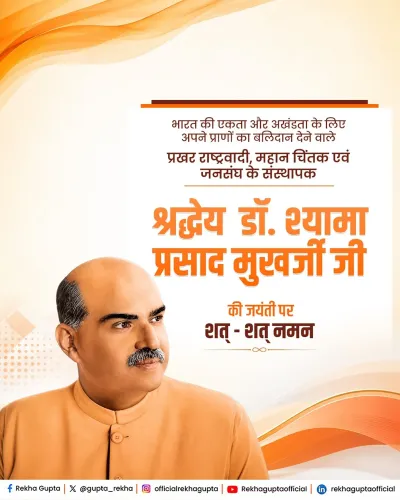
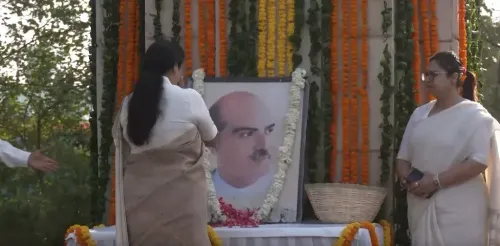
A quote about ideological origins. Delhi Chief Minister Rekha Gupta on Wednesday, 21 October 2026 shared a pointed statement by BJP National General Secretary (Organisation) BL Santhosh on Dr Syama Prasad Mookerjee — the man the party traces its deepest roots to — framing his legacy not as history but as living doctrine.
What BL Santhosh said — and why the words were chosen carefully
Santhosh's statement, as shared by CM Gupta, is blunt and deliberate: 'Dr Syama Prasad Mookerjee gave us the political identity. What the BJP stands for today is that very foundation of nationalism.' He added that Mookerjee 'was the one person who said that West Bengal was created only for the welfare of Hindus' and that he 'didn't think he had to be secular at that point to become acceptable to everybody — he wanted to be truthful to society.'
That last phrase is the sharpest edge of the message. In positioning Mookerjee's refusal of secular optics as 'truthfulness' rather than exclusion, Santhosh is doing something specific: recasting a historical stance as a moral virtue the party still holds.
Mookerjee, the Jana Sangh, and the BJP's founding DNA
Dr Syama Prasad Mookerjee founded the Bharatiya Jana Sangh in 1951, a decade after the trauma of Partition reshaped the subcontinent. His politics were rooted in advocacy for Hindu interests during and after Partition — particularly in Bengal, where the drawing of borders in 1947 split communities overnight. The Jana Sangh was the ideological predecessor from which the Bharatiya Janata Party eventually emerged, and the BJP has consistently claimed Mookerjee as the philosophical anchor of its nationalist project.
References to Mookerjee inside the BJP are never accidental. They are a form of internal calibration — a reminder to cadres of where the party believes it came from and what it refuses to dilute.
West Bengal as the subtext
The specific invocation of West Bengal is notable. The BJP has spent years working to deepen its footprint in a state with a charged partition-era history and a dominant opposition. Citing Mookerjee's position that the state's creation served Hindu welfare is a message that resonates with a particular electoral and cultural constituency there — and Santhosh's remarks, amplified by a senior Delhi leader, carry that geographic undertone.
BJP leaders return to this well periodically, especially when the party wants to reinforce ideological consistency against accusations of drift or compromise. The message: the BJP's nationalism is not a modern invention. It was there at the founding.
Whether that argument finds new traction in Bengal — or simply firms up existing loyalties — is the question the party's eastern strategists are watching closely.
Point of View
Invoking Mookerjee's specific statements about the state's creation is as much a tactical message to that electorate as it is a historical tribute. The consistency of this messaging across years suggests it functions less as commemoration and more as a recurring statement of party identity.
NationPress
21 Oct 2026
Frequently Asked Questions
Who was Dr Syama Prasad Mookerjee?
Dr Syama Prasad Mookerjee was an Indian politician who founded the Bharatiya Jana Sangh in 1951, the predecessor to the BJP, and was a prominent advocate for Hindu interests during and after Partition.
What did BL Santhosh say about Syama Prasad Mookerjee?
BJP National General Secretary BL Santhosh said Mookerjee gave the BJP its political identity rooted in nationalism, and praised his stance that West Bengal was created for Hindu welfare, calling it 'truthfulness to society' rather than secularism.
Why is West Bengal significant in BJP's Mookerjee references?
West Bengal has deep partition-era history and remains a key electoral battleground for the BJP. Mookerjee's historical positions on Bengal's creation resonate with a specific constituency there, making invocations of his legacy politically significant for the party's eastern outreach.
What is the Bharatiya Jana Sangh and its connection to BJP?
The Bharatiya Jana Sangh was founded by Dr Syama Prasad Mookerjee in 1951 as a nationalist political party. It is the direct ideological predecessor from which the Bharatiya Janata Party evolved.
Why did Delhi CM Rekha Gupta share BL Santhosh's remarks?
CM Rekha Gupta shared the remarks as part of BJP's recurring practice of invoking Mookerjee's legacy to reinforce the party's foundational nationalist ideology, amplifying the message from her platform as Delhi's Chief Minister.