CM Rekha Gupta Marks Jana Sangh's 75th Founding Anniversary
Synopsis
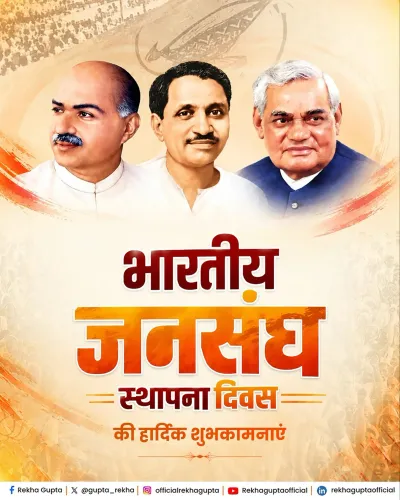
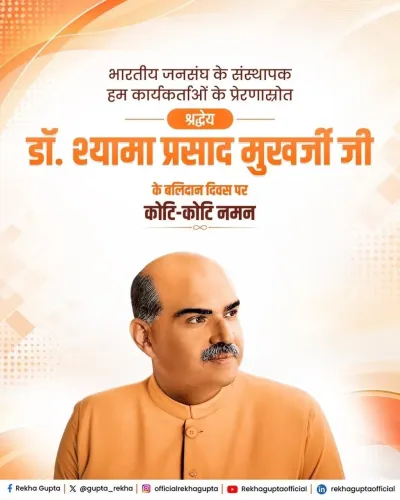
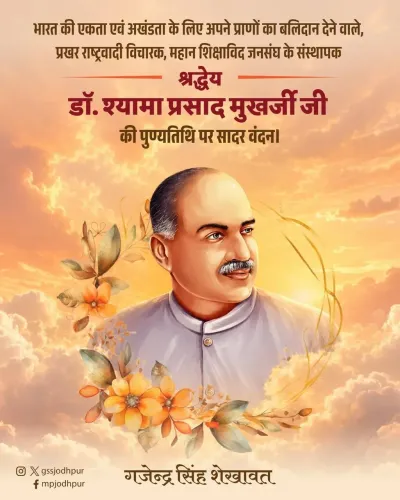
Delhi Chief Minister Rekha Gupta marked the Bharatiya Jana Sangh's 75th foundation day on 21 October 2026, honouring Dr. Shyama Prasad Mukherjee, Pandit Deendayal Upadhyay, and Atal Bihari Vajpayee while announcing her attendance at the commemorative event.
Key Takeaways
The Bharatiya Jana Sangh was founded on 21 October 1951 by Dr.
Shyama Prasad Mukherjee , making 2026 its 75th foundation day .
Delhi CM Rekha Gupta paid tribute to three ideological pillars: Mukherjee's sacrifice, Pandit Deendayal Upadhyay 's Integral Humanism, and Vajpayee 's nation-service dedication.
Gupta confirmed personal attendance at the anniversary event held under the presence of national president Nitin Nabin .
The hashtag #जनसंघ_से_जनजन_तक ('From Jana Sangh to every person') framed the BJP's continuity narrative.
The Jana Sangh eventually evolved into the Bharatiya Janata Party , which traces its ideological lineage directly to the 1951 founding.
Seventy-five years after Dr. Shyama Prasad Mukherjee founded the Bharatiya Jana Sangh on 21 October 1951, Delhi Chief Minister Rekha Gupta paid tribute to the party's foundational leaders and the countless workers who kept its 'nation first' flame alive — and announced she would attend the anniversary event in person.
In a post on Wednesday, 21 October 2026, Gupta invoked three pillars of Jana Sangh's ideological heritage: the sacrifice of its founder Dr. Shyama Prasad Mukherjee, the philosophy of Ekatma Manav Darshan (Integral Humanism) articulated by Pandit Deendayal Upadhyay, and the lifelong dedication to nation service embodied by former Prime Minister Atal Bihari Vajpayee. 'Sadar pranam to those innumerable dedicated workers who devoted their lives to the resolve of 'Rashtra Pratham' — Nation First,' she wrote, saluting a legacy that stretches across seven decades.
From a 1951 founding to a 75-year milestone
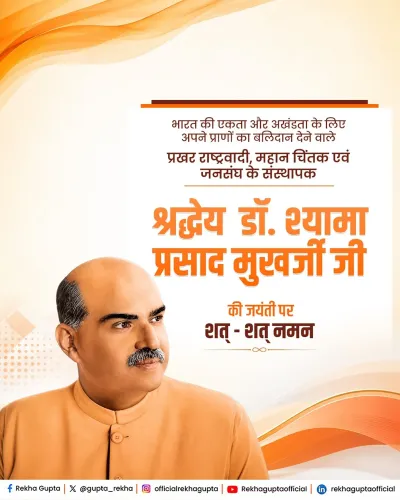
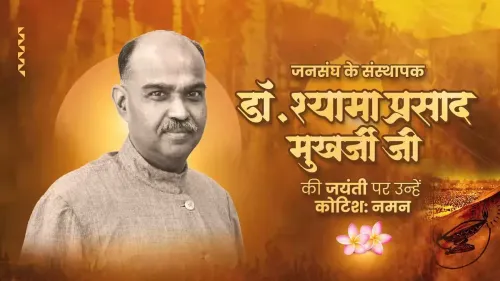
The Bharatiya Jana Sangh was born as a direct challenge to Congress dominance in newly independent India. Dr. Mukherjee, who opposed diluting national integration through special provisions such as Article 370, gave the party its founding energy — and paid for his convictions with his life, dying in detention in 1953. Pandit Deendayal Upadhyay then shaped its soul, weaving Ekatma Manav Darshan — a framework placing the individual within family, society, and nation as an integrated whole — into the party's philosophical core. Vajpayee carried that tradition into India's highest office, serving as Prime Minister and becoming the face of the party's transition from Jana Sangh roots to its present form as the Bharatiya Janata Party.
Why the BJP keeps returning to its Jana Sangh roots
The annual commemoration is far from ceremonial box-ticking. For the BJP, the 75th foundation day is an organisational touchstone — a moment to reaffirm ideological continuity, motivate grassroots workers, and draw a straight line between Mukherjee's 1951 vision and the party's present-day governance. The hashtag #जनसंघ_से_जनजन_तक — 'From Jana Sangh to every person' — captures the message precisely: a party born in opposition to Congress now claims a mass, pan-India identity.
Gupta confirmed she would attend the event held under the 'gracious presence' of the national party president Nitin Nabin, signalling the Delhi unit's active participation in what is both a historical commemoration and a live display of party cohesion ahead of what remains a competitive political landscape in the capital.
Seven decades on, the foundational triad of sacrifice, philosophy, and service — Mukherjee, Upadhyay, Vajpayee — remains the BJP's most powerful origin story, and the party intends every worker to know it by heart.
Point of View
Upadhyay, and Vajpayee, the party reinforces a 'nation first' ideological through-line that distinguishes its self-narrative from Congress-era politics. A sitting Chief Minister's public commitment to attend — and to invoke grassroots workers by name — is also a signal of party discipline and ground-level mobilisation. At 75 years, the anniversary lands at a moment when the BJP is keen to project both deep roots and mass reach, a balance the #जनसंघ_से_जनजन_तक slogan neatly encapsulates.
NationPress
21 Oct 2026
Frequently Asked Questions
When was the Bharatiya Jana Sangh founded?
The Bharatiya Jana Sangh was founded on 21 October 1951 by Dr. Shyama Prasad Mukherjee as an alternative to Congress dominance in post-independence India.
What is the connection between Jana Sangh and BJP?
The Bharatiya Jana Sangh is the direct predecessor of the Bharatiya Janata Party . After a period of merger into the Janata Party, the Jana Sangh's leaders reconstituted as the BJP in 1980 , carrying forward the same ideological heritage.
What is Ekatma Manav Darshan?
Ekatma Manav Darshan , or Integral Humanism, is the philosophy articulated by Pandit Deendayal Upadhyay that became the Jana Sangh's guiding framework, placing the individual within an integrated web of family, society, and nation.
Why did Rekha Gupta post about Jana Sangh's foundation day?
Delhi Chief Minister Rekha Gupta posted on 21 October 2026 to mark the party's 75th foundation day , paying tribute to its founding leaders and confirming her attendance at the official commemorative event.
Who was Dr. Shyama Prasad Mukherjee?
Dr. Shyama Prasad Mukherjee was the founder of the Bharatiya Jana Sangh, a strong advocate for national integration who opposed Article 370 . He died in detention in 1953 and is revered as a martyr by the BJP.